There’s something about moments like this that don’t arrive loudly. They’re announced, of course—framed as milestones, wrapped in language that feels historic. A first. A breakthrough. A launch. But if you sit with it a little longer, past the headline, past the ceremony, what begins to surface is something quieter. A shift in where quantum computing actually lives—not in theory, not in distant timelines, but somewhere closer to infrastructure.
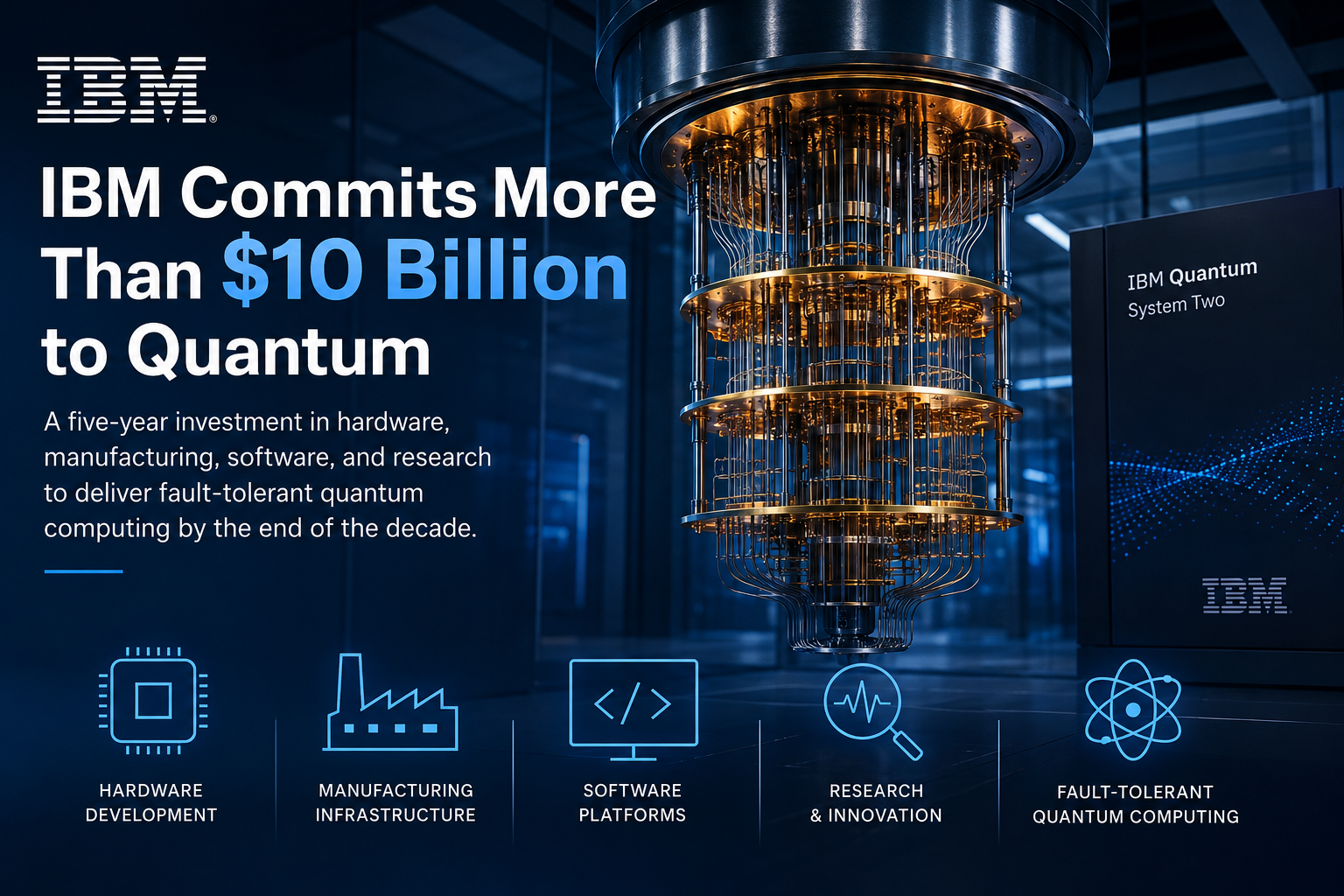
The announcement itself is straightforward: India is preparing to deploy its first quantum system through a collaboration with IBM, placing it in Amaravati as part of a broader national push into deep tech. But what’s interesting isn’t just the machine. It’s what it represents. Because for a long time, quantum computing has felt like something happening elsewhere—in specialized labs, in tightly controlled environments, in conversations that required translation just to follow. It was always advancing, but rarely landing. And this feels like a kind of landing.
There’s a pattern emerging, and you can almost feel it if you zoom out just slightly. Countries are no longer just funding quantum research. They’re placing systems—embedding them into regions, connecting them to ecosystems, letting them sit alongside universities, startups, policy frameworks, and eventually, industry. It’s less about proving that quantum works and more about learning how to live with it.
What this moment reveals, beneath the surface, is the early formation of something that looks a lot like a quantum corridor. Not in the fully formed sense—not yet—but in the way pieces begin to gather. Government backing, industry collaboration, physical infrastructure, access points for researchers and developers. It’s the same quiet layering we’ve seen in other technology shifts. AI didn’t become transformative because of a single model. Cloud didn’t matter because of a single server. It was the ecosystem around them. And this feels like the beginning of that same pattern in quantum.
There’s also something else happening here—something more subtle, but just as important. Access is changing. For years, engaging with quantum systems required proximity. Physical access. Deep specialization. A kind of gatekeeping that wasn’t intentional, but was inherent to how fragile and complex the systems were. But with systems like this being deployed—and increasingly connected through cloud interfaces—that barrier begins to soften. You don’t need to be in the lab anymore. You just need a way in. And that changes who gets to participate.
It’s easy to overlook how significant that is, because participation shapes direction. When more people can interact with a system—even experimentally, even imperfectly—you start to see different questions being asked. Different use cases emerging. Different kinds of thinking layered onto the same underlying technology. And that’s often where real acceleration happens—not just in the hardware, but in the imagination around it.
At the same time, there’s a tension running through all of this. Because while the system exists—while it’s real, operational, present—it doesn’t mean quantum computing is suddenly solved. The same underlying challenges remain. Qubits are still fragile. Noise still interferes. Error correction is still one of the defining bottlenecks. The machine doesn’t remove those realities. It exposes them.
And maybe that’s part of the point. Because moving from theory to infrastructure means moving from controlled conditions to shared environments. It means allowing more people to encounter the limitations directly, rather than reading about them abstractly. There’s something grounding about that. You start to see what works, what doesn’t, where the edges are, where the system begins to strain.
What’s interesting is how this aligns with a broader shift happening across the quantum space. We’re moving away from the idea that quantum progress will arrive as a single, undeniable breakthrough—a moment where everything suddenly works. Instead, it’s unfolding more like a gradual stabilization. Systems being placed. Control improving. Access widening. Use cases slowly finding their footing. It’s less cinematic, but more real.
And when you look at this through that lens, the location itself starts to matter. Amaravati isn’t just a backdrop. It’s a signal—a signal that quantum isn’t confined to a handful of global hubs anymore, that the geography of innovation is expanding, becoming more distributed, more layered. Not equal—not yet—but shifting. And with that shift comes something else: competition, yes, but also collaboration. Because quantum systems don’t evolve in isolation. They depend on networks—of researchers, of data, of shared experimentation. Each new node adds to that network, even if it starts small.
There’s a moment in all of this where everything feels very official—structured, deliberate, almost ceremonial. And then there’s the quieter layer underneath it, the part where you realize this isn’t really about the launch. It’s about what happens after. Who logs in. Who experiments. What breaks. What unexpectedly works. That’s where the story actually unfolds.
For the quantum curious, this kind of moment can feel both exciting and slightly disorienting, because it doesn’t give you a clean narrative. It doesn’t say we’ve arrived. It says something more ambiguous: we’ve started to place the pieces.
And maybe that’s the more honest version of progress. Not a leap, but a gradual assembling of systems that begin, almost quietly, to support themselves.
If you step back far enough, you can start to see the outline forming. Quantum computing isn’t waiting in the distance anymore, fully formed and ready to arrive. It’s being built into the present—piece by piece, region by region, system by system.
And the question shifts, almost without you noticing. From when will quantum be ready to something more immediate. Where is it already beginning to take hold—and what happens when it does?
That’s the part that lingers. Not the machine itself, but the feeling that something once abstract has begun to take root. Quietly. Imperfectly. But undeniably real.