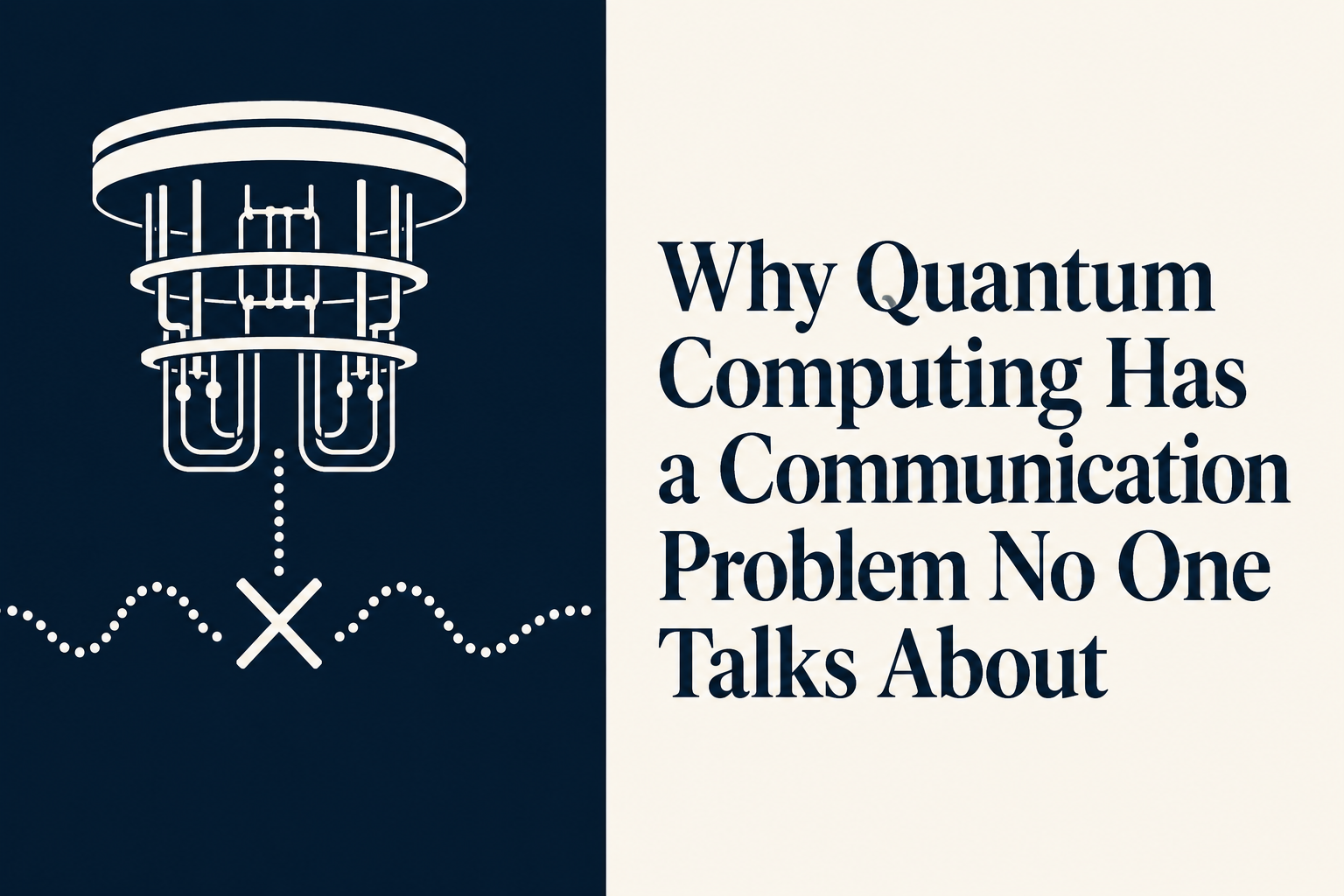
The dream of a quantum internet has always felt a little like wanting to whisper across an ocean and be heard perfectly on the other side, and not shouted and not repeated. Whispered. Exactly once. Exactly as intended.
That dream has been stalled for a long time by a stubborn physical truth. Quantum information does not like to travel. Or rather, it performs well for a while and then quietly deteriorates.
In classical networks, we cheat. When a signal weakens in a fiber-optic cable, it is amplified. We copy it. We boost it along its way. Quantum information refuses to play that game. The moment you try to copy an entangled quantum state, it collapses. The information is gone. No do-overs. No buffering the way we’re used to.
This single limitation has kept the idea of a global quantum network feeling perpetually just out of reach.
Until recently.
As 2025 winds down, a series of breakthroughs in nanofabrication has started to sketch something that looks less like science fiction and more like an engineering roadmap. The shift is subtle but profound. Away from bulky, hand-assembled components. Toward nanophotonic circuits so precise they can guide single photons the way riverbanks guide water.
The difference is scale. And intention.
The quiet difficulty of the quantum repeater
At the heart of the problem is something called the quantum repeater. In classical networking, a repeater receives a signal and forwards it. In quantum networking, you’re not allowed to read the signal. Looking destroys it.
So quantum repeaters perform a more delicate task. They store quantum information temporarily in a quantum memory, perform a form of entanglement handoff called a Bell-state measurement, and slowly stitch together a long-distance connection segment by segment. No copying. Just careful relaying.
The idea has long been understood. The execution has not.
To make this work across hundreds or thousands of kilometers, every interaction has to be nearly perfect. Every photon has to arrive on time, at the right wavelength, and interact with matter in precisely the right way. Traditional manufacturing methods aren’t precise enough. Too much loss. Too much randomness. Too many photons disappearing into the void.
This is where nanofabrication enters the story, not as a flashy upgrade, but as a quiet enabler.
Shrinking the problem until it behaves
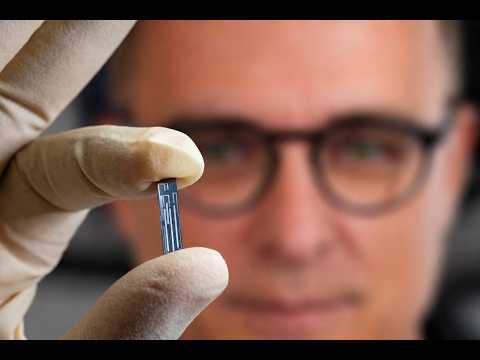
Instead of assembling quantum networking hardware from discrete components, researchers are now fabricating the network directly into materials such as silicon and diamond, thereby shaping structures at the scale of tens of nanometers. At this scale, light stops behaving like a loose wave and starts acting like something you can guide, trap, and persuade.
Three advances are doing most of the heavy lifting.
Diamond color centers that actually cooperate
Within synthetic diamonds, researchers create tiny atomic-scale defects known as color centers. Silicon-vacancy and tin-vacancy centers act like stationary qubits, capable of holding quantum information for surprisingly long times.
The old problem was inefficiency. These atoms would emit photons, but most of the light would scatter away, lost before it ever reached a fiber.
Nanofabrication changed that by placing color centers inside perfectly tuned nanocavities. Think of it like building a tiny echo chamber for light. Almost every emitted photon is captured and directed precisely where it needs to go. Less loss means longer distances. Fewer repeaters. Fewer chances for failure.
Teaching photons to change color without losing themselves
Quantum memories typically operate at nonoptimal wavelengths. Fiber-optic cables prefer the infrared C-band. For years, this mismatch quietly sabotaged long-distance networking.
Nanofabricated lithium niobate waveguides addressed this by enabling highly efficient frequency conversion. A single photon can change its wavelength without losing the quantum information it carries. No noise. No scrambling. Just a smooth translation from one color to another.
It’s one of those solutions that feels almost polite in how little drama it causes.
Putting everything on the same chip
Distance is not just about kilometers. It’s also about millimeters. Every gap between components is a potential source of loss.
New fabrication techniques now allow superconducting nanowire single-photon detectors to live on the same chip as the quantum memory itself. The photon barely has to travel before it’s detected. Fewer interfaces. Fewer cables. Fewer ways for the universe to interfere.
From links to a mesh
All of this adds up to a quiet but important shift. Early quantum networks were point-to-point links. Useful for demonstrations. Fragile in practice.
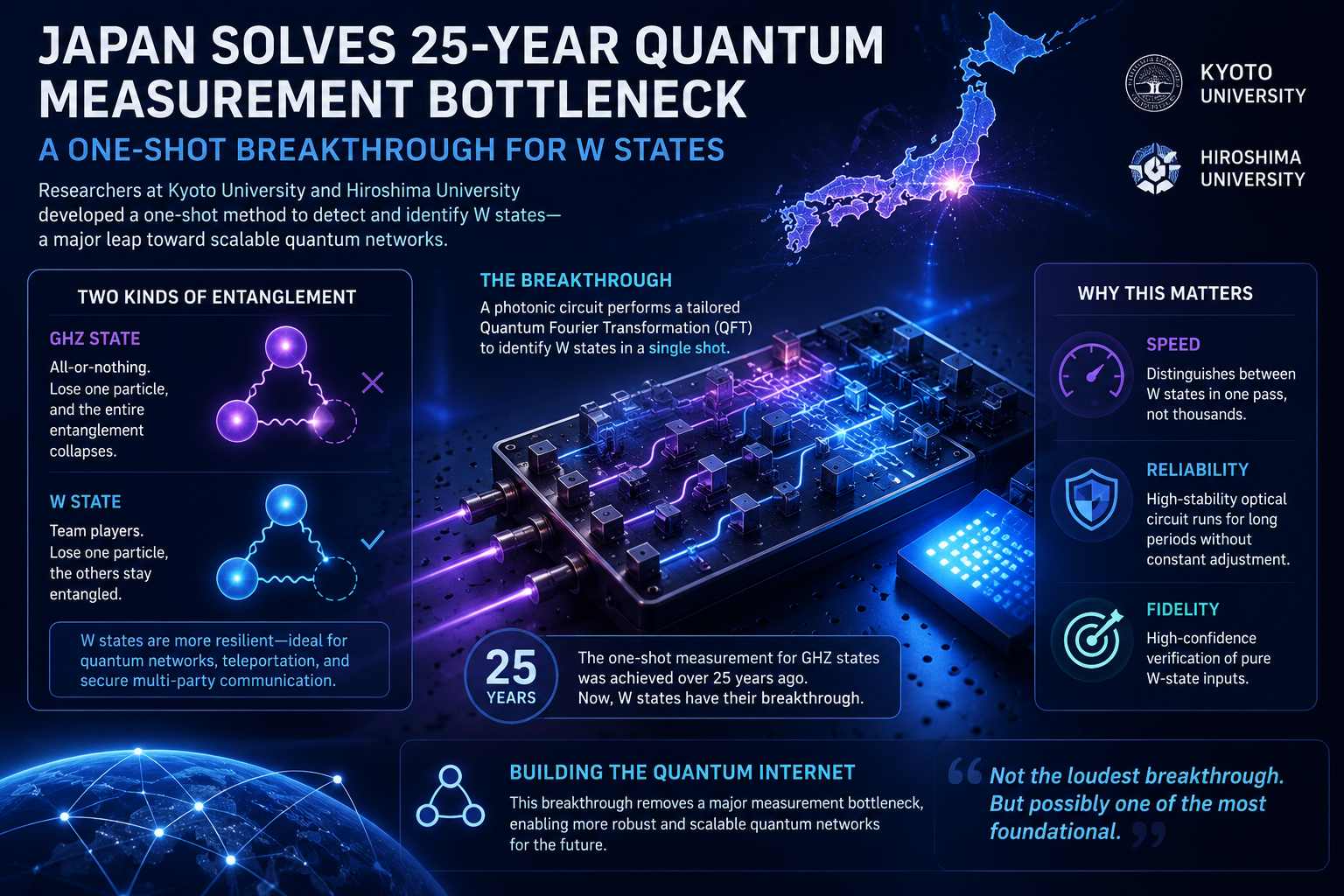
What’s emerging now looks more like a mesh. Chains of nanofabricated repeaters capable of spanning hundreds, then thousands of kilometers. Ground-based networks handling dense traffic between cities, paired with satellite links to leap across oceans.
The question has changed. It’s no longer “Is a quantum internet physically possible?” It’s “How fast can we manufacture it?”
That distinction matters.
Manufacturing brings timelines. Timelines bring accountability. And accountability is what turns beautiful physics into infrastructure.
As we move into 2026, the quantum internet still isn’t here. But for the first time, distance feels like an engineering variable instead of a hard stop. The whisper across the ocean is no longer impossible. It’s just waiting on fabrication schedules.
And that, quietly, is how futures begin.