In the global race toward quantum advantage, headlines tend to fixate on qubit counts, superconducting chips, or refrigerators colder than deep space. But some of the most consequential breakthroughs happen far from the spotlight, buried inside the infrastructure layer that will ultimately determine whether quantum networks can scale at all.
That is exactly what emerged from Japan in late 2025 and early 2026.
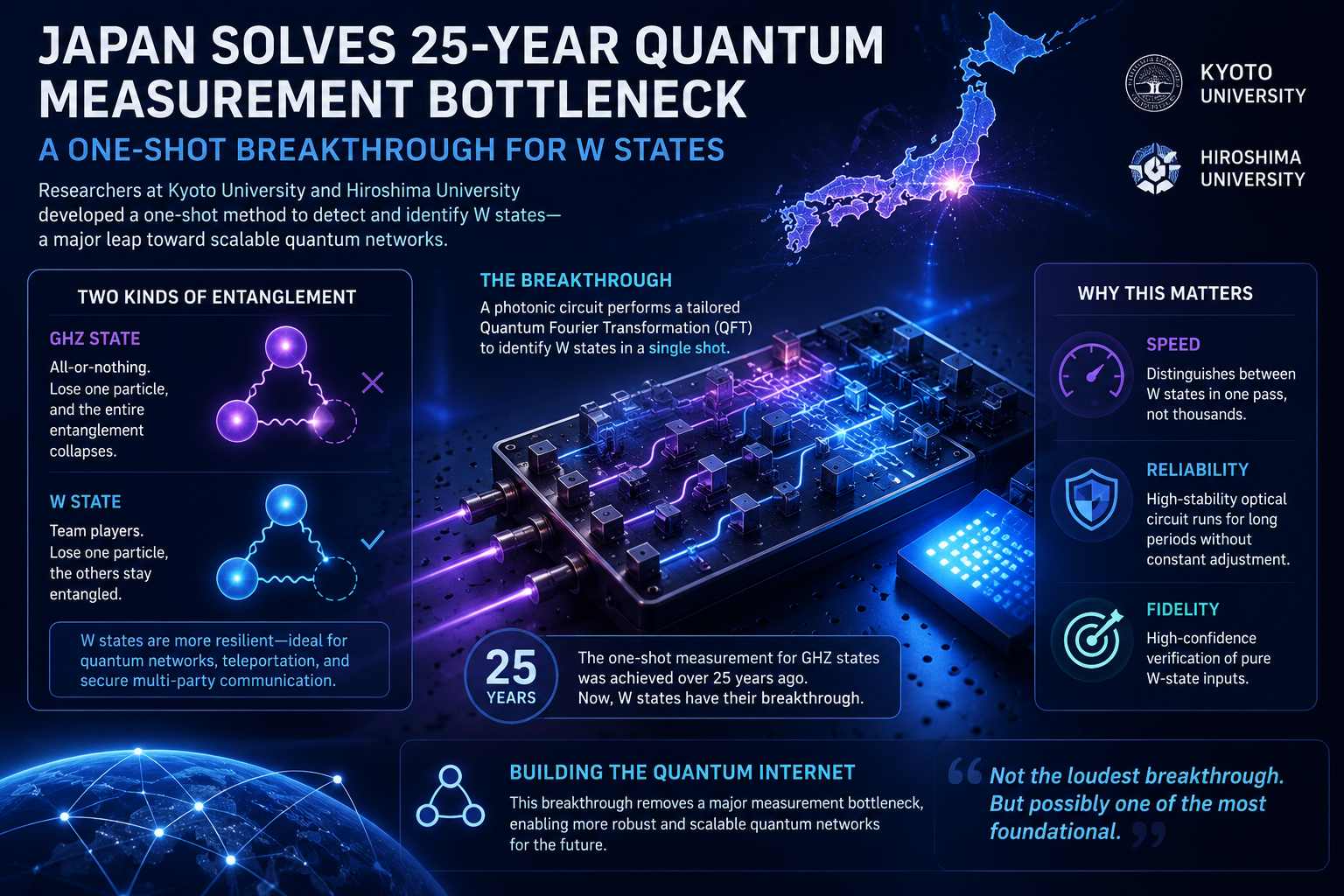
Researchers at Kyoto University and Hiroshima University quietly solved a 25-year bottleneck in quantum measurement: the ability to detect and identify W states in a single measurement pass. On paper, it sounds technical. In practice, it changes the feasibility equation for the future quantum internet.
This is not a flashy consumer-facing breakthrough. It is something far more important: foundational infrastructure.
Why W States Matter More Than Most People Realize
Inside quantum computing, not all entanglement behaves the same way.
Two forms dominate the conversation: GHZ states and W states. Think of them as two radically different architectural philosophies for building quantum systems.
GHZ states are powerful but fragile. Lose one particle, and the entire entangled system collapses. They are exceptional for precision sensing and certain computational tasks, but they are unforgiving in real-world network environments.
W states behave differently.
They distribute entanglement across multiple particles in a far more resilient way. If one particle is lost, the remaining system can continue functioning in an entangled state. That durability makes W states uniquely valuable for the next era of quantum infrastructure — including distributed quantum computing, secure multi-party communication, and long-distance quantum networking.
In other words, if GHZ states are high-performance race cars, W states are fault-tolerant network architecture.
And that distinction matters enormously once quantum systems leave the laboratory and enter the real world.
The Problem That Slowed the Entire Field
For decades, researchers faced a frustrating paradox:
W states were incredibly useful, but confirming their existence was computationally brutal.
The industry standard relied on quantum state tomography — a process that becomes exponentially more difficult as systems scale. Every additional particle dramatically increases the number of measurements required, creating what researchers often describe as the “curse of dimensionality.”
At small scales, the process was manageable.
At network scale, it became unsustainable.
This created a hidden constraint on the future of distributed quantum systems. You could theoretically build larger entangled networks, but verifying them efficiently was another matter entirely.
Meanwhile, GHZ states received a “one-shot” measurement solution more than two decades ago.
W states did not.
Until now.
Japan’s Breakthrough Changes the Measurement Equation
Led by Professor Shigeki Takeuchi, the Japanese research team developed a photonic quantum circuit capable of identifying W states in a single measurement pass by leveraging the states’ cyclic shift symmetry.
The key innovation was a specially tailored Quantum Fourier Transformation (QFT) designed specifically for W-state detection.
The implications are significant:
- Massive efficiency gains: Instead of requiring thousands of repeated measurements, the system can distinguish between different three-photon W states instantly.
- Operational stability: The optical circuit maintains stability for extended periods without constant recalibration — a major engineering hurdle in quantum optics.
- High-fidelity verification: The researchers demonstrated strong confidence in the accuracy of the measurements for pure W-state inputs.
This is the kind of advancement that does not immediately dominate public conversation but fundamentally reshapes what becomes commercially viable five years later.
The Bigger Picture: Building the Invisible Layer of the Quantum Internet
Every major technological shift eventually depends on infrastructure nobody talks about.
Cloud computing required invisible data center orchestration.
AI required invisible GPU networking.
The internet itself required invisible routing protocols.
Quantum networking will be no different.
The future quantum internet will not succeed because of qubits alone. It will succeed because researchers solve the less glamorous but existential problems surrounding stability, verification, routing, synchronization, and error resilience.
This breakthrough sits squarely inside that category.
By removing one of the largest measurement inefficiencies in multipartite entanglement, Japan’s researchers may have accelerated the practical timeline for scalable quantum communication more than many higher-profile hardware announcements have.
And that is the deeper story here:
The quantum race is no longer just about raw computational power.
It is increasingly about engineering systems that can survive contact with reality.