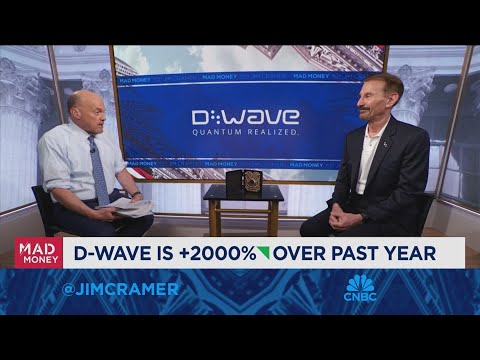
In a world where speculation often outpaces tangible outcomes, the realm of quantum computing stands as a notable frontier. Its promises are grand, yet the path forward is shrouded in complexity and nuance. Recently, D-Wave Quantum, a leader in this domain, offered a glimpse into its journey toward commercial viability in a candid conversation between Alan Baratz, D-Wave’s CEO, and Jim Cramer on Mad Money.
This dialogue, like many of its kind, unfolded not only in numbers and projections but also in the subtler articulations of hope, skepticism, and potential. Quantum computing, though in its infancy, captivates with its ability to solve optimization problems that classical computing methods cannot. It’s not just about raw computational power; it’s about the clarity of purpose in solving real-world business challenges, from workforce scheduling to protein folding.
Based on content from CNBC Television
The conversation kicked off against the backdrop of a market buzzing with the potential of quantum technology. D-Wave’s stock surge of nearly 2,000% over the past year underscores a fervent, almost speculative enthusiasm. Yet, as Cramer pointed out, this enthusiasm is tethered to a technology still unfolding in real-time. It invites a crucial question: has quantum computing truly arrived, or is public excitement running a step ahead of reality?
Baratz’s response was steeped in the grounded realism of their enterprise—D-Wave is uniquely positioned as the first company to bring quantum computing into the commercial sphere. This isn’t mere theoretical conjecture. Companies like NTT DoCoMo and Mastercard have integrated D-Wave’s systems into their operational frameworks, signaling a transition from novelty to necessity.
Consider this: the optimization of loyalty rewards programs, a task seemingly intuitive but profoundly complex, finds refinement through quantum solutions. What D-Wave offers is not the promise of data itself but the enhancement of decision-making through computation. It’s not merely about possessing information but optimizing the outcomes through their computational prowess.
Yet, the conversation extended beyond traditional business applications into realms like energy efficiency in blockchain technology—a domain burdened by enormous power consumption. Here, Baratz touched on an extraordinary breakthrough: a quantum proof of work computation that could slash the energy demands of Bitcoin and other cryptocurrencies by a factor of one thousand. The implications are, frankly, astonishing.
Cramer interjected with a healthy dose of skepticism—a reminder of the vast chasm between potential and proof. Energy grids, traditionally seen as growth markets, are being re-envisioned as quantum technologies could alter assumptions about energy demand growth. As quantum advancements continue, market assumptions—and the energy investments tethered to them—may require a re-examination.
The dialogue also revealed broader industry currents where giants like Jen-Hsun Huang of Nvidia and others bear perspectives that oscillate between cautious optimism and wary observation. In the specter of technology leaps, cost and power efficiency remain pivotal considerations.
In this intersection of innovation and commercialization, the conversation between Baratz and Cramer echoes a dual theme—of patience and forward momentum. For the invested public, the question is not merely whether quantum computing’s moment has arrived but how to prepare for its full emergence. The invitation to delve deeper, to understand the finer threads woven through this quantum tapestry, feels implicit yet vital.
As we stand at the precipice of what appears to be a quantum revolution, there’s a palpable tension between the present achievements and future potential. Perhaps the enduring question, then, is whether we are ready not just to witness but to participate in this unfolding narrative. It’s a story still being written, and much like a quantum state, it exists in a delicate balance of possibility and realization.
—