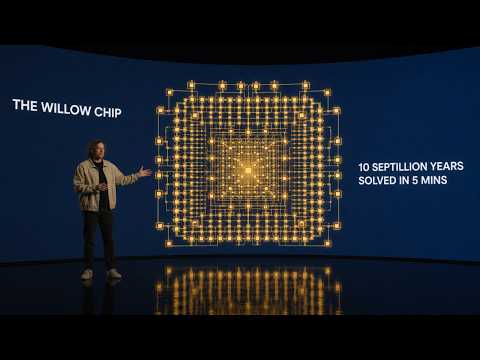
Quantum chips embody the promise of processing power that goes beyond anything classical computers can offer. Unlike classical bits that sit as zeroes or ones, qubits harmonize in a state of both, enabling a form of computation that explores multitudes of possibilities instantaneously. The allure here comes from solving colossal, calculation-heavy problems—but it all hinges on a delicate dance of coherence and error correction. The fragility of qubits, which makes them susceptible to the subtlest interference, is what transforms this field from promising to problematic.
Based on content from Luminox Zenith
The Race That Isn’t Rushed
The narrative often skips over the tussle with decoherence — where vibrations, minute temperature shifts, and rogue cosmic rays threaten the integrity of quantum states. The real race, therefore, isn’t simply about speed or supremacy but about precision and stability.
Google’s Willow, with its claims of crossing crucial error correction thresholds, signified a foundational step toward practical quantum systems. When a Chinese team, led by Pan Jianwei, emerged with a comparable chip, Zuchongzhi 3.2, the subplot was not about one-upmanship but rather a testament to parallel ambitions. The question wasn’t as much about who finished first but how close and dynamic the contest itself had become.
A Dual Track Journey
The key differentiator in their approach lies in the methodology. Google’s pathway, shaped by sophisticated engineering efforts at microscopic precision, suggests a hardware-intensive quest. In contrast, the Chinese pursuit hints at an alternative relying on elegant microwave qubit control — potential software finesse over hardware heft. If this juxtaposed path can scale, it might offer a more flexible and cost-effective way forward.
Both these ventures remain in the realm of prototypes rather than deployable solutions. They are promises clad as engines that rev without yet driving full journeys; showing success in controlled benchmarks rather than real-world applications like drug discovery or encryption solutions.
Emerging Narratives and Perspectives
As we digest these updates, several themes crop up. One must navigate not just the curves of genuine scientific progress but the slopes of hyped projections. The quantum spotlight has often exaggerated immediate implications, yet there is undeniable progress beyond the headlines.
Beyond Zuchongzhi, China’s diverse quantum landscape, exemplified by initiatives like KS Cold Atom Technology’s Hanyuan 2, broadens the action. These ventures, distinct in their foundational physics, enrich this multifaceted race, subtly redefining potential without declaring the definitive end of current technologies.
The Broader Context
Where headlines often seek definitive winners or losers, the reality paints a scene of shared human endeavor. This ongoing, competitive yet collaborative environment nurtures technological breakthroughs, advancing not just the capabilities within labs but potentially transforming economies and redefining security landscapes.
The conclusion then isn’t about panic or triumph but a reflective pause. Consider the nuanced trajectories of progress — where today’s experiment sets the stage for tomorrow’s applications. As quantum computing edges toward practical relevance, the broader question becomes: How do we prepare for, adapt to, and responsibly harness this impending quantum shift? This remains the most poignant inquiry as humanity steers toward its next significant technological frontier.
—