Imagine being invited to join one of the most ambitious scientific projects on Earth. That’s what just happened for three Canadian startups: Xanadu Quantum Technologies in Toronto, Nord Quantique in Montréal, and Photonic Inc. in Vancouver.
Each of them has been selected to advance to the next round of the Quantum Benchmarking Initiative (QBI), led by the U.S. Defense Advanced Research Projects Agency (DARPA). Yes, the same DARPA that helped launch the internet and self-driving cars. Its new goal is just as bold: to prove that a genuinely helpful quantum computer can exist by the year 2033.
What Stage B Actually Means
Reaching this stage is a significant milestone. It means these Canadian teams have already passed QBI’s first test. Their early proposals convinced DARPA that their approaches could one day lead to what’s called a “utility-scale” quantum computer, one that’s not only powerful but practical.
Now they have a year to turn their ideas into detailed blueprints. They’ll design prototypes, map out risks, and create realistic development plans. Each company could receive up to US $15 million in funding to do it. Once they’ve built their roadmaps, DARPA’s independent experts will evaluate whether their ideas could truly deliver more value than they cost to build and maintain. That’s what “utility” really means in this context: usefulness that outweighs the expense.
The Quiet Strength of Canadian Quantum
For Canada, this moment highlights a strength that’s been growing quietly for years. The country has long been a hub for quantum innovation, from the University of Waterloo’s Institute for Quantum Computing to D-Wave’s early commercial quantum systems.
Now, three distinct Canadian visions are emerging on the global stage.
- Xanadu builds light-based quantum processors and has developed open-source tools, such as PennyLane, that help researchers and developers experiment with quantum programming.
- Nord Quantique focuses on solving one of the most complex problems in the field — quantum error correction — which keeps delicate qubits from losing information.
- Photonic Inc. is exploring quantum networking using photonics, hoping to create systems that can connect and scale more naturally.
Each company represents a distinct approach to the quantum puzzle. Together, they demonstrate the diverse nature of innovation within this emerging field.
Why DARPA Is Paying Attention
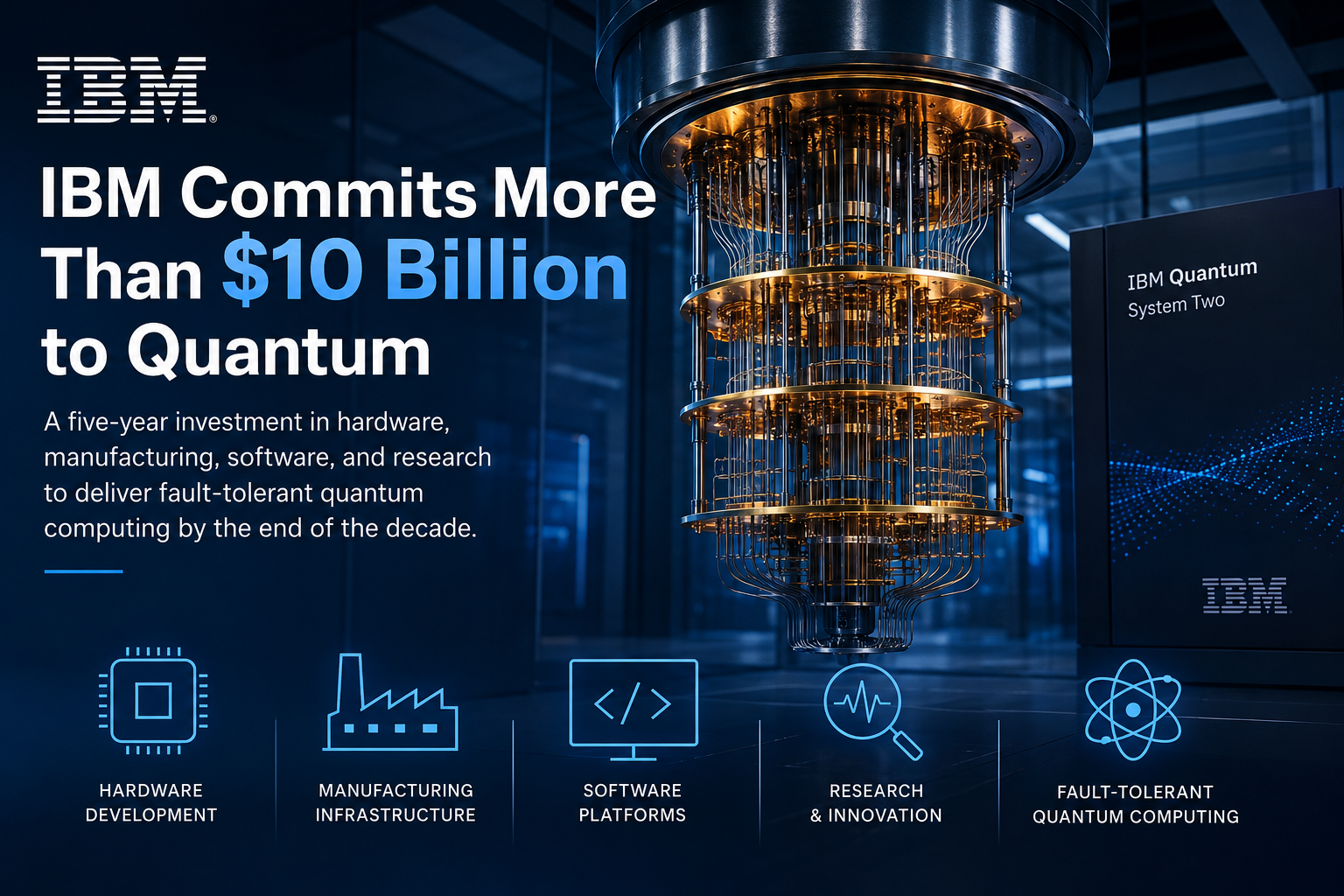
DARPA’s Quantum Benchmarking Initiative is not a competition with a single winner. It’s more like a research festival, where every promising approach gets a chance to showcase its capabilities. Out of the eighteen companies that began in Stage A, only eleven have progressed to Stage B. The list includes major players like IBM, IonQ, and Quantum Motion Technologies in the U.K., as well as Australia’s Diraq and Silicon Quantum Computing.
That means Canada’s inclusion is not just symbolic. It’s a sign of credibility. As one Xanadu executive pointed out, QBI’s US $300 million funding pool is about more than money. It’s a way for young companies to have their ideas validated in front of the world.
Making Quantum Understandable
If you’re new to quantum computing, here’s the essence. Traditional computers use bits that are either zero or one. Quantum computers use qubits that can be in a superposition state, which allows them to be in two states simultaneously. That strange quality allows them to handle certain types of problems much faster than classical machines.
The catch is that qubits are extremely sensitive. They can lose their state from the slightest vibration, a flicker of heat, or even cosmic rays. Maintaining stability is one of the most significant engineering challenges of our time. That’s why DARPA’s involvement is so meaningful. This is an agency renowned for transforming far-fetched dreams into practical technology, and now it’s applying that same determination to quantum computing.
What Comes Next
During Stage B, the Canadian teams will refine their blueprints and focus on very practical questions. How can they scale up their qubits without multiplying errors? How can they build control systems and cryogenic hardware that actually work outside a research lab? Most importantly, how can they design a machine that performs functional tasks like modeling molecules for new medicines faster or cheaper than the world’s most powerful supercomputers?
If they can answer those questions convincingly, they’ll move to Stage C, where designs are tested and proven. That stage comes with significantly larger funding opportunities, up to US $300 million for those who can demonstrate that their approach is efficient.
A Turning Point for Quantum Engineering
What makes this phase so exciting is that it signals a shift in focus. Quantum computing is growing up. It’s moving beyond theory and physics demonstrations into complete system engineering. As MIT News recently described it, the field is entering its “industrial adolescence,” where success depends as much on manufacturing and scalability as it does on brilliant ideas.
The Canadian government seems to recognize this too. The latest federal budget includes CA $334 million over five years to support the country’s quantum industry. That combination of local support and international collaboration could help Canada turn its research depth into commercial strength.
The Long Road Ahead
Of course, there are still many hurdles ahead. Even DARPA approaches this work with cautious optimism. The agency plans to scrutinize every design and ignore the hype that sometimes surrounds the field. Many promising architectures have already struggled to scale or faced unexpected limits. But as IBM researchers often note, building a fault-tolerant quantum computer isn’t about a single breakthrough. It’s about many layers of progress stacking together, one solved problem at a time.
Why It All Matters
The most inspiring part of this story is the spirit of collaboration. Companies around the world are experimenting with various methods, including photons, ions, and superconducting circuits, each adding a new color to the spectrum of possibilities. If even a few of these approaches succeed, we could see quantum computers become practical tools within a decade, woven into chemistry labs, climate models, and AI research centers.
For Canada, the success of Xanadu, Nord Quantique, and Photonic is not just a win for technology. It’s a story about curiosity, persistence, and imagination. It’s a reminder that innovation often thrives at the intersection of science and storytelling, where bold ideas meet real-world engineering.
And perhaps that’s what makes this moment so exciting for anyone who’s quantum curious. The countdown to 2033 isn’t just about hardware or funding. It’s about witnessing a new kind of computer and a new kind of collaboration come to life.