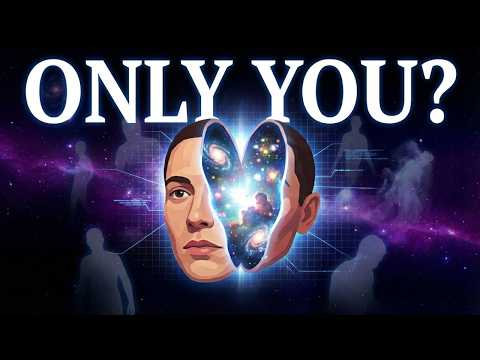
The brain that is listening to these words right now is the same organ that, just last night, built an entire world out of nothing. It constructed rooms you have never visited, conversations with people who may not exist, and emotional experiences so vivid that your heart rate changed, your breathing shifted, your muscles tensed beneath the sheets. And when you woke, that whole elaborate architecture dissolved in seconds, gone, as though it had never been. Yet, while you were inside it, you could not tell the difference. Not once did you pause in the middle of a dream and think, “This is clearly fabricated.” The simulation was perfect because the simulator and the audience were one and the same.
Based on content from Sleepless Overthinker
Now, consider this. The organ responsible for that flawless nightly deception is the very same organ telling you now that what you see, hear, and feel during waking hours is fundamentally different. It asks you to trust that this version of reality is the real one, but it offers no proof beyond what it generates itself. Tonight, let us follow this thought carefully and gently into the strangest territory of philosophy and modern physics: What if you are the only real person, not as a belief to defend, but as a possibility neither philosophy nor physics has managed to rule out?
You have never experienced anything outside your own body, not once. Every sunset, every piece of music, every hand you have ever held has arrived as a pattern of electrical impulses translated inside a dark, sealed chamber of bone. The brain itself has no light receptors, no microphones. It floats in cerebrospinal fluid surrounded by absolute silence and total darkness, building the entire world you think you inhabit from coded signals traveling along nerve fibers at roughly 100 m/s.
Think about what that means. The redness of a rose does not exist in the electromagnetic wavelength bouncing off its petals—color is something your visual cortex fabricates. The warmth of sunlight is not warmth in the way you experience it—it’s rendered as a felt sensation in your somatosensory cortex. The sound of someone’s voice is pressure waves in air, transformed into electrical patterns that your auditory system assembles into meaning. These translations are not optional; there is no way to access the raw world directly.
In the winter of 1641, a French philosopher, René Descartes, began stripping away every assumption he held in his mind. Could he be certain the physical world existed? His senses had deceived him before. Could he be sure other people existed? They appeared in his dreams as convincingly as they did in waking life. In the end, Descartes only found certainty in his own act of doubting: Cogito, ergo sum. I think, therefore I am.
Many philosophers since have pointed out that Descartes’ escape was unearned. George Berkeley later proposed that no material world exists behind perceptions; only minds and ideas do. Objects persist when unobserved because God is always perceiving them. Without divine assurance, we are left with solipsism, the view that only your mind is certain to exist. Everything else could be mere features of your own experience without independent reality. For 24 centuries, no one has conclusively argued against solipsism.
Quantum physics reopens the inquiry into the nature of reality. Classical physics treated the world as solid and measurable, indifferent to perception. Enter the early 20th century and the famous double-slit experiment. When unmonitored, photons create an interference pattern. When observed, they behave as particles. Observation seems to influence the fundamental nature of particles, suggesting that reality is not merely independent but responsive.
As you contemplate these questions, consider this: somewhere in your early childhood, you began to infer that others had thoughts and internal worlds. Developmental psychologists call this theory of mind. But remember, it is indeed just a theory built on inference, not direct evidence. Every relationship, every trust or love, is a leap across an unbridgeable gap of assumption.
The tension between overwhelming philosophical conundrums and moments of profound clarity remains. It’s a dance between acceptance of our constructed experiences and the pressing questions we cannot ignore. Whether you’re a true solipsist or a believer in an objective universe, perhaps the most compelling question is what we do with the perspective we carry. If you are the center of your universe, or just a fragment of an infinite reality, each insight you gather is a lens that shapes your role within this tapestry we call life.
As you find yourself in the waning moments of reading, the quiet tension between overwhelming possibility and serene acceptance lingers. Each thought, each idea is a whisper in its own echo chamber, asking you to listen closely, breathe deeply, and consider, for just a moment longer, the delicate boundary between what is known and what is imagined. What will you make of this strange, flickering dream called reality? Can we say with certainty which—or if any—interpretation truly comprehends the fullness of existence? In the end, perhaps, clarity is found not in answers, but in the questions themselves, echoing softly in the silence between thoughts.
—