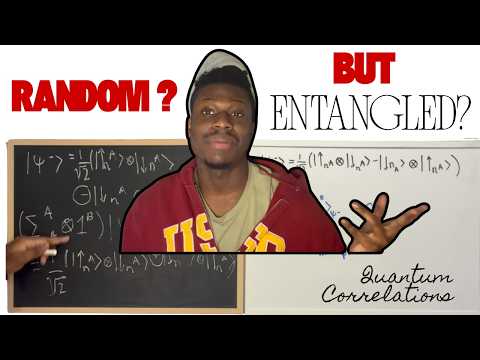
A very important proof concerning correlations in quantum states. Along the way, I break down several important concepts, including local spin expectation values, measurement directions, spin operators, and the mathematics behind the singlet state.
Based on content from Chicken Puck’s Quantum Computing tutorials
In the realm of quantum computing, concepts that may at first seem intrinsically bound by their abstract nature often reveal themselves through the precise language of mathematics. Our focus today is the intriguing proof that each subsystem of a singlet state—a quantum state of two spin-1/2 particles—displays zero local spin expectation value in any direction. This exploration not only delves into the heart of quantum entanglement but also lays the groundwork necessary to understand the profundities of quantum correlations and Bell’s theorem.
The question posed seems simple enough: in a singlet state where we have two entangled particles, A and B, what happens if we measure the spin of A alone, or B alone? Counterintuitively, the expectation is zero. But simple as it may seem, embedding this result into the complex tapestry of quantum mechanics requires a deeper dive into the intricacies of quantum states and the nature of measurement.
To begin, let’s consider what it means to measure along a specific direction. When we say a particle is “spin up”, it isn’t arbitrary; it is a declaration dependent on a specified direction, denoted as na for particle A. This direction is crucial as it defines the frame within which we observe the quantum world. n, being a unit vector, speaks not of magnitude but of orientation, giving clarity to the otherwise chaotic playground of quantum phenomena. Among the peculiarities of spin-1/2 particles—like those in a singlet state—arise from the properties of their corresponding Pauli matrices, which pin the essence of transformations in this vector space.
As one navigates further into this mathematical landscape, the singlet state—the wellspring of quantum entanglement—emerges. Here, spin measurements reveal their true nature: individually random yet jointly harmonious. Imagine performing this dance of measurement a thousand times over; you’d find that outcomes of +1 and -1 appear in perfect symmetry, each offsetting the other to converge at an average of zero. This is because, put simply, quantum mechanics isn’t concerned with the fortune of a single game but with the ensemble over many trials.
Observing such behavior invariably leads to an insightful revelation: local randomness can coexist with pair-wise certainty. While particle A provides no foresight into its measurement result, and neither does B, together their outcomes are tightly interlinked when measured in the same direction. This is the entangled orchestra that quantum systems conduct: individual unpredictability against a backdrop of perfect collective synchronization. A is up while B is precisely down, in mirrored reflection of one another.
This counterintuitive harmony underpins Bell’s theorem, which contests the often-pre-supposed classical realism by demonstrating that no local hidden variable theory can reproduce all the predictions of quantum mechanics. Torn between classical intuitions and quantum realities, a deeper truth beckons an understanding that reality is stranger yet fundamentally interwoven with subtleties.
As we conclude this exploration, the lesson lingers. Quantum systems, through apparent disorder, reflect a deeper, universal order—one revealed through their entangled states. Each subsystem’s zero expectation is not a sign of disorder but an indication of the profound, perhaps inevitable, dance of quantum particles. In questioning and proving the zero spin expectation, we glimpse the broader canvas upon which the quantum world is painted: a picture that both defies and defines understanding.
As we further unravel these mysteries, questions linger. How might these concepts inform emerging technologies, or reshape our philosophical grasp on reality? The discussion is far from over, inviting both inquiry and contemplation, as we continue to navigate the tangled paths of quantum nuance.
—