There’s a certain kind of cold that can only be found in the depths of the universe. Yet, in a lab on the outskirts of Tokyo, the same biting chill envelops a machine—a vessel mere mortals christen a quantum computer. Its existence is an intricate dance, dependent not only on the ingenuity of quantum chips but on an entire ecosystem fabricated to support its delicate nature.
Based on content from Untold Historian
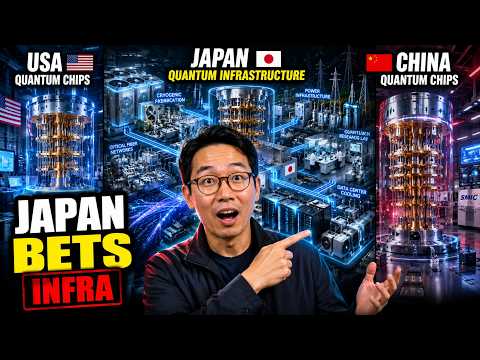
In the feverish rush for quantum supremacy, the international stage is dominated by a palpable rivalry between the United States and China, countries ardently engaged in manufacturing the swiftest quantum chips. Their endeavors are punctuated with state-backed initiatives, proliferating into billion-dollar investments earmarked for undisputed quantum chip ascendancy.
Meanwhile, in Japan, a shrewd strategy is unfolding, a narrative rarely highlighted in mainstream discourse—one that champions the infrastructure that cradles these futuristic marvels. Japan, renowned for its technological resilience, is quietly crafting a network of precision components, cryogenic systems, and elements essential for the seamless integration of quantum technology into our reality.
On paper, the US and China appear as titans in this qubit count contest. America, taking unprecedented steps for its federal apparatus, is acquiring equity stakes in quantum companies. China matches strides with state-backed labs pushing superconducting hardware, reaching benchmarks that, in some cases, rival or surpass Western counterparts.
Yet, let us pause to consider the essence of these pursuits. Quantum computers, teetering between the possible and the unobtainable, do not merely require breakthrough chips to function. They demand an interdependent ecosystem, drawing from advanced fabrication methods akin to those that Rapidus crafts in its Hokkaido habitats.
Japan’s fidelity to the infrastructure narrative is a manifestation of lessons learned from its so-called “semiconductor defeat” in the 1990s, a period marked by the collapse of its once formidable semiconductor industry due to international trade disputes and strategic miscalculations. It’s a brazen history, candidly acknowledged by Japanese policymakers, now weaving that awareness into their contemporary quantum gambit.
The heart of this strategy is an audacious investment in the supporting pillars of quantum technology. While others might chase after the glory of the fastest chip, Japan is nurturing the web of connections that breathe life into these delicate processors—because a chip, divorced from its infrastructure, is impotent.
This approach reverberates through policy and partnerships that span industries. The collaborative ventures that intertwine logic chip designs from IBM with Rapidus’s new-age fabrication epitomize a synthesis of quantum and classical computing realms—a duality that optimizes today’s computational challenges rather than reinventing them.
Japan’s commitment to building this intersection of quantum and classical computing is further reflected in projects like RIKEN’s Fugaku Next, a supercomputer expected to enhance synergies between time-tested classical elements and burgeoning quantum capabilities.
So, why does this matter beyond the realm of academic curiosity? The maturation of quantum computing heralds transformative potential across industries as multifaceted as pharmaceuticals and finance, with ripple effects touching everyday life in unforeseen ways. Moreover, it represents a latent threat to existing encryption protocols, with implications that extend into the national security domain.
As Tokyo, Washington, and Beijing continue to advance their respective strategies in this field, the evolution of quantum technology and its surrounding infrastructure will likely steer international policy and economic landscapes for decades. In contemplating these developments, we are reminded of the broader question: What does it mean to lead in an era where technology redefines the fabric of competition?
As we continue to observe these nations maneuvering the delicate balance of innovation and infrastructure, it becomes evident that the victory in quantum computing extends beyond technical benchmarks to the more profound implications of shaping the ecosystems that sustain them. In this quiet exploration, Japan’s narrative suggests that sometimes the most insightful moves are those that elude the spotlight, weaving a powerful tale of resilience and strategic foresight that crosses the boundaries of traditional competition.
—