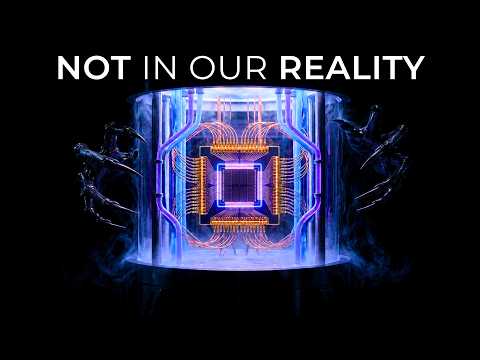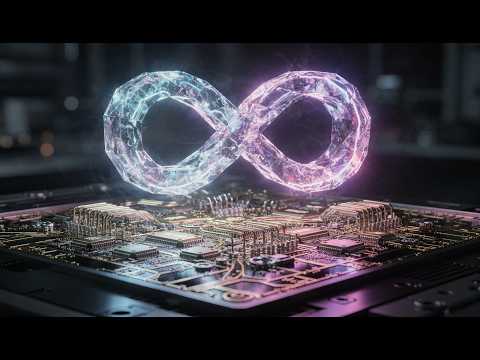
Imagine something so small it fits in the palm of your hand yet so powerful it could solve a mathematical enigma in five minutes—a puzzle that would otherwise challenge the mightiest supercomputers for 10 septillion years. This isn’t a gaze into a crystal ball nor a headline from a sci-fi novel. It is the reality brought to us by Google’s Willow, a quantum processor marking a fascinating milestone in computational history.
In December 2024, Google’s Quantum AI team unveiled Willow, inducing shivers of excitement across scientific realms. A simple number encapsulated the breakthrough: 5 minutes against 10 septillion years. This simplicity, though, hides a paradigm-shifting complexity that necessitates not just engineering prowess but a philosophical lens to fathom the narratives this chip whispers to us about the universe.
Based on content from Cosmic Files
To appreciate how extraordinary Willow’s capabilities are, one must first grasp the fundamental differences between classical and quantum computing. Classical computers, no matter how sophisticated, calculate step by linear step, akin to plodding through pages of long division. Quantum computers, however, eschew linearity. With qubits, capable of existing in a superposition of both zero and one simultaneously, they elevate computation into a multidimensional dance.
Enter superposition and entanglement—concepts at the heart of quantum computing’s enigma. When qubits become entangled, they cease to be solitary units and morph into a unified system, with changes in one impacting others instantaneously, regardless of physical separation. It is the elegant orchestration of these entangled qubits in Willow’s 105-qubit layout that unfurls computations across a spectrum of possibilities wider than the number of atoms in the observable universe. The sheer scale raises the untraceable whispers: if not within the chip, where are these computations occurring?
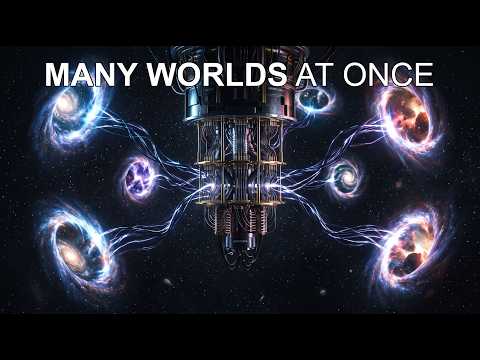
The Many-Worlds Interpretation offers one speculative answer, proposing that with each quantum decision, reality doesn’t collapse into a single outcome but rather fans out across countless parallel worlds. In this view, a quantum processor like Willow could be seen as weaving together calculations woven in the silence of numerous, unseen realities. It’s a notion Hartmut Neven, head of Google’s Quantum AI, hasn’t shied away from, suggesting Willow’s feats lend unexpected credence to the multiverse theory.
Not all physicists embrace this interpretation. Critics remind us that the impressive results of quantum computers like Willow, realized through specific benchmarks such as random circuit sampling, may lead to overreaching claims of parallel universes. Despite the allure, many physics dilemmas can still be disentangled with standard quantum mechanics without evoking the grand canvas of multiverses. Yet, the conversation’s mere existence underscores the profound nature of quantum computing’s push into the metaphysical territories.
Beyond philosophical ponderings lies a technical triumph revolutionizing the pragmatic potential of quantum computers: quantum error correction. Traditionally, the fragility of qubits meant that errors mushroomed as systems expanded, akin to juggling a growing number of soap bubbles amidst a tempest. Willow, however, flipped this script, demonstrating that augmenting qubit arrangements into logical qubits can halve error rates with exponential efficiency, breaking past the elusive error correction threshold. This is not just a theoretical achievement but a real-world pivot towards practical utility.
What beckons in this frontier of corrected quantum computing are possibilities as vast as they are transformational. We stand at the brink of medicine accelerated by molecule-level simulations, energetics redefined by redesigned chemistry, and artificial intelligence unlocked by algorithms decipherable only through quantum lenses. The path forward is daunting, lined with barriers born of engineering, but these are barriers within humanity’s storied tradition of ingenuity and innovation.
In this palpable tension between the conceivable and the fantastical, Willow isn’t merely a machine; it’s a prism refracting the future of science, technology, and reality itself. The debate about the many worlds theory may never be resolved, yet this hand-held device’s whisperings hint at a universe far richer than we dared to dream. Whether Willow proves the existence of parallel universes or not, it incontrovertibly opens questions that bring physics from the page into the tangible realm of possibility. The rest is up to us to explore.
—