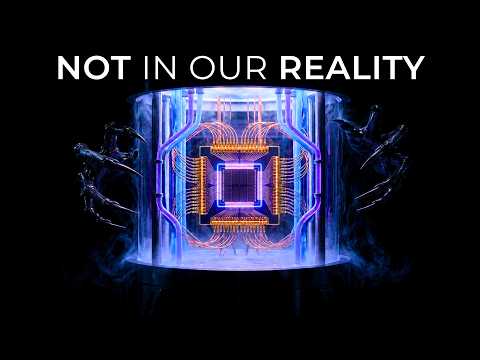
At first glance, the headlines cut to the chase with a splash of hubris we’ve come to expect from the tantalizing frontier of quantum physics: “Scientists Just Made Quantum Time Flow Backward and Nobody Can Explain It.” Yet, like many such proclamations, the truth resides in the methodical cadence of research, rather than in media clamor. Here, we journey beyond the headlines, demystifying the phenomenon of quantum time reversal.
Based on content from Hardware Grid
The nature of time itself—elusive, all-consuming—is at the heart of human curiosity. It defines our existence. But throw quantum mechanics into the mix, and suddenly time seems more malleable, more abstract. Contrary to sensationalized ideas of reversing time, these experiments don’t send people or particles back, unraveling past wrongs or reliving memories. Instead, they deftly dance around the edge of our quantum understanding, revealing layers upon layers of complexity.
At its core, time reversal in quantum systems refers to the reversal of quantum state evolution, which essentially means retracing the steps of a quantum state under specific controlled conditions. The implications touch on quantum error correction and, ultimately, the development of fault-tolerant quantum computing, holding the gate open to computation that’s faster and more secure than classical methods.
Consider stepping into IBM’s quantum research facility at Poughkeepsie, New York, where technology hums between possibilities rather than within them. It’s a dance of extremes—cooling experiments to colder than the void of space, vibrations so slight yet disruptive, crying for solutions that are as intangible as they are ingenious. The result is a towering, steel-lined edifice—a literal house built around a chip the size of a fingernail. Nearby, on the pragmatic side of innovation, Chinese researchers have crafted systems fitting into typical server racks, highlighting the physical embodiment of this field’s duality.
But why these architectural differences across continents? These designs reflect more than just logistical hurdles—they echo strategic choices about superconducting qubits in America versus room-temperature neutral atoms and photonics elsewhere. While superconducting systems in the U.S. promise unparalleled speed but require elaborate infrastructure, alternatives pursued by China focus on room-temperature operations with trade-offs in speed.
The tension between these approaches—fast-paced operations versus room-temperature convenience—paints a rich tapestry of technological narrative. For example, Google’s foray into superconducting quantum computing achieved astonishing benchmarks, like simulating events faster than the lifespan of the universe. Yet, quietly, they hedge their bets by exploring neutral atom systems, diversifying their strategic investments much like the vast potential energies lying dormant within quantum states themselves.
This dance of engineering, ambition, and rivalry overcomes the edges of what we know and heads into speculation that could reshape our understanding of reality altogether. Still, while some interpret it as a race, others see it as a collaborative weave, a tapestry enriched by diverse perspectives rather than a zero-sum game.
Critics might argue that we’re investing too heavily in unproven quantum dreams while globally pressing issues require attention. However, the historical arc of scientific progress shows that today’s obscure pursuits can become tomorrow’s indispensable tools—a theme as recurrent in science as it is in life.
Ultimately, these small movements in the quantum realm serve a greater purpose. They inch us closer not only to a new kind of computing power but contribute to an expanding understanding of nature’s most fundamental rules. And so, rather than prompting visions of time machines, perhaps these studies gesture us toward questions: To what future will these explorations usher us, and how might they redefine our perceptions of time, reality, and ourselves?
—