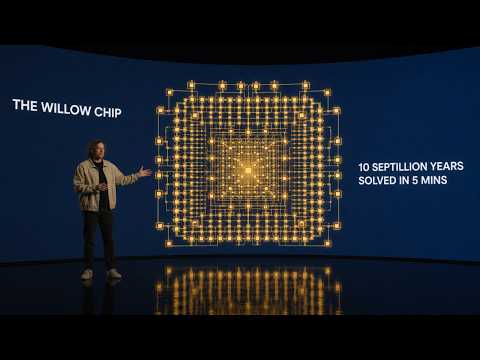
In the realm of time, where 10 septillion years stretch beyond imagination, like grains of sand slipping through an endless hourglass, Google’s latest announcement in December 2024 reverberated with the quiet power of a seismic shift. Their quantum chip, whimsically named ‘Willow,’ accomplished in under five minutes what would otherwise require the universe’s collective lifespan multiplied many times over, performed by the world’s fastest supercomputer. It’s a figure that sits somewhere between the grandiosity of the cosmos and the humble, practical ambitions of human endeavor, bringing into focus the dichotomy inherent in technological advancement.
Based on content from Engineered Tomorrow
This isn’t merely a tale of compute speeds—or one simply of technological prowess—but rather, it’s about confronting the very limits of classical computation. Traditional computers, those reliable workhorses of silicon transistors and binary logic that have steadily advanced through the decades, find themselves straining under the exponential weight of certain complex problems—problems that, if imagined as a tangled knot, grow more convoluted with each additional factor. Enter quantum computing, with its qubits and the eerie dance of superposition and entanglement.

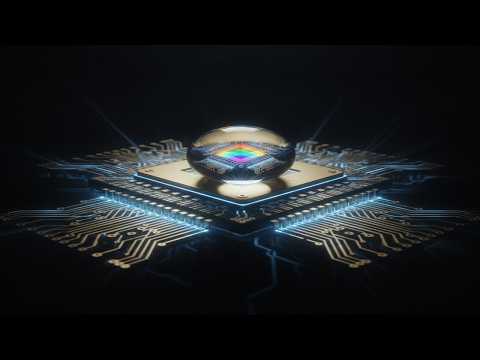
The Willow chip stands as a beacon of this new age. Using 105 qubits arranged in a practical tapestry of possibilities, it solves mathematical conundrums by processing numerous possibilities at once, whispering to us in the language of probabilities. Encased in a delicate world colder than the darkest corners of space, this processor leverages the fragility of quantum states to surpass classical constraints, revealing calculations at a span that outdates pharaohs and outpaces the birth of stars.
However, it would be misleading to crown Willow—or quantum computing, broadly—as the immediate successor to our current technological paradigm. Rather, it illustrates where opportunity meets limitation. The solutions it provides are specialized, applicable to niches where the epic weight of classical computation falters and fails. Areas like molecule modeling, complex algorithms in physics, and expansive simulations of nature feel the budding embrace of quantum’s potential.
In October 2025, Google’s strides extended further into realms once owned by lofty notions and sci-fi whims. The unveiling of quantum echoes—a protocol born from the intuitive leaps of researchers Mi and Kochegzhin—yielded tangible verifiability in an arena often criticized for its opacity. It’s a considerable stride forward, grounding quantum’s abstract wonders in practical reality, with efficiency measured not just in computational prowess but in answering the skeptical query: Does it hold veritable utility?
While Google’s superconducting architecture sets a benchmark, competitors like IBM and other tech pioneers, each with their own unique approach, harmonize and clash in a vibrant dance of innovation. Partnerships with pharmaceutical giants whisper of a future where drug discovery unfurls through the unique calculations only quantum can provide. As Hartmut Neven succinctly placed it, the path to commercial relevance is complex but inevitable.
And here we pause, confronted by the stark truth: Willow, for all its brilliance, marks a burgeoning start, not a finish line. The road stretches long and undefined, demanding millions of fault-tolerant qubits, spurring efforts that cross international lines and corporate boards, driven into the uncharted space by necessity more than desire. The implications ripple outward, challenging existing standards of security and encryption and beckoning the question—how do we build public trust in technologies that redefine known limits?
As technology tiptoes toward this future of dizzying complexity, let us remain observant, considering the weight it intends to lift from our traditional systems and the light it promises to cast upon the intricacies of the natural world. The quantum era whispers possibilities in the language of the unanticipated. Whether it’s a fleeting glimpse of an algorithm or a roadmap to resolute applications in health, materials, and climate, we stand at the precipice—a moment worth witnessing, a question worth asking.
—