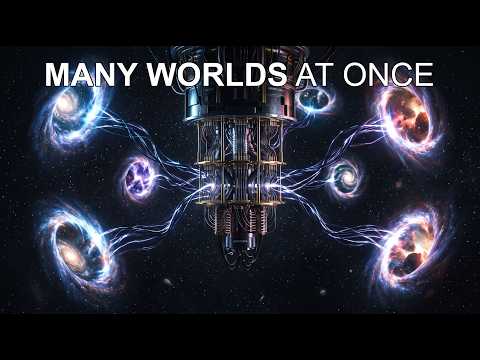
In the quiet corridors of Oxford, during the calm yet charged 1980s, a young physicist named David Deutsch sat immersed in a world not everyone dared to acknowledge: the multiverse. Here, his thoughts meandered through theories that conjured visions of innumerable unseen worlds intertwining with our own. He proposed that quantum computers harness their mysterious power by drawing upon this very multitude of universes, a claim so audacious that many of his contemporaries simply bypassed it.
Based on content from Quantum Space Research
Almost four decades later, Google echoed Deutsch’s once-ignored assertion, sending ripples through the scientific community. This enigma isn’t just about computational prowess; it’s a journey through the life of a nearly forgotten genius and the quest for the ultimate machine—one poised to rejuvenate one of science’s most intriguing debates. Alongside familiar names like Google and IBM, and amidst Cold War tension silenced in youth, lies an unassuming number that dwarfs the observable universe itself.
What are we to make of this? For most physicists, aligning scientific practicality with the untethered vastness of the multiverse spells contention. Does each qubit, a fundamental unit of quantum information, work in lockstep across realities? Both doubt and hope linger, tightly woven in the minds of physicists, reflecting deeper puzzles about existence itself.
Remember Hugh Everett? In Princeton, 1957, Everett, at a mere 27 years, framed a thesis that would revolutionize quantum mechanics: that for every outcome, there is a reality; no one outcome collapses. Heads and tails coexist, suspended in separate tapestries of time forever proceeding unseen by the other.
Despite skepticism, David Deutsch persisted. His passion borne from Karl Popper’s philosophical lens urged him to consider scientific theories not as practical pretenses but as truths demanding belief. The “many-worlds interpretation” became his unflinching truth, forming the bedrock of his visionary work on quantum computation, described in his 1985 paper—a proposal more akin to a physical law than a computational breakthrough alone.
Picture a lecture room from that era, perhaps unadorned, light filtering in feebly as Deutsch postulated worlds upon worlds cradling shared computations. Few in the audience would see beyond the mathematical elegance to the profound implications Deutsch fearlessly accepted: a universe infinitely more complex than physics then dared suggest.
Fast forward, and now a chip resting in a Californian lab reintroduces this ancient query to living rooms globally, bridging scientific circles to the common mind. Google’s announcement catapulted a theory science had almost forgotten into vivid discourse, sparking a competition as tacit as it was monumental in scope.
What then if a machine behaves exactly as Deutsch envisioned? What lies beyond satisfaction within a reality so crowded with possibilities it’s nearly incomprehensible? Would this construct of many-fold realities vindicate Deutsch’s unwavering mantra or simply beg further inquiry into the potential and limits of human understanding?
These thoughts meander and loop much like the storyline—an emanation from Everett, Deutsch, and a quiet but tenacious scientific inquiry that refuses to evade larger truths for the comfort of settled science. Yet, the question remains: should we fear or relish this bold new realm of knowledge where each calculation might echo eternally across a cosmic tapestry we only now begin to glimpse?
As the conversation lingers, we must ponder the shape of our universe—is it solitary or symphonic in nature, and what legacy shall our collective understanding lay upon it? An invitation perhaps for us to seek deeper truths, not just in realms known, but in those unfurling endlessly, modestly obscured by the shadows of our own existence.
—