When we think about the future of quantum computing, we tend to picture the people building the hardware.
We imagine physicists designing new qubits. Engineers solving error correction. Researchers are publishing groundbreaking papers that advance the science.
Those people deserve every bit of the attention they receive.
But after speaking with Alicia Welden on the Women in Quantum podcast, I found myself thinking about a different kind of contribution. One that rarely makes headlines, yet may be just as essential to whether quantum technologies ultimately succeed.
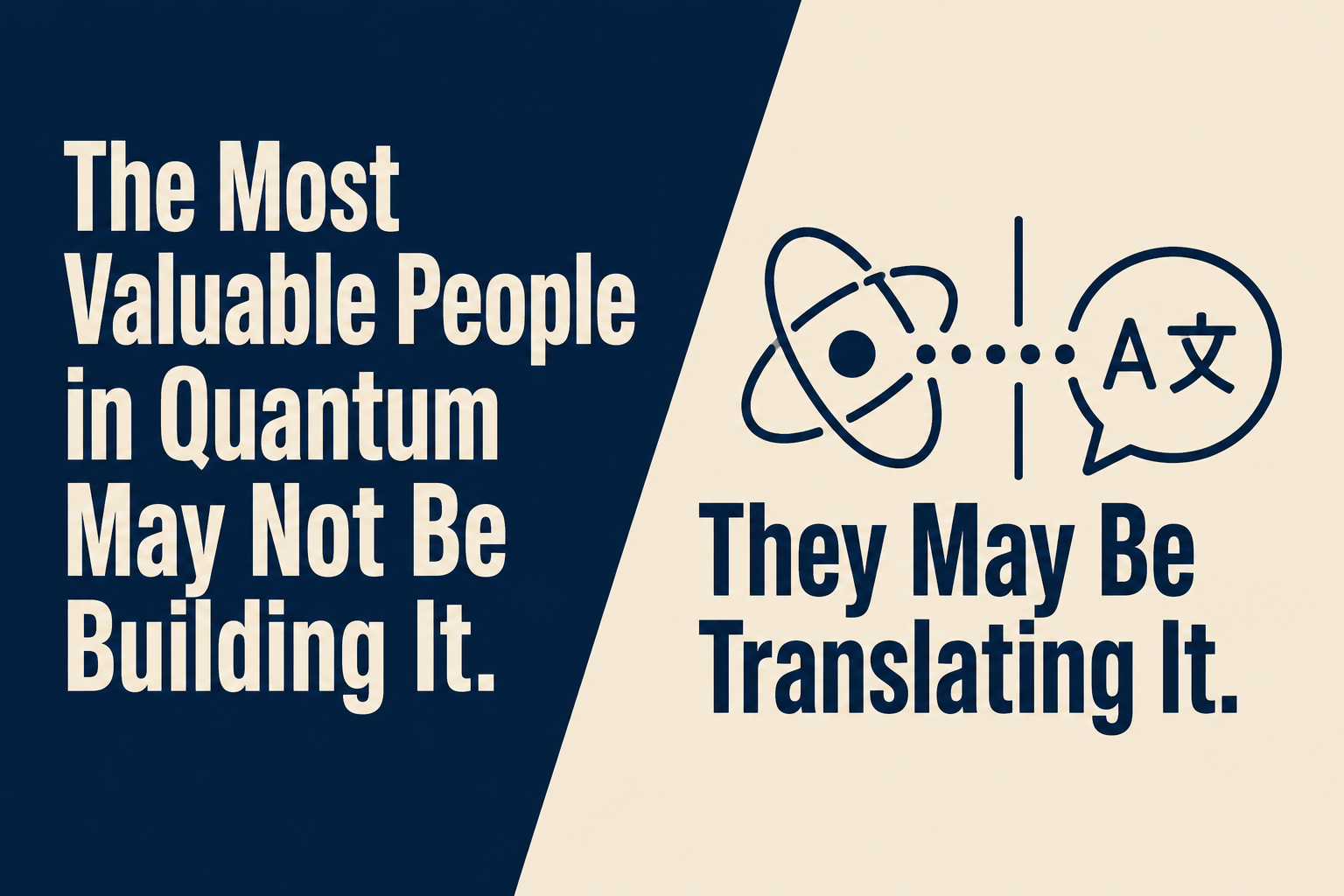
Translation.
Not language translation.
Knowledge translation.
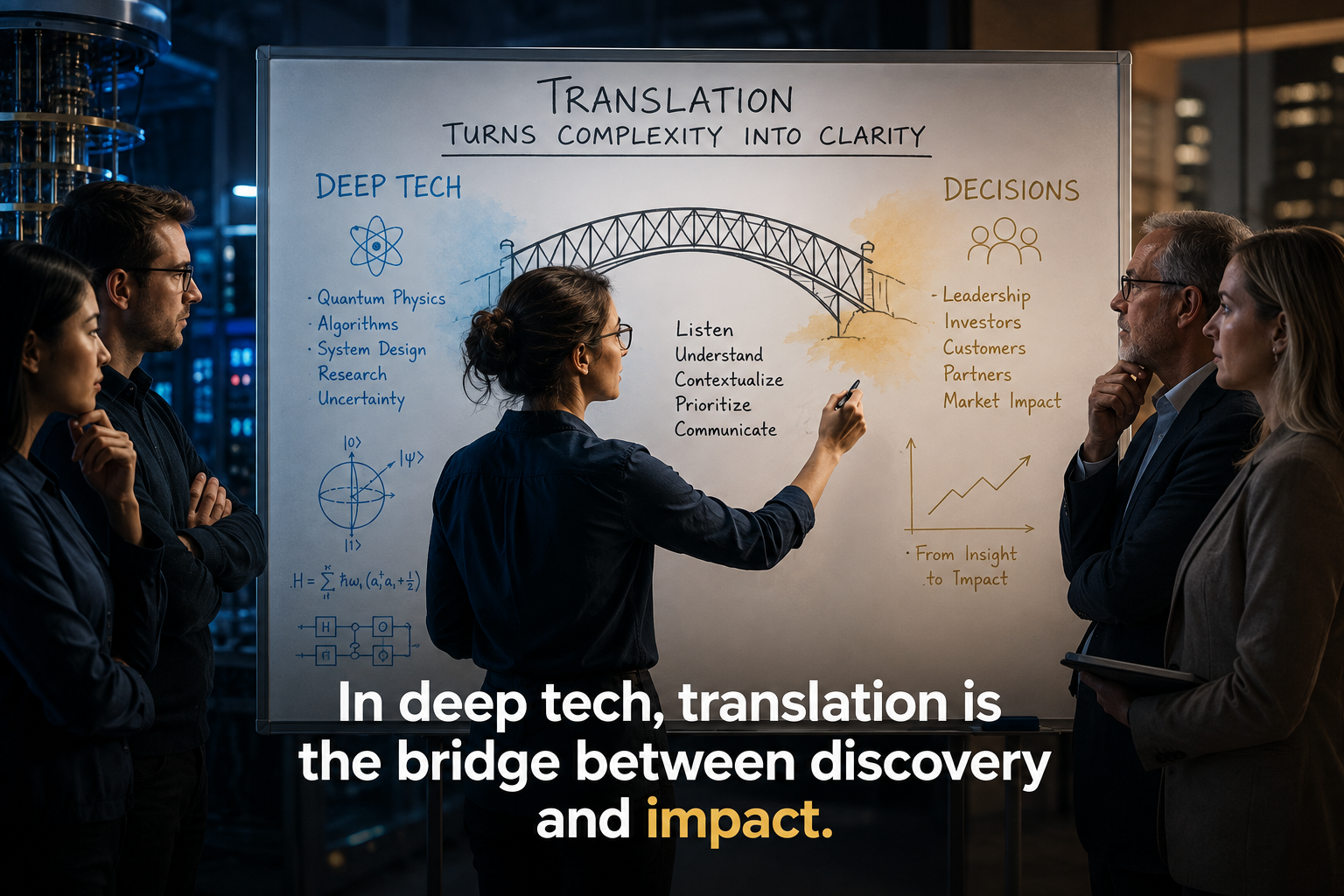
Alicia, a theoretical chemist whose career has spanned academia, national laboratories, quantum startups, and now Fujitsu, doesn’t describe herself simply as a researcher anymore. She describes herself as someone who sits at the intersection of research and the outside world. Between scientists and businesses. Between technical possibility and practical application. She sees herself as a translator.
That answer stayed with me long after our conversation ended because it captures something that extends far beyond quantum computing. Every emerging technology eventually reaches a point where innovation alone is no longer enough. Breakthroughs in the lab are essential, but they don’t automatically become breakthroughs in business or society.
Someone has to explain why the technology matters. Someone has to connect disciplines that rarely speak the same language. Someone has to help organizations understand not only what has been invented but also why they should care. That work is rarely the part that earns headlines, yet it is often the difference between a promising discovery and meaningful adoption.
Quantum computing is a perfect example. The field is advancing at an extraordinary pace, but its long-term success won’t depend solely on physicists, chemists, engineers, or computer scientists. It will also depend on people who can bridge the gap between technical possibility and real-world application, translating complex research into language that business leaders, policymakers, investors, and the broader public can understand and act upon.
The field has no shortage of brilliant scientists. Every week brings new papers, new hardware announcements, new funding rounds, and new milestones. Yet outside the quantum community, many executives still ask remarkably simple questions.
How will this affect my business?
Should we be paying attention now?
What problems can it actually solve?
Those aren’t scientific questions.
They’re translation questions.
During our conversation, Alicia explained that her role isn’t conducting quantum chemistry research day after day. Instead, she works across research and development, helping universities, companies, and partners understand what Fujitsu’s researchers are building and where those innovations might create value. She draws on her technical background to understand the science, then communicates it in ways that resonate with commercial partners.
That ability is becoming increasingly valuable across deep technology.
For years, expertise was measured by specialization.
Know more.
Go deeper.
Become the world’s expert in one increasingly narrow topic.
That model still matters. We will always need specialists pushing the boundaries of physics, chemistry, computer science, and engineering.
But emerging technologies demand something else as well.
People who are comfortable living between disciplines.
People who understand enough computer science to speak with developers, enough business strategy to advise executives, enough mathematics to appreciate the underlying models, and enough communication to make all of it understandable without oversimplifying it.
Those people don’t always invent the technology.
They make the technology usable.
This isn’t unique to quantum.
Artificial intelligence experienced the same evolution.
The organizations creating the greatest business impact with AI aren’t necessarily the ones publishing the newest transformer architectures. They’re the ones helping healthcare providers, manufacturers, banks, retailers, and governments understand where AI actually fits into their workflows.
Translation created adoption.
Cloud computing followed the same pattern.
Cybersecurity did too.
Quantum will be no different.
What’s interesting is that Alicia didn’t become a translator by abandoning science.
She became one because she spent years immersed in it.
Her background in mathematics and quantum chemistry lends her credibility with researchers, while her industry experience enables her to appreciate commercial priorities. Rather than choosing one world over another, she learned how to move between both.
That intersection is where many of tomorrow’s careers will emerge.
We often tell students that they need to become physicists to contribute to quantum computing.
Or software developers.
Or hardware engineers.
Those roles are absolutely critical.
But they’re not the only paths.
The quantum ecosystem also needs product managers who can translate technical roadmaps into customer value. Marketing professionals who can communicate progress without relying on hype. Business development leaders who understand both scientific capability and industry demand. Technical writers who can explain complex concepts with clarity. Community builders who connect researchers, startups, investors, educators, and policymakers.
These are not secondary roles.
They’re force multipliers.
Without them, remarkable research risks remaining trapped inside conference proceedings and academic journals.
Translation also requires something many technical fields underestimate.
Humility.
One of the themes Alicia returned to throughout our conversation was uncertainty. Rather than offering bold predictions about when quantum computing will transform every industry, she acknowledged the field’s complexity. Scientists don’t know every answer. Timelines are difficult to predict because research rarely follows a straight line. That honesty isn’t a weakness. It’s what makes science trustworthy.
The irony is that the best translators don’t try to eliminate complexity. They respect it. Rather than reducing difficult ideas to catchy sound bites or bold predictions, they preserve nuance while making them approachable. They help people understand that uncertainty isn’t a sign that progress has stalled. It’s a natural part of scientific discovery. Every meaningful breakthrough begins with questions that don’t yet have answers.
Perhaps that’s one of the most overlooked skills in emerging technology today. The goal isn’t to convince people that every problem has already been solved. It’s to help them become comfortable with ambiguity, to understand where the field stands today, where it’s headed, and why some questions simply require time, experimentation, and collaboration. That kind of communication builds trust because it values honesty over hype.
As quantum computing moves from research laboratories into corporate boardrooms, government agencies, and commercial products, the need for translators will only grow. The next decade won’t belong exclusively to the people designing better quantum processors or developing new algorithms. It will also belong to the people who can explain why those advances matter, who can bridge the gap between research and real-world impact, and who can move comfortably between disciplines without feeling the need to belong entirely to one.
Innovation doesn’t spread simply because remarkable technology exists. It spreads because someone helps the rest of the world understand what that technology means, who it serves, and how it creates value. In a field as technically demanding as quantum computing, that ability to translate may prove to be just as important as the breakthroughs themselves.