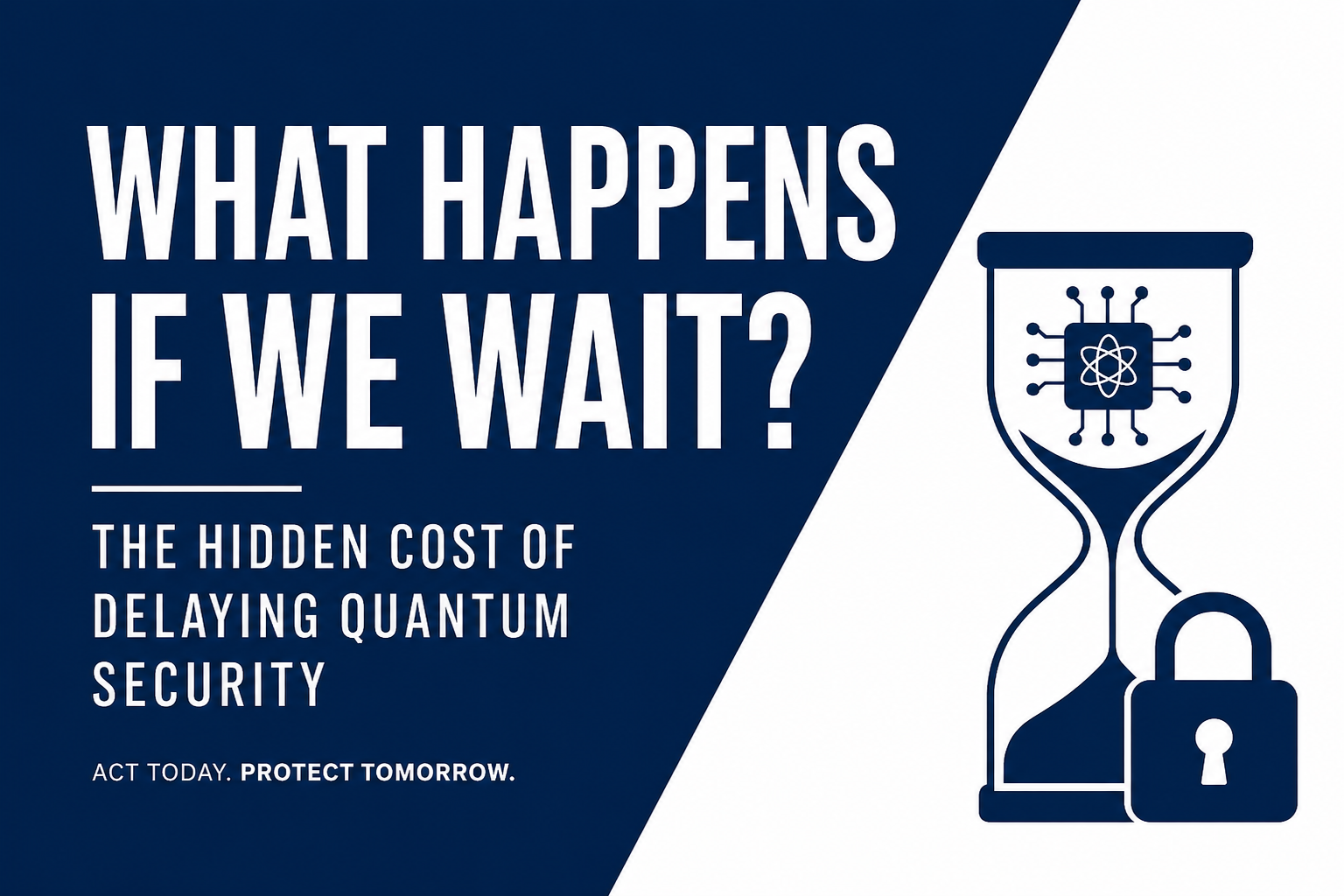
What happens if organizations wait until quantum computers arrive before preparing for post-quantum security?
At first glance, that might seem like a reasonable strategy. After all, fault-tolerant quantum computers capable of breaking today’s encryption standards do not yet exist. Why spend time and resources solving a problem that appears to be years away?
The answer is simple.
Because the risk does not begin when the quantum computer arrives.
The risk begins long before that.
In a recent conversation on the Impact Quantum Podcast, cybersecurity entrepreneur Kevin Kane challenged a common assumption about quantum computing. While much of the public conversation focuses on future breakthroughs, revolutionary applications, and scientific milestones, Kane believes organizations should be paying closer attention to a quieter threat already unfolding behind the scenes.
Waiting until quantum computers arrive may be the most expensive cybersecurity mistake organizations ever make.
The “Harvest Now, Decrypt Later” Problem
One of the most important concepts in quantum security is “harvest now, decrypt later.” The idea is surprisingly straightforward.
Adversaries do not need a quantum computer today to benefit from one tomorrow.
Instead, they can collect encrypted data right now and store it indefinitely. Financial records, intellectual property, government communications, healthcare information, legal documents, military intelligence, and corporate secrets can all be copied and archived today.
The information remains encrypted. When sufficiently powerful quantum computers eventually become available, those archives can be revisited and decrypted. This changes the timeline entirely.
Organizations often think of cybersecurity as a present-day challenge. If data remains secure today, many assume the threat has been addressed. Quantum computing introduces a new dimension to that thinking. Information with a long shelf life may already be vulnerable even if quantum computers remain years away.
The question is no longer, “Can someone break this encryption today?” The question becomes, “Will this information still matter when they can?” For governments, financial institutions, defense organizations, pharmaceutical companies, and critical infrastructure providers, the answer is often yes.
Financial Markets Depend on Trust
One of Kane’s most compelling observations centers on the financial system. Modern markets operate because participants trust the underlying infrastructure. Every transaction, trade, payment, account transfer, and digital communication relies on encryption. Most people never think about it because the system largely works. Trust has become invisible. But trust is also fragile.
Imagine a scenario where a major cryptographic breakthrough is announced. News spreads rapidly across social media, trading platforms, financial news networks, and messaging applications. Questions emerge about whether sensitive communications, banking transactions, or institutional data have been exposed.
Would people patiently wait for technical experts to explain the details? Or would they react immediately? History suggests that markets rarely pause for technical nuance. Whether the threat is fully understood or not, perception alone can drive behavior. Investors move money. Institutions react. Customers withdraw funds. Rumors spread faster than facts.
The challenge is not simply whether encryption remains mathematically secure. The challenge is whether public confidence remains intact. Quantum preparedness is therefore not just a cybersecurity issue. It is increasingly becoming a financial stability issue.
National Security Is Becoming a Quantum Security Challenge
For decades, encryption has quietly protected national defense systems, intelligence operations, diplomatic communications, and critical government infrastructure. As quantum technologies advance, that protection faces new scrutiny.
Countries around the world are investing heavily in quantum research for a reason. They recognize that quantum computing is not simply another technological innovation. It has the potential to alter the balance of power in cybersecurity, intelligence gathering, and information warfare.
The race is not only about building quantum computers. It is also about defending against them. Organizations often imagine cyberattacks as isolated events targeting individual companies. The reality is that future quantum threats could have implications that extend far beyond a single organization.
Supply chains, financial networks, communications infrastructure, transportation systems, energy grids, and government operations are deeply interconnected. A weakness in one area can quickly become a vulnerability across many others. That is why governments throughout North America, Europe, and Asia have begun accelerating post-quantum cryptography initiatives. The transition is no longer viewed as optional. It is becoming a strategic necessity.
Infrastructure Vulnerability Is Easy to Ignore Until It Isn’t
Perhaps the greatest danger is that much of the infrastructure we depend on was never designed with quantum threats in mind. Many organizations are still discovering where cryptography exists within their own environments. It is embedded in applications, cloud services, VPNs, databases, authentication systems, communication platforms, industrial control systems, and third-party software.
In large enterprises, no single person may have complete visibility into every cryptographic dependency. This creates a difficult reality. Migrating to post-quantum security is not a software update that happens overnight. It requires inventorying systems, identifying vulnerabilities, testing replacements, ensuring compatibility, training teams, and coordinating across multiple departments and vendors.
For some organizations, this process could take years. Waiting until a quantum threat becomes urgent means starting the transition when everyone else is trying to do the same. History repeatedly shows that organizations that prepare during periods of stability adapt more effectively than those forced into reactive change during a crisis. The companies that thrive through disruption are usually the ones that started preparing before the disruption became obvious.
The Time to Prepare Is Before You Need To
Quantum computing will continue to dominate headlines because of its promise.
Researchers are pushing the boundaries of science. Investors are pouring capital into the ecosystem. Governments are making strategic commitments. New breakthroughs seem to arrive every month.
Yet one of the most important lessons from the quantum industry has little to do with future computers themselves. Preparation matters. Organizations do not buy insurance after the fire. They do not install backups after losing their data. And they should not begin planning for quantum security only after quantum computers can break current encryption systems. The transition to post-quantum cryptography is already underway.
The organizations that begin understanding their cryptographic exposure today will likely have more options, more flexibility, and fewer surprises tomorrow. Because the real question is not whether quantum computing will eventually change cybersecurity. The real question is whether we will be ready when it does.
How prepared is your organization today?