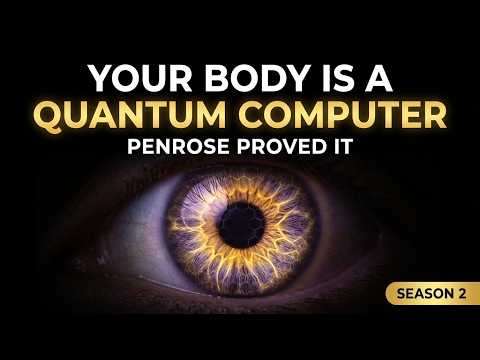
What if your cells were silently performing quantum calculations right now, a secret your biology has kept hidden in plain sight? As we traverse this episode of Elena’s Quantum Diaries, we venture beyond abstract reality architecture into the hardware animating it—your body. Through the groundbreaking lens of Roger Penrose and Stuart Hameroff’s Orchestrated Objective Reduction (Orch-OR) theory, consciousness emerges not merely from the firing of neurons but from quantum events unfolding inside microtubules, those unassuming protein structures nestling within every neuron of your brain.
Based on content from Elena’s Quantum Diaries – by Elena D’Avalon
Reconfiguring Consciousness: Imagine: anesthesia does not silence neurons—instead, it disconnects the symphony of microtubules. Isn’t it curious that consciousness vanishes when microtubules quiet down, even as neurons continue their electrical dance? This subtle detail, often overlooked, suggests that consciousness does not simply glow into being through neural patterns; it might weave through the delicate lattice of microtubules, aligning with quantum superposition, objective reduction, and orchestrated collapse.
The Quantum Mechanism: Inside microtubules, quantum superpositions dance between potential states, not unlike Schrödinger’s famous cat puzzle. According to Penrose, these states do not merely collapse under observation but are nudged by gravity itself, compelled by the universe’s structure to resolve. Here, Hameroff suggests our brain’s microtubules may orchestrate these quantum transitions, where each collapse crystallizes into a unit of conscious experience. Imagine your thoughts as a cascade of these collapses, a silent quantum concert underpinning every moment of consciousness.
Evidence Against Skepticism: Skeptics once argued that quantum coherence couldn’t survive the chaotic warmth of a living cell. Yet, defying expectations, Graham Fleming’s research unveiled quantum processes in photosynthesis—discoveries that rewrote what we knew, revealing energy transfer in bacterial systems through quantum coherence. Similarly, avian studies discovered that birds navigate by sensing Earth’s magnetic field through radical pair entanglement, challenging preconceptions about where quantum effects can thrive. These findings underscore that the “too warm, too wet” objection is losing its grip on quantum biology.
Why It Matters: While Orch-OR remains a debated position, its implications could redefine our comprehension of mind-body dynamics. Penrose and Hameroff propose a scenario where your body doesn’t merely shelter consciousness—it might be the quantum stage where possibilities converge into the moment you inhabit. A realization that shifts the perspective from mystical awe to a recognition of how profoundly strange and intricate reality really is.
So, as we unravel these connections, the interface between biology and quantum physics invites a pause—a moment to reflect on how interconnected, how complexly woven, life truly is. As you let these ideas settle, consider this: what if the boundary between physics and biology wasn’t real, but simply uncharted? As always, I’m eager to hear which insights resonate most with you. Comment below, and let’s continue the dialogue.
Join us next Wednesday as we delve deeper into entanglement and the profound implications of particles—and possibly people—acting beyond individual distinction. Stay quantum, stay curious.
With quantum precision,
Elena D’Avalon
—