Across the landscape of modern physics, the Standard Model stands as a towering edifice—a comprehensive yet imperfect map of the particles and forces that make up our universe. As with any intricate structure, its limitations, though discreet, are visible to those who know where to look. This post explores the ideas driving physicists to look beyond these confines, to sketch a more complete picture of reality.
The Standard Model has been a reliable guide. It explains the electromagnetic, weak, and strong forces, uniting them under a single theoretical umbrella. It has predicted particles, such as the Higgs boson, with remarkable precision. Yet, it stops short of weaving gravity into its fabric, a gap that becomes especially apparent when contemplating the early universe or the heart of a black hole.
Based on content from Professor Dave Explains
Unfying Forces: Toward a Grand Unified Theory
At the crux of current theoretical work is the aspiration of unification—combining forces under one grand theory. The electroweak unification, which melds the electromagnetic and weak forces, was a major milestone. But some physicists think bigger. They aspire toward a Grand Unified Theory (GUT), integrating the strong force into the equation. This concept suggests that quarks and leptons, seemingly distinct, may transform into one another over vast timescales, a prospect hinted at by experiments like Super-Kamiokande and DUNE.
The Quantum Dance: String Theory’s Ambitions
The dream extends even further with string theory, proposing that the particles of the Standard Model could be actualized as tiny, vibrating strings. This framework beautifully offers a quantum description of gravity through the emergence of a hypothetical particle, the graviton. String theory is bold, hinting at additional spatial dimensions, yet it remains on the fringes of empirical validation. Laboratories worldwide hold their breath, awaiting data that might turn speculation into certainty.
An Unequal Balance: CP Violation
The imbalances in our universe—the predominance of matter over antimatter—point toward phenomena not fully captured by the Standard Model. Charge-parity (CP) violation, though acknowledged, is insufficient to account for these cosmic scales. Researchers probe this mystery by exploring the electric dipole moments (EDM) of electrons and neutrons. Experiments like ACME attempt to capture this subtle non-zero EDM, an endeavor inching ever closer to revelation.
The Collider and the Supersymmetric Promise
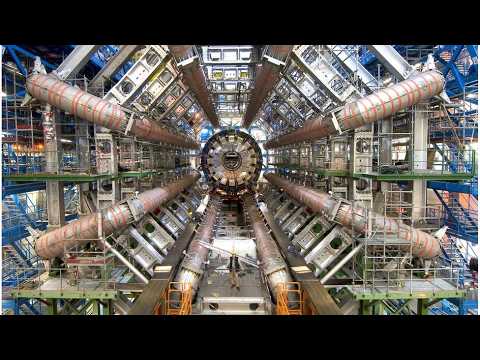
At CERN, the Large Hadron Collider (LHC) continues its search for new physics, embodying the ambition to clarify the universe’s hidden realms. Supersymmetry was once a beacon of hope—a theory suggesting each Standard Model particle has a higher-spin partner. Yet, despite the LHC’s high-energy collisions, glimpses of these supersymmetric particles remain elusive. The idea lingers, a testament to the complexities and evolving nature of physical laws.
Each collision in the LHC is a dialogue between theory and reality, unraveling high-energy states and unveiling short-lived phenomena like the quark-gluon plasma, while forging pathways to understanding particles that remain unseen.
The Future Path: New Theories and Explorations
The search for answers is relentless. Beyond the Standard Model, we anticipate new theories and methodologies to emerge, crafted by thousands of collaborators around the globe. Whether investigating the Higgs boson’s self-interactions or scrutinizing rare decay paths, the potential for breakthroughs is vast.
It’s not mere discovery that drives this quest, but an intrinsic curiosity about what lies at the universe’s core. What new truths will shift our understanding next? For the physicist, the appeal of the unknown is irresistible—it’s where genuine innovation rests.
As we stand on the precipice of another chapter in particle physics, one must ponder: how close are we to crafting a unified and coherent tapestry of cosmic forces? Perhaps it’s a question not just for scientists, but for anyone curious about the fundamental forces shaping existence.
—