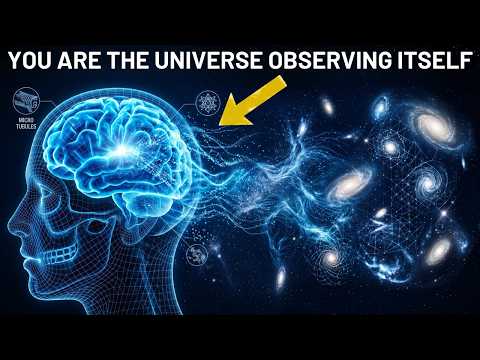
Every morning, as the dawn light filters through familiar curtains, something miraculous happens. Out of the enigmatic void of sleep, a vibrant tapestry of sensation unfurls. The tactile warmth of sheets, the muted symphony of morning sounds, and the intimate recollection of self surge into existence, creating a subjective tapestry we call consciousness. For centuries, this daily reawakening has been assumed to be no more than the mechanical performance of neural scripts—a grand biological calculation, reducible to electrical synapses playing their part in a deterministic dance.
Based on content from Frontiers of Science
Yet, whispering beneath this tangible reality is another story, a possibility that the brain is not merely a biological computer but is engaging with something profound, threading into the very fabric of the cosmos. This hypothesis, known as quantum consciousness, invites us to peer beyond the limitations of classical physics into a world where the seemingly impossible—like consciousness itself—takes shape in the quantum realm.
To grasp this theory, we must first acknowledge the intellectual frontier dubbed the “hard problem of consciousness.” Traditional science maps out how sensory information travels; we know the circuits the light from a red apple ignites in the brain. But why does seeing red feel a particular way? It’s a puzzle untouched by classic physics, the laws of predictability and determinism, leaving us with neurons that operate like gears but miss the essence of the experience they purportedly create.
On this precipice of understanding, we turn to quantum mechanics—a realm where particles reside in states of superposition, where entangled entities share instantaneous connections across spacetime, where the act of observation can alter outcomes. Such principles, considered too ephemeral for the macroscopic world of warm, living brains, now suggest an incredible possibility: that consciousness arises from these quantum quirks.
Within the cerebral microcosm, beneath even the networks of neurons, lies the cytoskeleton, particularly the microtubules. Once dismissed as cellular scaffolding, these intricate structures may function as quantum processors. Imagine your mind, not as an intricate tangle of binary firings, but as a symphony of quantum harmonies. These microtubules possibly facilitate quantum superposition, existing miraculously in multiple states, processing an array of possibilities that coalesce into thought and awareness.
The theory posits that the essence of conscious experience is drawn from the collapse of quantum superpositions within these microtubules—individual bursts of perception that cumulate into the seamless continuity we perceive as reality. This positions consciousness not as an emergent property, but as a fundamental intertwined with the quantum sheet of existence, shaping a universe where cognition connects with cosmic strings.
Consider quantum entanglement: particles symbiotically linked despite separation by vast spatial expanses. If this connectivity underpins neural processes, the molecular entanglement within microtubules could allow for instantaneous internal communication, harmonizing disparate brain regions into a unified consciousness, a consciousness that feels singular and whole.
Magnifying the intrigue of quantum cognition are phenomena like anesthesia and sleep. Anesthetics obscure consciousness by disrupting microtubule vibrations, severing quantum ties with reality, only for consciousness to re-emerge as the vibrations resume. Similarly, sleep may reflect a dance between waking coherence and a return to the quantum ocean of possibilities, dreams offering glimpses of existence unshook by material constraints.
If consciousness finds roots in the probabilistic nature of quantum mechanics, this erases the deterministic constraints, carving a niche for genuine free will. In a universe where outcomes perpetually unfurl from superposed states, you are not bound by predestined events; instead, you partake in a cosmic game of infinite variability.
As traditional scientific views encounter the resilient intricacies of biological quantum coherence—visible in the photosynthetic quantum tunes of plants, or avian navigation through entanglement—nature’s ingenious designs slowly unfurl before us. It seems plausible that life’s complexity wove these quantum threads into the neurological tapestry to realize consciousness.
These revelations enshrine an enchanting vision of existence: if consciousness threads through quantum architecture, it does not simply extinguish when organic structures falter. Quantum states, impervious to annihilation, might echo into the cosmos, leaving traces of conscious whispers scattered across the universe, waiting to be tethered once more.
This exploration isn’t just a frontier of neuroscience or physics; it’s a meditation on our existential place in the cosmos. Whether you’re pondering the profound connections within your own mind or gazing into the night sky, there’s a chance you’re not alone but intricately entangled with the universe itself.
As we stand on this precipice of understanding, knowing there’s more to explore, the question looms, inviting deeper reflection: If the universe itself perceives through the quantum feedback of consciousness, what narrative writes itself out in the silence between each moment, waiting for us to hear?
For now, we pause, letting questions linger like particles in superposition, yearning for the next observation that might bring light to the shadows.
—