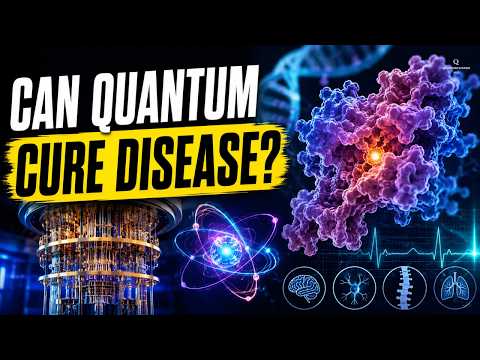
In the vast symphony of biological processes that sustain life, proteins play an essential role. These molecular machines are intricately shaped, and it’s precisely this structure that dictates their function. However, when proteins malfunction, the harmonious flow of biological activities is disrupted, often with adverse consequences manifesting as debilitating diseases like Alzheimer’s, Parkinson’s, and Huntington’s. This leads us to a tantalizing question: What if we could foresee the onset of disease, reshaping our approach to medicine?
Based on content from Quantum SystemHub
In the vast symphony of biological processes that sustain life, proteins play an essential role. These molecular machines are intricately shaped, and it’s precisely this structure that dictates their function. However, when proteins malfunction, the harmonious flow of biological activities is disrupted, often with adverse consequences manifesting as debilitating diseases like Alzheimer’s, Parkinson’s, and Huntington’s. This leads us to a tantalizing question: What if we could foresee the onset of disease, reshaping our approach to medicine?
The challenge of predicting such maladies lies at the molecular level, specifically in understanding how proteins fold. Think of protein folding as nature’s microscopic origami—a delicate dance where a string of amino acids coils and bends to form a unique three-dimensional structure. Each step in this process is like a move in an intricate ballet, choreographed by chemical interactions. When the choreography falters, proteins misfold and aggregate into toxic clumps that hinder cellular function.
Despite knowing a protein’s amino acid sequence, simulating its folding process remains a daunting task for traditional computers. Enter the computational wall, a barrier solidified by discrepancies in scale and the fundamentals of physics. Levanthol’s paradox quantifies this conundrum: the time required for a protein to explore all potential configurations far exceeds the lifespan of the universe itself, yet within our bodies, proteins fold in mere milliseconds. Classical computers, limited by exponential memory demands, stumble as they attempt to mimic this efficiently orchestrated process.
Yet, a glimmer of hope emerged with AlphaFold, a breakthrough heralded by artificial intelligence. By employing neural networks, AlphaFold sidestepped the exhaustive simulation of each atomic interaction, instead leveraging patterns across species to predict lowest energy configurations. However, this AI approach has its bounds; it struggles with novel proteins and areas devoid of sequence alignments.
And so we turn to quantum computing, which may very well be the key to unlocking the mysteries of protein folding. Unlike classical computers, quantum systems operate under principles that parallel the quantum mechanics governing molecular interactions. Here, qubits—leveraging superposition and entanglement—exponentially compress computational space, making seemingly insurmountable problems approachable.
Quantum computers, rather than approximating, native represent quantum states. By implementing algorithms like the Variational Quantum Eigensolver (VQE), researchers simulate the physical journey of protein folding with remarkable precision. Capturing the essence of molecular configurations as they navigate their pathways, quantum simulations—though still in infancy—offer an extraordinarily detailed map from amino acid sequences to functional proteins.
Indeed, significant strides are occurring within esteemed institutions. IBM and Biogen have demonstrated the potency of quantum modeling in pioneering research, focusing on complex proteins including those implicated in neurological disorders. As quantum technologies evolve, with experiments continuously reducing computational burdens, the horizon of possibility broadens.
Yet, realism must temper our optimism. Presently, quantum infrastructure battles noise, limited qubit capacity, and error rates. Full-scale simulations of large biological proteins remain aspirational. However, as quantum computing matures in tandem with AI, envisioning a future where diseases are preventable through molecular insight feels within reach. Imagine a world where drug molecules are digitally designed and their interactions precisely forecasted—all before any physical trials commence.
This integration of quantum and biology leaves us contemplating broader horizons. Would accurate simulation of all proteins transform disease into a challenge of prediction and prevention? It’s a captivating thought, wrapped in the promise of unfolding technologies. As research progresses, these questions—and their answers—beckon us forward, shaping the future of medicine one qubit at a time.
Thank you for joining this exploration. Stay tuned for more insights at the intersection of quantum computing and transformative scientific endeavors.
—