Quantum mechanics is often described as the realm of the almost invisible, a territory that defies our everyday intuitions with its particle-wave dualities and probabilistic implications. Yet, understanding these concepts isn’t merely a cerebral exercise; it’s a feat of visualization—a task made brilliantly accessible by the physics textbooks that dare to illustrate the unseeable.
Based on content from Tibees
Imagine the earnest flicker of curiosity as one stands before a bookshelf tapping into this shared human desire to grasp the elusive truths of quantum mechanics. Within the pages of these academic tomes, art meets science, and the abstract comes to life, if only in diagrams and sketches. These textbooks, intended for university students, confront the full complexity of quantum physics without shying away, casting the intricate shadows of particles, waves, and everything in between onto each page.
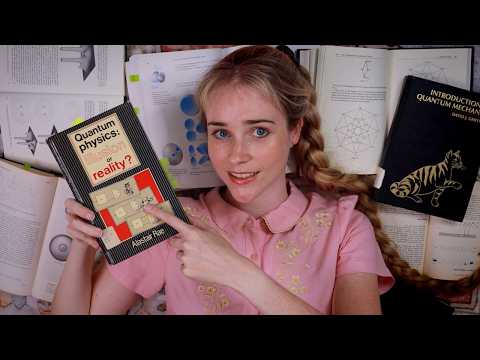
One such book, Quantum Physics: Illusion or Reality by Alistair Ray, challenges us to question: What truly is the nature of light? Is it a particle? A wave? This narrative unfolds with visual cues—a sequence of diagrams depicting experiments like the famous double slit setup, wherein photons trickle one by one through slits yet still create the same interference pattern that broad streams produce.
Ray’s illustrations delve into the dual nature of light, capturing the dance of possibilities that is both enthralling and bewildering. Like a whispered secret that demands to be heard over and over again, each image insists that there is more beneath the surface of what we see.
Consider also the timeless thought experiment of Schrödinger’s cat, which extends these debates from light to larger ontological questions. Is the cat alive or dead? The pages unfold like acts in a play, each moment straddled between reality and potentiality—a testament to the philosophical threads woven into the quantum narrative.
Moving from the philosophical to the thoroughly practical, Griffiths’ Introduction to Quantum Mechanics turns its gaze upon the mathematics underpinning these ideas. Here, the wave function takes the spotlight, illustrating probability as a plot with peaks and valleys, its graphical depiction illuminating the abstract notion of particle location turnings into a visual narrative of sorts.
Learners explore adiabatic approximations and the intricacies of one-dimensional motion, with the humble pendulum and vibrational boxes becoming metaphors for quantum states and energy levels. Each illustration, a distinct pathway, guides the reader through a landscape of probabilities and realities, where each line and curve has intent and significance.
And as this pictorial journey threads its way into greater depths of complexity, it encounters Bada’s work on Atoms in Molecules, which examines electron density in molecules. It transcends the particle, addressing the supra-atomic scale of molecules with topological maps shaded in relief—a new kind of celestial charting that chronicles the swirls and folds of electron clouds.
Beyond the paper, modern reconstructions and experiments bring these conceptual illustrations into labs and fields—a cyclical dance where theory informs practice, confirming or challenging the drawn images in a dialogue as old as science itself. The process reinforces the notion that understanding quantum mechanics is not merely academic but an ongoing pursuit of revealing nature’s most subtle secrets.
These textbooks and their art matter because they bridge worlds—between the concrete, measurable universe and the imaginations that attempt to describe it. They remind us that illustration isn’t just a tool for clarity but a profound language of its own, capable of expressing the ineffable and the unseen.
In a world dizzy with data and the rush of instant knowledge, perhaps these illustrated pages encourage us to linger a little longer—like a hiker pausing to watch the play of light over mist in a hidden valley, aware that something extraordinary is taking shape beneath the surface.
As you explore or revisit the vivid canvases of these textbooks, where does your curiosity lead? What aspects of quantum mechanics would you illustrate to unravel the mysteries of the universe?
—