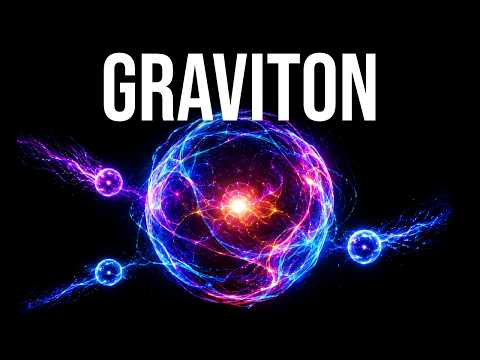
What if gravity has a particle, but that particle is almost impossible to detect? In this episode of The Sleeping Physicist, we explore the graviton, the hypothetical quantum carrier of gravity, and why it sits at the center of one of the deepest unsolved problems in physics.
Learn why every known force except gravity has a confirmed carrier, why general relativity describes gravity as geometry rather than an ordinary force, and why trying to quantize gravity leads to infinities that cannot be repaired in the usual way. We follow the path from force carriers, curved spacetime, and the quantization problem to what a graviton would have to be: massless, spin two, universally coupled, and unlike any other boson in the Standard Model.
We also explore why detecting a single graviton may be physically impossible, why the Planck scale blocks direct experiments, and why renormalization fails when gravity is treated like the other quantum forces. From string theory and loop quantum gravity to extra dimensions, holography, graviton mass bounds, and modern experimental constraints, this episode asks whether the graviton truly exists, and what its existence would reveal about the quantum structure of spacetime itself.
Like the video if you enjoy calm, clear physics
Subscribe for more science, space, and universe explanations
Comment where you’re listening from or what physics topic you’d like next00:00:00 Forces Need Carriers
00:04:37 Gravity As Geometry
00:09:01 The Quantization Problem
00:13:10 What A Graviton Must Be
00:17:52 Spin Two Requirement
00:23:08 Graviton Versus Other Bosons
00:29:09 How Gravitons Would Interact
00:33:53 Virtual Gravitons
00:39:17 Graviton Detection Problem
00:44:59 Energy Scale Barrier
00:49:33 Perturbative Breakdown
00:54:34 Renormalization Fails
01:00:32 String Theory Graviton
01:05:43 Loop Quantum Gravity
01:11:32 Graviton In Extra Dimensions
01:17:22 Holographic Approaches
01:22:43 Graviton Mass Bounds
01:28:21 Experimental Constraints
01:34:38 What A Graviton Would Do
01:40:42 Whether The Graviton Exists#Graviton #QuantumGravity #Gravity #GeneralRelativity #QuantumPhysics #Spacetime #StringTheory #LoopQuantumGravity #StandardModel #TheSleepingPhysicist
Based on content from The Sleeping Physicist
In the shadowed confluence of quantum physics and general relativity, there lies a whisper of a mystery: gravity, a force we intimately understand through its effects yet remain baffled by in its quantum guise. The graviton, an elusive particle, dances on the edge of our scientific understanding, a specter that haunts theoretical physicists striving to weave the tapestry of the universe into a coherent quantum fabric.
At a glance, the universe’s forces seem to display symmetry, each with its own particle emissary — the electromagnetic force has the photon, the strong force holds onto gluons, and the weak force carries W and Z bosons. Yet, gravity stands curiously apart, without an experimentally confirmed particle. This absence is striking because it nudges us toward understanding why general relativity beautifully and poetically describes gravity as the curvature of spacetime rather than just another force.
The heart of the issue lies in quantization. When physicists attempt to encapsulate gravity within the quantum cradle, they’re met by the unfathomable seas of infinities — mathematical anomalies that defy renormalization, a process that succeeds for other forces. Gravitons, if they exist, would embody a radical exception to our current exemplar: the Standard Model will be tweaked to describe massless particles with spin two, acting like whispering sylphs entwined in the gravitational fields.
Further complicating this quest is the grim reality that detecting a graviton may be an exercise in impossibility. It’s as if the universe tucked the graviton behind the veil of the Planck scale, laughing at our plodding experimental efforts. Even in our relentless pursuit, where we explore virtual particles and their transient dance in vacuum fluctuations, graviton detection remains a challenge beyond today’s technological instrumentation.
While we cannot easily detect gravitons, theoretical frameworks endeavor to give them life. String theory confronts these ghostly entities, positing that they might emerge naturally in its extra-dimensional symphony, while loop quantum gravity offers a different route towards quantizing spacetime. Holographic approaches tease us with the promise that graviton properties might yet be encoded within the boundaries of what we observe, leading to innovative mathematical depictions that might one day bridge this gap.
Despite our sophisticated attempts and the extensive bounds placed by modern experiments, the metaphysical essence of whether gravitons exist — and what they would reveal about spacetime’s quantum structure — remains an exhilarating puzzle. It invites us to contemplate a reality where our understanding of time and space could be as textured and layered as a painting that shifts in meaning as we attempt to decipher its strokes.
This inquiry isn’t just academic; it touches the foundational principles that shape our existence. It urges us to consider: what new horizons beckon if gravity, the most familiar of forces, yields a particle? What profound insights into the universe’s architecture might be unlocked? Such are the questions that remind us the cosmos’ greatest truths often reside in the whispers of the unseen, beckoning with stories untold.
Whether gravitons will step out from theory into the realm of empirical reality remains an open-ended journey. Yet, even as we grapple with infinities and transcendental mathematics, this pursuit enriches our scientific narrative and invites our collective curiosity. Perhaps in this dance of discovery lies the thread tying us to a deeper understanding — sparking reflection and inviting explorers to venture further into the cosmos’ enigmas.
As we leave this quiet reflection on gravitation’s quantum conundrum, I leave you with a thought: what will be the next step in uncovering spacetime’s hidden mosaic? Will our tools and minds, ever evolving, someday unravel gravity’s mysteries, or will it forever remain the enigmatic stage upon which the universe unfurls its drama?
—