One of the most interesting quantum breakthroughs this month did not involve a record-breaking processor, a dramatic qubit announcement, or another race toward fault tolerance.
Instead, it came from something quieter. More mathematical. Almost hidden beneath the larger headlines surrounding the industry.
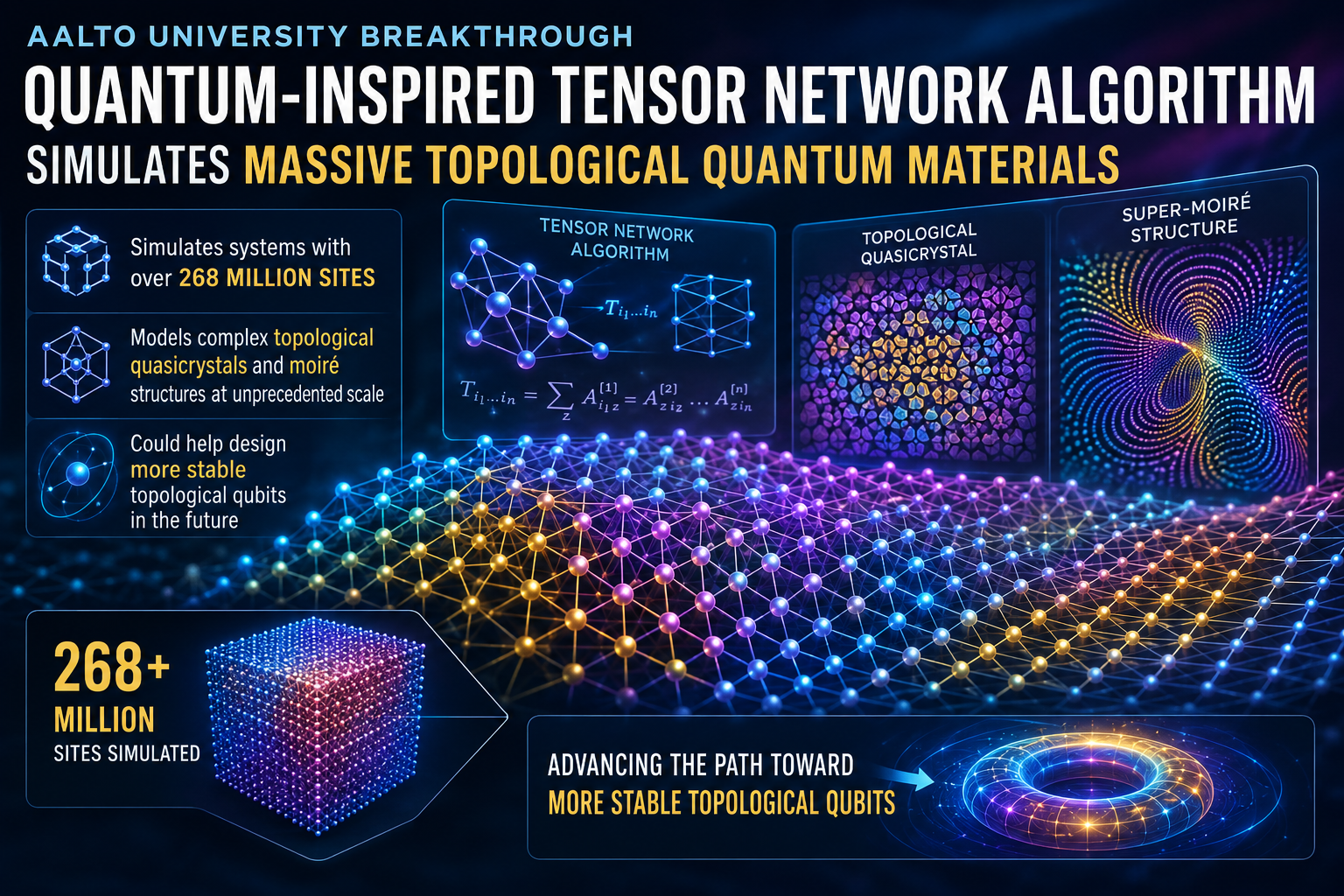
Researchers at Aalto University developed a quantum-inspired tensor network algorithm capable of simulating extraordinarily large topological quantum materials systems containing more than 268 million sites.
That number alone feels almost surreal when you pause beside it for a moment.
Two hundred and sixty-eight million interacting locations inside a simulated quantum material. Not as a theoretical sketch on a whiteboard, but as a structured computational model researchers can actually work with.
And yet the most important part is not really the scale itself.
It is what this scale may eventually help unlock: more stable topological qubits.
Which, quietly, could become one of the most important long-term pathways toward practical quantum computing.
For years, one of the central problems haunting quantum computing has been fragility. Quantum systems are astonishingly sensitive. Heat, vibration, electromagnetic interference, tiny fluctuations in the environment — almost anything can disturb a qubit’s state. The machines operate like instruments listening for whispers inside a hurricane.
That fragility is not just an engineering inconvenience. It is the reason error correction has become such a dominant force in the industry. Entire architectures are now being designed around the problem of maintaining coherence long enough to perform meaningful calculations.
Topological qubits have always stood apart in these conversations because, in theory, they may naturally resist certain types of noise.
That possibility has made them almost legendary inside quantum research circles.
The idea itself feels strangely elegant. Instead of constantly correcting fragile quantum information after errors occur, topological systems encode information in ways that are inherently more stable due to the structure of the material itself. The protection comes from geometry and topology from the shape and organization of the quantum state, rather than only from active correction systems layered on top of it.
There is something beautiful about that approach.
Almost architectural.
But designing and understanding these materials is enormously difficult.
Quantum materials do not behave cleanly. Their interactions scale into overwhelming complexity remarkably quickly. Electrons influence one another in nonlinear ways that become almost impossible for classical methods to fully capture at large scales. Even advanced supercomputers eventually begin to strain under the weight of these calculations.
This is where the Aalto University breakthrough becomes genuinely important.
Their tensor network algorithm allows researchers to model massive non-periodic topological systems — specifically topological quasicrystals and super-moiré structures at scales previously considered impractical.
And the phrase “quantum-inspired” matters here too.
The work itself currently runs on classical systems, not quantum hardware. But increasingly, some of the most fascinating progress in the quantum industry is happening in this hybrid space between classical and quantum methodologies. Researchers are building algorithms today that are inspired by quantum mechanics and may later transition directly onto quantum architectures as hardware matures.
The boundaries between these worlds are starting to blur.
You can feel it happening across the industry lately.
Quantum computing no longer feels like an isolated technology stack trying to replace classical computing outright. Instead, it increasingly resembles an ecosystem where AI, HPC systems, tensor methods, classical simulation, photonics, and quantum processors continuously overlap and reinforce one another.
The future appears less singular than people expected.
More layered.
More collaborative.
And honestly, more believable.
What makes the Aalto work especially compelling is the speed involved. Researchers reported that they could simulate these enormous systems almost instantly compared with older computational approaches. That matters because scientific discovery is often constrained not just by intelligence or theory but also by the speed of iteration.
If simulations take months, exploration slows dramatically.
If simulations become fast enough to test ideas rapidly, entire fields accelerate.
Material science begins moving differently.
And topological materials are becoming increasingly important not only for quantum computing, but also for condensed matter physics, next-generation electronics, and advanced sensing systems.
There is also a larger emotional shift happening underneath all of this.
For years, quantum headlines revolved around abstraction:
qubit counts,
roadmaps,
future promises,
speculative timelines.
But lately, the field feels more grounded in infrastructure and materials science. Researchers are focusing intensely on what quantum systems are physically made from, how they behave under realistic conditions, and what architectures might remain stable outside laboratory environments.
The conversation is becoming operational.
Less mythology. More engineering.
That maturity matters because eventually every emerging technology collides with physical reality. Ideas must become manufacturable. Stable. Repeatable. Economically viable. The romance phase ends, and infrastructure begins.
The quantum industry appears to be entering that transition now.
And topology may become one of the defining themes of the next era.
Topological systems are attractive precisely because they may reduce complexity elsewhere. If qubits themselves become inherently more stable, the burden on error-correction systems decreases. That could dramatically alter the economics and scalability of future quantum hardware.
Of course, there is still uncertainty. Quantum computing remains filled with competing architectures, unresolved challenges, and technological paths that may or may not succeed. Superconducting systems continue advancing. Photonics is accelerating. Neutral atoms are gaining momentum. Trapped ions remain powerful contenders.
No single pathway has “won.”
But topological approaches continue attracting fascination because they hint at something deeper: stability emerging naturally from the physics itself.
That possibility feels almost calming compared to the constant noise surrounding scaling races.
And maybe that is why this announcement stands out emotionally in a strange way.
It is not loud.
There is no flashy consumer product attached to it. No viral demonstration. No dramatic marketing narrative claiming the arrival of artificial superintelligence next quarter. Most people outside specialized research communities will never hear about tensor networks or topological quasicrystals at all.
But researchers notice these things.
Quietly.
Breakthroughs like this shape the foundation of future systems long before the public sees visible products emerge from them.
In many ways, this is how technological revolutions actually happen. Not through singular cinematic moments, but through thousands of layered advances in mathematics, materials science, algorithms, infrastructure, manufacturing, and theory slowly converging together.
A better simulation tool here.
A more stable material there.
An architecture that scales slightly more efficiently.
An algorithm that removes one bottleneck that researchers once assumed was unavoidable.
And eventually, the industry wakes up inside an entirely different landscape.
That is what makes this Aalto University breakthrough feel significant.
Not because it instantly solves quantum computing.
But it strengthens one of the pathways that might eventually make large-scale quantum systems stable enough to matter in the real world.
The quantum industry is increasingly discovering that progress is not only about building larger machines.
Sometimes it is about understanding the materials deeply enough that the machines stop fighting physics quite so hard.