There’s a particular kind of confidence that doesn’t announce itself loudly.
It doesn’t flood timelines with oversized promises or rely on theatrical demos to sustain momentum. Instead, it compounds slowly — through engineering discipline, institutional patience, and the willingness to solve difficult problems long before the market fully understands why they matter.
That’s what makes the recent rise of Photonic so significant.
At first glance, the headlines focused on valuation. A roughly $2 billion USD mark places the Vancouver-based company firmly among the most important players in the emerging quantum economy. But the real story is not about the number itself. It’s about what the number represents.
This is not another speculative technology narrative inflated by hype cycles. It is a signal that the market is beginning to recognize a deeper shift already underway: quantum computing is entering its engineering era.
And notably, Canada is becoming one of the places where that future is being built with unusual clarity and restraint.
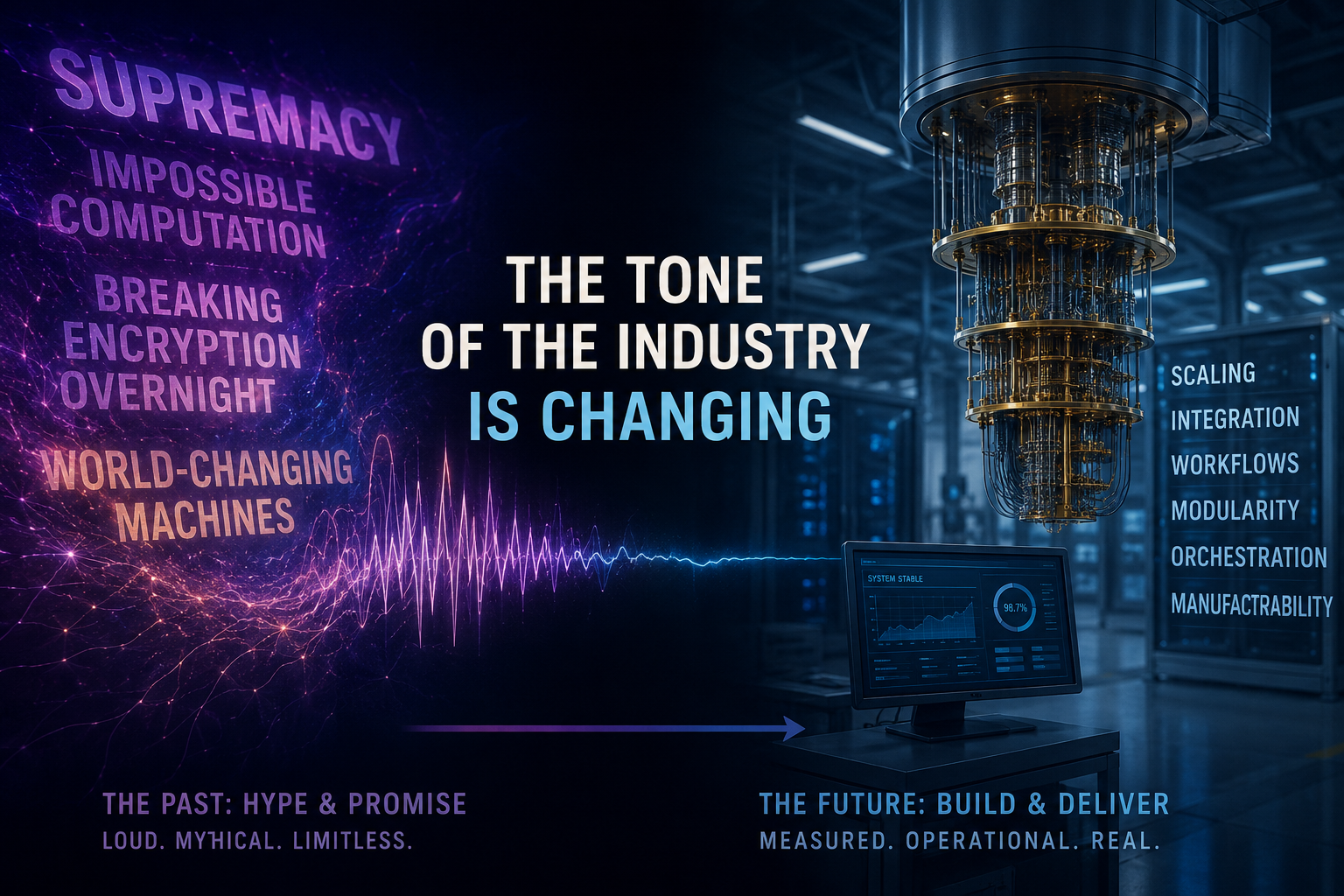
Beyond Quantum Supremacy
For years, much of the public conversation around quantum computing revolved around “quantum supremacy” — the moment a quantum machine could perform a highly specific calculation faster than a classical supercomputer.
It made for compelling headlines, but commercially, those demonstrations were often disconnected from real-world utility.
The next chapter is different.
The industry is now confronting the far more difficult challenge: how do you scale quantum systems into reliable, fault-tolerant infrastructure capable of solving industrial problems in chemistry, logistics, materials science, medicine, and energy?
This is where Photonic’s architecture becomes strategically important.
While many first-wave quantum companies pursued superconducting systems or trapped-ion approaches, Photonic has placed a long-term bet on silicon spin qubits connected through photonic interconnects — essentially using light itself as the networking layer between quantum modules.
That distinction matters more than most people realize.
One of the greatest bottlenecks in quantum computing is not proving that qubits can work. It is figuring out how millions of them can work together without collapsing under heat, interference, and instability.
Photonic’s modular approach addresses this challenge differently. Instead of attempting to force every qubit onto a single monolithic chip, their architecture allows separate quantum systems to communicate across fiber-optic connections. In practical terms, it points toward a distributed quantum network — what many researchers increasingly describe as the foundation for a future quantum internet.
That is a profound shift in design philosophy.
It moves quantum computing away from isolated laboratory machines and toward scalable infrastructure.
And perhaps even more importantly, it aligns quantum development with something the world already understands extremely well: silicon manufacturing.
The Strategic Power of Silicon
There is an understated elegance in choosing silicon.
Rather than inventing entirely new industrial ecosystems from scratch, Photonic is leveraging decades of global semiconductor infrastructure and adapting it for quantum systems.
In other words, they are not trying to replace the existing computing stack.
They are trying to evolve it.
This may ultimately prove to be one of the smartest strategic decisions in the entire quantum sector.
The history of technology repeatedly shows that winning platforms are rarely the ones with the most exotic science. They are the ones capable of integrating into scalable manufacturing systems, supply chains, developer environments, and global infrastructure.
The companies that endure are usually the ones that make the future interoperable.
That’s why Photonic’s emphasis on interconnects is especially compelling. They are not simply building a quantum computer. They are positioning themselves as part of the connective tissue that could allow future quantum systems to communicate across networks, clouds, and distributed environments.
It is a platform strategy masquerading as a hardware company.
And platform strategies tend to shape eras.
Canada’s Long Game Is Finally Paying Off
There is another dimension to this story that deserves more attention.
For decades, Canada produced exceptional quantum research while struggling to commercialize it at scale. The country invested early in institutions like the Perimeter Institute for Theoretical Physics and the Institute for Quantum Computing, building one of the world’s strongest academic foundations in the field.
But historically, much of that intellectual capital flowed outward.
Talent migrated.
Ideas were acquired.
Breakthroughs became someone else’s commercial advantage.
That pattern now appears to be changing.
The emergence of companies like D-Wave, Xanadu, and Photonic suggests Canada is evolving from a research ecosystem into a full-stack commercialization environment capable of sustaining globally competitive quantum enterprises.
This transformation did not happen overnight.
It is the result of decades of institutional consistency — something increasingly rare in modern technology economies.
Programs like the Canadian Alliance Quantum grants matter precisely because they address the most fragile phase of deep-tech development: the transition between academic insight and deployable infrastructure.
That bridge is where many breakthrough technologies quietly die.
Canada appears to be learning how to keep them alive.
The Return of Hard Engineering
There is also a cultural lesson embedded in this moment.
For much of the last decade, the technology sector rewarded velocity, narrative construction, and spectacle. Companies became extraordinarily skilled at monetizing anticipation itself.
Quantum computing has resisted that pattern.
Physics is indifferent to branding.
You cannot growth-hack cryogenic stability.
You cannot market your way around decoherence.
You cannot shortcut error correction.
Eventually, reality asserts itself.
What makes Photonic’s trajectory interesting is the degree to which it reflects a return to hard engineering culture — quiet persistence, long timelines, and value creation rooted in technical accomplishment rather than visibility.
There is something deeply Canadian about that posture.
Less spectacle.
More endurance.
And in a market increasingly exhausted by performative innovation, that restraint is beginning to look less like modesty and more like strategic discipline.
Quantum Infrastructure Is Becoming Geopolitical Infrastructure
None of this exists in isolation from geopolitics.
Quantum computing is no longer viewed purely as a scientific frontier. It is rapidly becoming a national capability with implications for encryption, cybersecurity, defense, advanced materials, pharmaceutical discovery, and economic competitiveness.
Who controls the infrastructure matters.
Where the standards are developed matters.
Which political systems shape the quantum stack matters.
This is one reason Canada’s emergence as a serious quantum hub carries strategic weight beyond its market capitalization. A strong Canadian presence creates diversification within the global quantum ecosystem — particularly as governments become increasingly wary of concentrated technological dependence.
It also reinforces a broader truth about the next generation of infrastructure technologies: trust will become just as important as capability.
And trusted ecosystems are not built overnight.
The Quiet Compounding of a New Era
What we are witnessing now is not a sudden breakthrough.
It is the visible surface of decades of accumulated work finally reaching critical mass.
That may be the most important lesson in all of this.
The future is often imagined as something explosive — a singular breakthrough moment that changes everything instantly. But most transformational technologies emerge differently. They evolve through quiet compounding: research institutions, engineering cultures, patient capital, talent pipelines, and infrastructure layers reinforcing one another over long periods of time.
That is what Canada’s quantum sector increasingly represents.
Not a flash of momentum.
A system reaching maturity.
And if Photonic’s rise tells us anything, it is that the next era of computing may not belong exclusively to the loudest players in the room.
It may belong to the ones willing to endure the silence long enough to build something real.