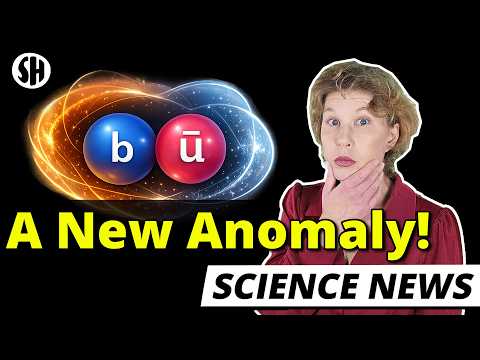
In an intriguing turn of events, physicists at CERN have re-encountered an anomaly in the decay patterns of B mesons, which might have significant implications for the field of particle physics. This anomaly has played a tantalizing game of hide and seek over the years, sparking discussions about its true nature. Could it point to undiscovered particles, necessitate a revision of the standard model, or, ultimately, mean nothing at all? Let’s dig deeper into what this could mean for the future of particle physics.
The genesis of this conversation arises from a recent study by the LHCB collaboration at CERN. Their focus was on B mesons, particles that are ephemeral in nature, mainly composed of two quarks, which break down in the blink of an eye – quite literally a picosecond. The decay of these B mesons, specifically through rare channels, offers a fascinating glimpse into the particle world. When a B meson decays, the contained bottom quark can transform into a strange quark, emitting two leptons, usually muons, in the process. This particular decay process draws attention because it involves virtual particles, which aren’t directly observed but influence outcomes significantly.
Based on content from Sabine Hossenfelder
Here’s the kicker: if there are unrecognized particles contributing as virtual results, discrepancies from the standard model’s predictions might surface. And that’s precisely what the physicists are examining. They scrutinize how frequently these decays occur, the spatial distribution of decay products, and any variations in behavior between leptons like electrons and muons. Past data showed slight deviations from the expected standard model behavior, hovering around the two to four sigma level. A while back, these anomalies seemed to have vanished but now appear to be resurfacing. In particular, the angular distributions exhibit a disagreement marked by a statistical significance of four sigma – not enough to claim a discovery, but certainly an anomaly worth the buzz.
What are the potential interpretations of these findings? On one hand, some theorists speculate about the existence of new particles like leptoquarks or Z’ bosons, not predicted by the standard model but possibly influencing these decays. Discovery of such particles would suggest the presence of even more undiscovered entities. Alternatively, the anomaly might merely betray an error in the standard model’s calculations, not the existence of new physics.
Nevertheless, there’s also a chance this anomaly is merely a statistical fluke. The field of particle physics isn’t new to such quirks, especially when the fervent pursuit of anomalies in data often amplifies their presence. Yet, persistence of peculiar findings in the same decay sector hints at potential truths not yet surfaced – the hallmark of groundbreaking discoveries awaiting validation.
This exploration into particle physics holds significant value, meriting an open mind. Although Sabine Hossenfelder, the source of this insight, gives this paper a modest five out of ten on the ‘anomaly meter,’ it underscores a pivotal aspect of scientific inquiry. Seek, and anomalies may reveal themselves. But proceed with caution: like four-star reviews, they might not hold definitive truth without examining the underlying details.
As the intrigue around this anomaly continues to unfold, we find ourselves reminded of the dynamic nature of scientific exploration: questioning the status quo, investigating the unexplained, and revisiting findings until clarity is achieved or new pathways are forged.
Thanks for diving into the fascinating nuances of particle decay with me today. Stay curious for more insights from the ever-evolving world of physics.