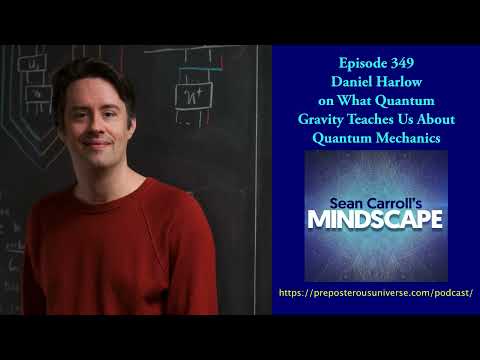
“There’s something special about gravity.” So begins our exploration into the interconnected worlds of quantum mechanics and general relativity—two domains of physics that, despite their daunting intricacies, offer fertile ground for theories that push the boundaries of our understanding of the universe. In a conversation with Sean Carroll, theoretical physicist Daniel Harlow delves into these complex ideas on the latest episode of the Mindscape Podcast.
Based on content from Sean Carroll
Harlow, who holds a Ph.D. from Stanford and is an associate professor at MIT, has made significant strides in understanding the information dynamics of black holes—a cornerstone in the study of quantum gravity. Gravitation, unlike the other fundamental forces in particle physics, reveals a universal influence; it treats all forms of matter with equal imperturbability, a truth as profound now as it was in Newton’s era. Yet it is precisely this universal quality that makes gravity a curious anomaly. It refuses to yield easily to the frameworks that have allowed us to construct the grand edifice that is quantum mechanics.
Throughout the discussion, Harlow and Carroll ponder a curious inversion of expectations set by earlier luminaries such as Einstein. Carroll muses how even though we have developed robust theories about quantum mechanics and gravity separately, integrating them into a coherent whole has proven elusive—decades of scientific inquiry yielding to a complex dance of theory and speculation without definite resolution.
Harlow’s work hints at innovative directions, situating quantum gravity as a fertile ground that might redefine our understanding of quantum mechanics itself. This line of thought is particularly tantalizing when we consider black holes, which act as natural laboratories where these theories could possibly meet and reconcile. Harlow notes, “Black holes are very interesting objects to think about in the context of gravity,” suggesting that their very existence demands a rethinking of why all objects feel gravity in the same way.
However, when the conversation turns towards cosmology, the picture becomes decidedly less clear. The universe, described by Harlow as a “system you’re part of,” precludes the notion of an external, omnipotent observer—a crucial catalyst for many quantum predictions. Here, unlike with black holes, there isn’t the same promise of a convening theory. The task, then, becomes how science, inherently reliant on what can be observed and measured, can grapple with these foundational questions without an observer lying outside the system.
Harlow posits a provocative stance: perhaps quantum mechanics itself needs revisiting. He shares how his research increasingly challenges conventional perspectives, finding resonance—not in quantum mechanics as an absolute— but as something emergent in the right conditions. This notion wrestles directly with historical interpretations, like those of Bohr and Heisenberg, who famously entertained the decisive role of the observer in shaping not just measurements but reality itself.
The conversation navigates this labyrinthine reality by acknowledging both the entrenched limitations and expansive possibilities within our quest for understanding. While some strategies fixate on established theories like string theory or the AdS/CFT correspondence, alternate explorations into the evolving dynamics of information theory, holography, and the cosmological constant offer equally fertile ground. A unified theory remains elusive, still almost a conceptual specter on the fringes of theoretical physics, compelling yet ungraspable.
As the podcast winds to its close, Harlow and Carroll allow themselves a reprieve from explanatory formalities, touching upon their divergent yet complementary perspectives in a spirited exchange. The broader picture remains one of multitudes—myriad approaches, constant querying, each contributing a stitch to the intricate tapestry of understanding. The conversation leaves us with an ever-pertinent inquiry lingering in the air: Could the resolution of these profound paradoxes require us to not just observe the universe differently but to reimagine the foundations of observation itself?
For more on these engaging discussions and to listen to the full episode, visit the Mindscape Podcast page.
—