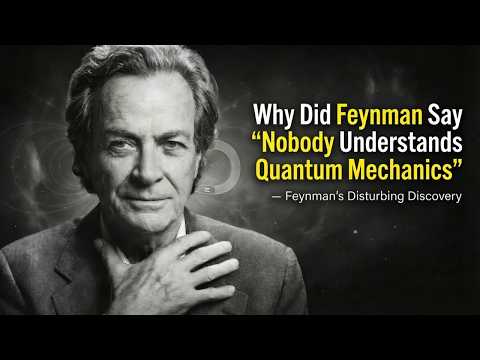
You’ve heard the quote a thousand times: “Nobody understands quantum mechanics.” But have you ever stopped to ask what Feynman actually meant? Because he wasn’t talking about the math being hard. And he wasn’t being modest. He was pointing at something much stranger — a gap at the heart of physics that hasn’t been closed in nearly a century.
In this video, we investigate the real meaning behind Feynman’s most famous line, tracing it back to his 1964 Messenger Lectures at Cornell (published as The Character of Physical Law). Through the double-slit experiment, the measurement problem, and the still-unresolved debate between quantum interpretations, we uncover what “understanding” really means — and why quantum mechanics refuses to give it to us.📚 SOURCES:
Richard Feynman, The Character of Physical Law, Chapter 6: “Probability and Uncertainty — The Quantum Mechanical View of Nature” (MIT Press, 1965)
Richard Feynman, QED: The Strange Theory of Light and Matter (Princeton University Press, 1985)
Richard Feynman, Robert Leighton, Matthew Sands, The Feynman Lectures on Physics, Vol. 3 (Addison-Wesley, 1965)
John Bell, Speakable and Unspeakable in Quantum Mechanics (Cambridge University Press, 1987)
David Mermin, “Is the Moon There When Nobody Looks?”, Physics Today, April 1985🎬 CREDITS: Script: AI-generated, inspired by Feynman’s public lectures and published works Voice: AI-synthesized narration Visuals: AI-generated imagery
⏱️ TIMESTAMPS: 00:00 – The quote that launched a thousand misunderstandings 01:45 – Suspect #1: Is the math just too hard? 05:10 – Suspect #2: Do we not have enough data? 08:30 – The word everyone overlooks 10:15 – The double-slit experiment, step by painful step 15:00 – Why every analogy for quantum behavior fails 18:20 – The measurement problem nobody has solved 21:00 – Einstein vs. Bohr: same math, opposite conclusions 24:10 – What “shut up and calculate” really costs us 26:45 – Is the demand for understanding just a human prejudice?
What does “understanding” mean to you in physics — should a theory explain what’s happening, or is getting the right answer enough? Let us know your take.⚠️ WARNING: [This video is AI-generated (synthetic voice and visuals). It is an original, fictional lecture inspired by Richard Feynman’s teaching style and public ideas, and is not an authentic recording, endorsement, or statement by Richard Feynman or his estate. Any resemblance is for educational/creative purposes]
Based on content from Feynman Reborn
You’ve likely come across the famous Richard Feynman quote more times than you can count: “Nobody understands quantum mechanics.” It’s one of those sentences that lingers, insinuating itself into discussions about the mysteries of science. Yet, the true depth of what Feynman meant hinges not on modesty nor complexity but on a much stranger, more unresolved frontier of physics that has eluded explanation for almost a century.
Feynman’s words, originating from his 1964 Messenger Lectures at Cornell, urge us to reconsider our definitions of “understanding” within the realm of quantum mechanics—a discipline where conventional knowledge feels inadequate. The beauty and perplexity of physics begin to unfold here, like the opening curtain on a stage where answers are riddles in disguise.
The Limits of Mathematical Mastery
Consider the first suspect in this intellectual mystery. You might think, “The math must be too arcane, too abstract.” Pages filled with equations resembling a language invented by aliens could easily lead one to this conclusion. Yet, mathematics in quantum mechanics is precise and reliable—it molds predictions with astonishing accuracy. The undeniable success of these mathematical models in practical applications, such as semiconductors and laser technologies, affirms their robustness. If it were merely the math that we didn’t understand, such technological feats wouldn’t stand as they do, built atop quantum foundations.
The Ocean of Evidence
Now, turn to the second suspect: perhaps it’s simply a lack of data, an incomplete map of the quantum terrain. Here too, reality defies this notion. Quantum mechanics has withstood the scrutiny of relentless experimentation. Tests of Bell’s inequalities in the 1980s served as profound investigations into the heart of quantum uncertainty. Experiments continue to insistently affirm quantum predictions, forcing hidden variable theories to retreat into the corners of speculation.
The Nature of “Understanding”
The core of Feynman’s intrigue is not apprehending quantum mechanics’ complexities or scarcity of data. It is the elusive mental picture—a movie we seek to run in our minds—that quantum mechanics stubbornly refuses to project. Feynman invites us into a world where electrons flirt with both the realms of particles and waves, challenging the visceral intuitions honed through macroscopic daily life.
The Double-Slit Revelation
To truly dissect Feynman’s statement, we must journey through the iconic double-slit experiment. Here, reality offers an unforgiving test that bends our understanding of nature. When electrons, indisputably particles, create wave-like interference patterns—a tapestry of probabilities unweaving familiar threads of logic—our classical views unravel. The very act of observing these particles alters their behavior, a heartbreaking reality that redefines the term “observer” in science, weaving observation into the fabric of reality itself.
Retreating into Acceptance
And finally, consider Wheeler’s delayed choice experiment, where past choices seem retroactively altered by future observations. It’s a whisper of the surreal, echoing through layers of scientific inquiry. Here, we realize perhaps “understanding” quantum mechanics might mean accepting frameworks that defy established certainty, embracing probabilities over determinism.
A Question for the Future
Feynman’s proclamation that “nobody understands quantum mechanics” is less a confession than a call to boldly accept that our understanding of quantum phenomena demands a departure from the traditional meaning of the word “understand.” It invites us to dwell in an intellectual space where clarity is forged in tension with ambiguity. As we move forward, we are challenged to ask: Should a theory explain what happens, or is it sufficient that it works? This question remains at the heart of physics, the echo of Feynman’s wisdom inviting us to critique, expand, and ultimately redefine what it means to understand.
What does ‘understanding’ truly mean to you in the context of physics? Should a theory explain every nuance, or is the accuracy of its predictions the defining criterion? Share your perspective and join a conversation that stretches into the heart of scientific inquiry.
—