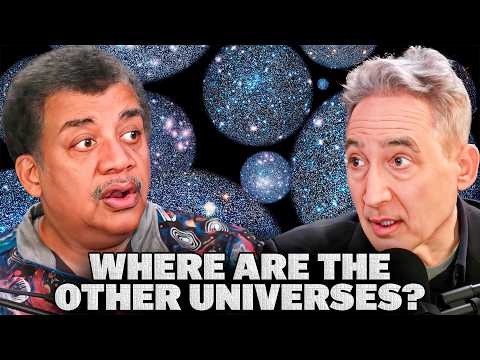
On the latest episode of StarTalk, Neil deGrasse Tyson and co-host Chuck Nice embarked on an enlightening exploration with Brian Greene, the esteemed theoretical physicist. Together, they navigated the intricate concepts that challenge our understanding of the universe, such as the many-worlds interpretation and the enigmatic structure of the multiverse. These ideas, though appearing to border on the fantastical, are firmly rooted in the sobering, precise language of mathematics. But as we shall see, mathematics can both illuminate and obscure the path to understanding.
Based on content from StarTalk
The Multiverse and Many Worlds: More Than Mere Speculation
The distinction between the multiverse and the Many-Worlds Interpretation, a pivotal theme of the discussion, is not a mere splitting of semantic hairs. As Greene explains, while both concepts extend beyond the tangible realm of our daily perceptions, they arise from different theoretical origins. The multiverse is an overarching hypothesis proposing the existence of multiple universes beyond our observable horizon, whereas the Many-Worlds Interpretation emerges from a foundational, albeit radical, reading of quantum mechanics. Proposed by Hugh Everett in 1957, this interpretation suggests that every quantum event spawns a branching of reality into multiple outcomes, each as real as the one we perceive.
At first glance, the Many-Worlds Interpretation appears to explode the neat confines of reality as we know it, but Greene clarifies that it is a conservative extension of quantum mathematics. In essence, it refuses to force an artificial collapse of the quantum wave function merely to match classical sensibilities. This raises the intriguing question: is the mathematical framework of quantum mechanics a faithful representation of reality, or is it merely a tool we’ve fashioned to snatch glimpses of an enigmatic cosmos?
Mathematics: A Lens on Reality or Just a Useful Fiction?
This question segues into a broader debate about the role of mathematics in deciphering the universe. Greene, who admits to having once seen math as the ultimate arbiter of truth, now concedes that it might be more a language of convenience than the fabric of reality itself. This nuanced view doesn’t diminish the power of mathematics — rather, it suggests humility in the face of what we do not know. After all, as Tyson points out, why should constructs of human invention, like mathematics, dictate the underlying truths of existence?
The Lures and Limits of String Theory
The conversation then meanders through the landscape of string theory, a theoretical framework that posits that particles are not pointlike dots but rather tiny, vibrating strings. This concept, compelling in its symmetry and elegance, dares to unify the known forces of the universe. Yet, four decades after its inception, string theory remains in a liminal state between theoretical promise and empirical validation.
Greene reflects on this with a mix of admiration for its conceptual beauty and acknowledgment of its still-unrealized predictions. The tantalizing possibility of AI enhancing our cognitive reach arises, suggesting that computational advances could unlock the secrets of string theory where human imagination hits a wall.
The Vast Complexity of Cosmic Queries
The episode rounds out with “Cosmic Queries,” a segment where listeners pose questions that unravel the awe-inspiring yet confounding nature of the universe. Topics range from the rotational dynamics of the universe and its role in cosmic expansion to the question of whether quantum information can survive black holes, explored through theoretical constructs such as Hawking radiation. Each question opens a doorway to a host of possibilities, reminding us that while our understanding grows, so too does the boundary of the unknown.
Embracing the Uncertainty
As we traverse these intellectual landscapes, it becomes apparent that embracing uncertainty is not an admission of defeat but an acknowledgment of the vastness of the universe. In grappling with these concepts, we are reminded, in the words of Neil deGrasse Tyson, to “keep looking up.” In questioning, we find not only knowledge but also the profound beauty of wondering about what lies just beyond the veil of our current understanding.
The session with Brian Greene left us with thoughts both chaotic and clear, tangled yet thrilling. As we take a step back and view the patchwork of theories and possibilities laid before us, we are left pondering: if the universe is a tapestry of so many hidden dimensions and shadow realities, how might we continue to unlock the mysteries stitched into its fabric?