There’s a moment early in the video where the speaker slows down, not dramatically, just enough to signal a shift. It moves away from the usual way quantum computing is presented and toward something more grounded. Instead of leading with big claims about the future, the video focuses on what is actually happening now inside quantum systems and what still needs to be solved before those systems become useful.
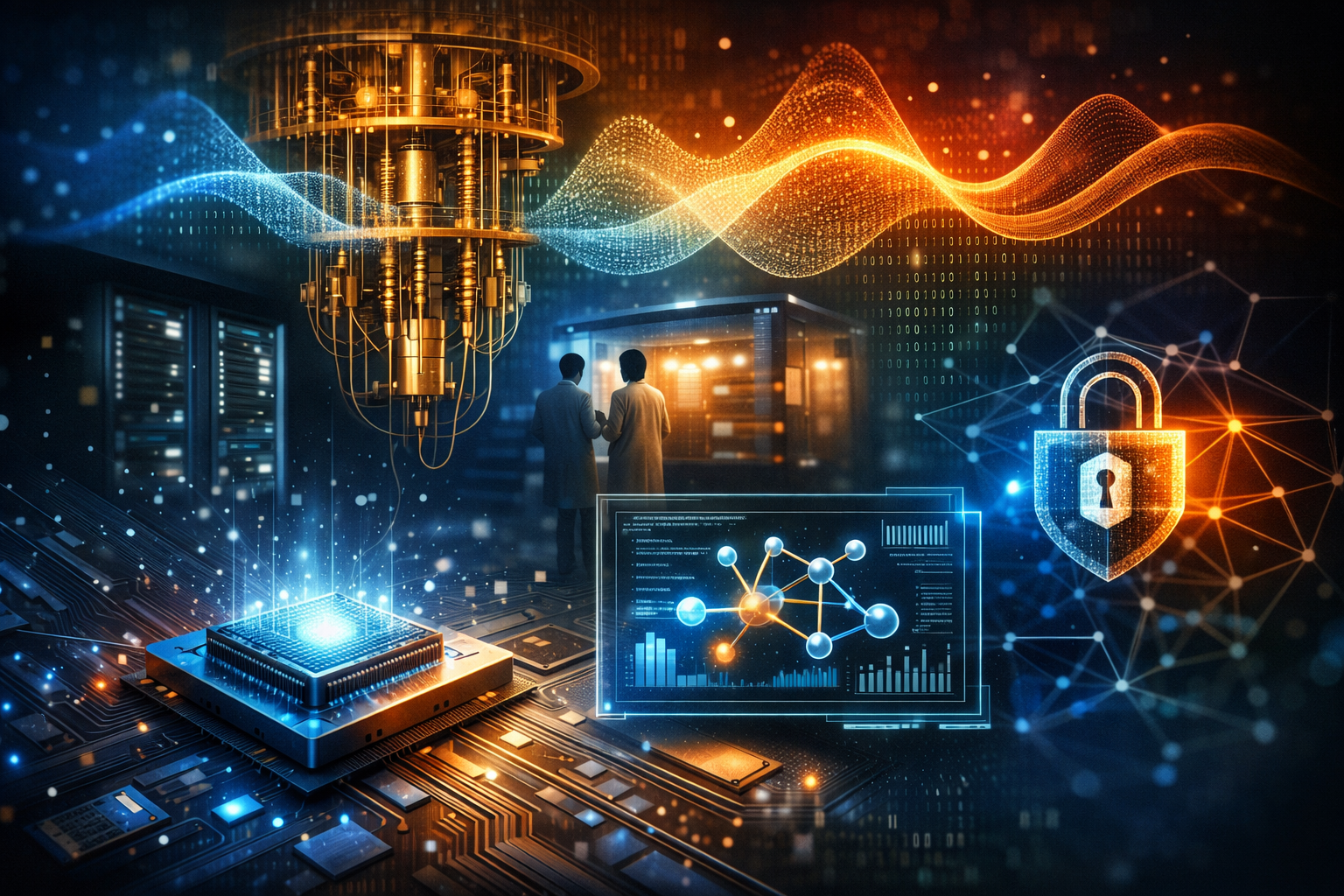
At its core, the video shows that the real challenge in quantum computing is no longer just building more qubits. It’s making those qubits usable, stable, and reliable. The conversation centers on the layers that sit between raw hardware and real-world application control systems, error mitigation, and software orchestration. These are the parts that don’t always get attention, but they are where progress is quietly accelerating.
A significant portion of the discussion focuses on noise. Quantum systems are inherently fragile, and information inside them can easily degrade. The video makes it clear that noise isn’t a temporary obstacle—it’s a fundamental condition of the technology. The work now is not about eliminating noise entirely but about managing it. Companies working in quantum control and error correction are becoming essential as they find ways to stabilize systems enough to produce consistent, repeatable results.
The video also shifts the conversation from theoretical potential to practical utility. Instead of asking whether quantum computing will work someday, it asks what it can do today—and under what conditions. This includes identifying specific use cases where quantum systems can outperform classical systems, even if only in narrow scenarios. The emphasis is on incremental, verifiable progress rather than distant breakthroughs.
Another key theme is integration. The video highlights that quantum computers are not standalone systems. They need to work alongside classical infrastructure, which means building hybrid environments where both types of computing can interact effectively. This integration layer is becoming one of the most important areas of development because it determines how quantum capabilities can actually be deployed in real-world workflows.
Security also emerges as an immediate concern. The discussion touches on post-quantum cryptography, emphasizing that the impact of quantum computing on encryption is not a future problem—it is already influencing decisions today. Organizations are beginning to prepare for a transition to quantum-resistant algorithms, even before large-scale quantum computers are fully realized.
Throughout the video, there is a clear emphasis on reliability. It’s not enough for a quantum system to work once under ideal conditions. It needs to produce consistent results over time. This focus on repeatability reflects a broader shift in the industry—from experimental validation to operational performance. Trust in quantum systems will be built through stability, not just capability.
What becomes evident is that the center of gravity in quantum computing is moving. The focus is shifting away from hardware alone and toward the full stack—hardware, control, software, and integration working together. The companies making progress are not just building better machines; they are building systems that can be understood, used, and eventually scaled.
By the end of the video, the message is clear: quantum computing is no longer just a research effort waiting for a breakthrough. It is an engineering challenge being worked on in layers. Progress is happening, but it is happening through refinement—through solving small, complex problems that make the larger system more stable and more usable.
For anyone trying to understand where quantum computing stands today, the video offers a more realistic view. It shows that the path forward is not defined by a single moment of success, but by continuous improvement across multiple layers of the technology stack.