The most important signal in the current specialty mix data is not that hardware remains dominant. That part is expected. Quantum is still a deep-technology industry built on difficult physics, specialized engineering, and long hardware roadmaps. The more important signal is that software is now present in 55% of the top 100 startups in the dataset, while hardware appears in 65%. That 10-point gap is narrow enough to force a reframing of the market. Software is no longer a secondary layer attached to a small number of tool companies. It is structurally central to how the ecosystem is being built, positioned, and commercialized.
At first glance, the data can still be read through a traditional hardware lens. In the overall specialty presence analysis, hardware appears in 65 startups, software in 55, cryptography in 18, materials in 10, and sensing in 9. That gives hardware the top slot, and for some readers, that might seem to confirm the old narrative that quantum remains primarily a hardware race with a thin software layer wrapped around it. But that is too shallow a reading. If software appears in more than half of the top 100 startups, the implication is not simply that there are many software companies. The implication is that software capability is embedded across the market, including inside companies that still present themselves as hardware-led businesses.
The primary specialty data sharpens this interpretation. When each startup is reduced to its first-listed specialty, hardware accounts for 54% and software 24%. That gap is much wider, and it tells us something important about market identity. Many companies still introduce themselves first through their hardware modality, platform design, or device architecture. In public positioning, hardware remains the front door. But when the broader multi-tag view is considered, software rises dramatically to 55%. That means a large share of companies whose identity begins with hardware still rely on software as a core part of their actual product stack.
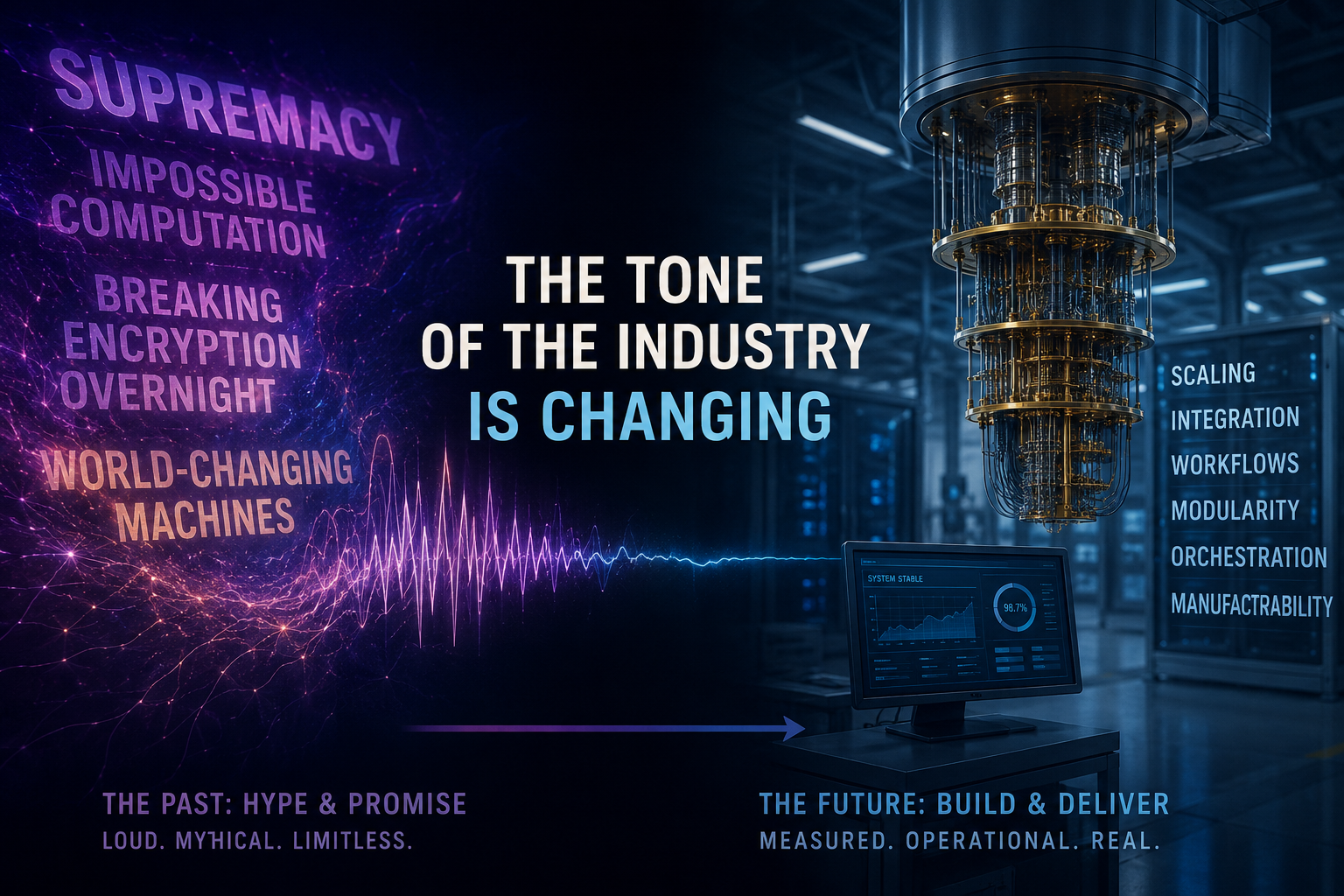
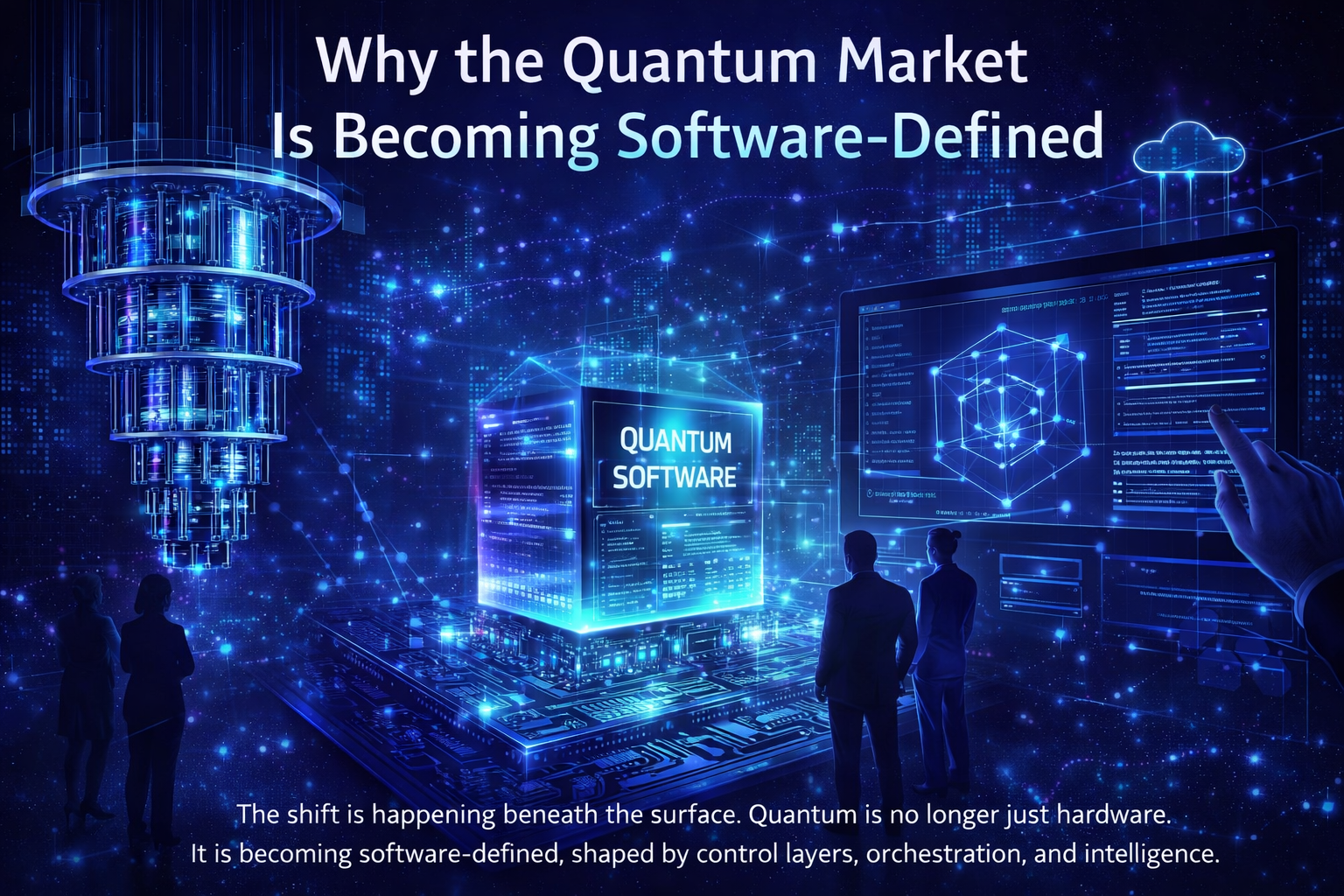
This is exactly why the phrase “software-defined quantum” matters. The shift is not from hardware to software in the simplistic sense. The shift is from pure hardware narratives to integrated systems narratives. In the earlier phase of the market, startups could be evaluated largely on qubit type, coherence metrics, fabrication approach, or the promise of a physical architecture. That logic has not disappeared, but it is no longer sufficient. As the sector matures, value moves to the layers that make hardware usable: compilers, orchestration, control systems, error handling, workflow integration, cloud access, and performance optimization. Once those layers become essential, software becomes part of the product’s core identity.
The regional data reinforces this interpretation. Software is not concentrated in one corner of the market or confined to a few outlier ecosystems. In North America, software appears in 59.5% of startups, compared with hardware in 67.6%. In Europe, software accounts for 51.2%, while hardware reaches 73.2%, again showing that even in a region with strong hardware depth, software remains deeply embedded. The more striking numbers appear in Asia-Pacific and the Middle East, where software exceeds hardware in the mix of specialties. Asia-Pacific shows software at 77.8% versus hardware at 44.4%, and the Middle East shows software at 66.7% versus hardware at 50.0%. Even allowing for smaller sample sizes, the directional message is clear: software is a structural feature of the ecosystem across geographies.
This matters for how insiders should think about competition. A hardware-first reading of the market tends to emphasize modality rivalries: photonic versus superconducting, trapped-ion versus neutral-atom, silicon versus alternative architectures. Those debates remain relevant, but the specialty mix suggests they are no longer enough to describe the competitive landscape. If more than half of the leading startups make software a defining specialty, then competition is increasingly taking place across multiple layers at once. Two companies can operate in the same physical modality and still have very different commercial prospects because one has a stronger compiler stack, better orchestration layer, more usable workflow software, or a clearer enterprise abstraction model.
That shift also helps explain why certain startups and subsegments generate disproportionate attention. The market has become more interested in companies working on control infrastructure, architecture co-design, error mitigation, enterprise software design, and full-stack orchestration because those layers translate technical complexity into usable outcomes. They reduce friction between experimental hardware and real customer workflows. They also create defensibility that is harder to summarize with a single benchmark number but easier to see in adoption, integration, and roadmap credibility.
There is also a commercial reason this pattern matters. Enterprise buyers do not purchase quantum platforms as scientific abstractions. They purchase access, usability, reliability, workflow fit, and a believable path to value. Hardware is necessary, but software is what makes that hardware legible to non-specialist buyers. A Fortune 500 technology leader is rarely buying into a modality story alone. They are buying into an environment: how jobs are written, how workloads are optimized, how errors are managed, how classical and quantum resources interact, how a team integrates the stack into existing infrastructure, and how the vendor reduces implementation risk over time.
This is why the persistence of software-heavy and full-stack models should be read as a signal of market maturity rather than a mere statistic. In an immature frontier market, one would expect hardware to dominate almost entirely, with software appearing only in a small fringe of services or tooling. That is not what the data shows. Instead, the market reveals widespread hybridization. Hardware is still the most common specialty, but software is present often enough to indicate that the ecosystem is reorganizing around integration. The winning companies are no longer just those that can build something remarkable in the lab. They are the ones who can turn technical performance into a usable system.
The broader implication is that industry narratives need to catch up to the data. It is no longer accurate to talk about quantum as though it were mainly a hardware sector with some attached software tools. Quantum is becoming a layered market in which hardware remains foundational, but software increasingly determines usability, defensibility, and enterprise relevance. A startup can still lead with hardware in its branding and fundraising story, but if it lacks meaningful software depth, the business risks becoming a black box whose commercial promise depends too heavily on future hardware improvements alone.
Seen in that light, the 65% versus 55% split is not a small statistical detail. It is one of the clearest indicators in the dataset that the ecosystem is moving beyond pure hardware narratives. The signal is not that hardware matters less. The signal is that software now matters too much to remain in the background. The future leaders of the quantum market are likely to be the companies that combine physical differentiation with software-defined control, software-defined usability, and software-defined paths to enterprise value. That is what the specialty mix is really showing. The market is still quantum, but it is increasingly becoming software-defined quantum.