If you only map the quantum industry by country, the picture looks clean. The United States leads in the number of startups. The United Kingdom looks dense. Canada, France, Australia, Israel, Germany, and Singapore all register as meaningful nodes. That kind of view is useful for macro policy, national funding strategies, and top-line market sizing.
But it is not the best way to understand how innovation actually happens.
After reviewing the regional and hub analyses in the Quantum Startup Landscape dataset, the clear pattern is that innovation is driven by city-scale clusters, not just national footprints. Countries tell you where companies are legally domiciled. Cities tell you where talent is concentrated, where founders cross paths, where suppliers and research institutions sit nearby, and where commercial momentum compounds.
That distinction matters because quantum is not a normal software market. It depends on dense combinations of physics talent, specialized engineering, access to fabrication, cryogenics, control systems, national labs, university pipelines, cloud channels, and patient capital. Those ingredients do not spread evenly across a country. They collect in a few metro corridors.
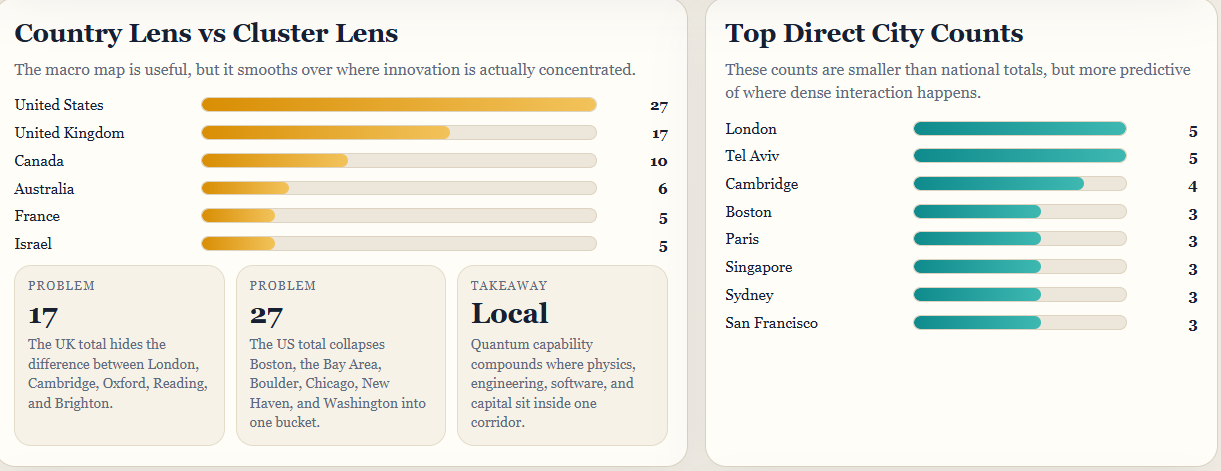
The repo’s country-level view supports the usual headline. The dataset counts 27 startups in the United States, 17 in the United Kingdom, 10 in Canada, 6 in Australia, and 5 each in France and Israel. That is informative at a glance. But it quickly becomes analytically blunt. “United Kingdom: 17” does not tell you whether the real engine is London, Cambridge, Oxford, or a corridor that links all three. “United States: 27” says even less, because Boston, the Bay Area, Boulder, Chicago, New Haven, and Washington each play very different roles in the market.
The city-level data is far more revealing. London and Tel Aviv each show five startups in the direct city count. Cambridge records four. Boston, Bristol, Paris, Singapore, San Francisco, Sydney, and Kansas each record three. Those are not just administrative labels. They are indications of local density. Once density appears, knowledge spillovers, hiring mobility, founder recycling, pilot activity, and infrastructure sharing start to matter more than national averages.
The UK is the clearest example of why country views can flatten the story. At the country level, the United Kingdom appears as a single 17-company block. At the hub level, the picture becomes much more interesting. The London hub report covers 13 startups within its coverage area, including Cambridge Quantum Computing, ORCA Computing, Oxford Quantum Circuits, PhaseCraft, Pqshield, Quantinuum, Riverlane, and Universal Quantum. The Cambridge hub still lists 10 startups in its orbit, spanning hardware, software, and cryptography. That tells us the UK is not just a national market with many companies. It is a tightly linked corridor in which London, Cambridge, Oxford, Reading, and Brighton function as a single innovation system.
That is a much stronger signal than a country total. It suggests labor and knowledge mobility. It suggests that investors can access multiple layers of the stack within a single travel radius. It suggests that researchers, software teams, control-stack specialists, hardware builders, and security companies are not operating in isolation. A country map cannot show that kind of adjacency.
Tel Aviv shows a different but equally important pattern. Israel appears as a five-company national node in the country table. The city cluster view shows that these five companies are concentrated in a single metro: Classiq, LightSolver, Qedma, Quantum Machines, and Quantum Source. That concentration matters because it reveals specialization. The hub skews heavily toward software and hybrid infrastructure, with four of the five companies tagged as having software exposure and 80 percent classified as at the pilot stage. That profile says much more than “Israel has five startups.” It says Tel Aviv is operating as a compact commercialization cluster where software abstraction, control systems, and error-mitigation layers are developing in close proximity.
Paris provides a third lesson. France has five startups, which may look modest compared with the UK or the United States. But the Paris hub brings together Alice & Bob, C12 Quantum Electronics, Pasqal, and Quandela in a single concentrated environment. That is not just four names on a list. It is a city cluster combining fault-tolerance ambition, materials-heavy hardware work, neutral-atom systems, and photonic platforms. Paris is not simply contributing to a French total. It is assembling a concentrated bench of technically distinct companies that can shape one another’s hiring markets, supplier relationships, and investor attention.
Canada adds another useful contrast. At the country level, Canada appears as a 10-startup market spread across Vancouver, Burnaby, Toronto, Waterloo, Montreal, Sherbrooke, and beyond. That sounds nationally diversified, but the hub reports reveal two more meaningful stories beneath the surface. The Vancouver-Burnaby corridor concentrates platform and hardware activity around 1QBit, D-Wave Quantum, D-Wave Systems, and Photonic, with half of the cluster already at the revenue stage. The Toronto-Waterloo corridor is smaller, but arguably more revealing: Xanadu, EvolutionQ, and ProteinQure create a three-company cluster with two production-stage companies and a software-heavy profile. That tells us more about Canada’s path to commercialization than the national total does. The country count says Canada is present. The city-corridor view shows where utility and scale are actually concentrating.
This is why city clusters often outperform country-level analysis as an innovation lens.
First, clusters show density. Density is what allows knowledge to circulate quickly. Founders hire from nearby labs. Engineers move between adjacent startups. Researchers commercialize from the same academic centers. Early customers, technical advisors, and local investors build pattern recognition faster. Innovation does not just depend on how many companies exist. It depends on how close the right capabilities are to one another.
Second, clusters show specialization. Tel Aviv’s software-heavy profile is different from Paris’s hardware concentration. The London-Cambridge corridor shows a more balanced mix of hardware, software, cryptography, and materials. Those differences matter for diligence, talent strategy, and ecosystem forecasting. A country’s average hides them.
Third, clusters show maturity more clearly. The hub reports are especially useful here. London shows a spread from research to production to the revenue stage. Cambridge shows a similar mix but with slightly more emphasis on pilot-stage companies. Tel Aviv is overwhelmingly in the pilot stage. Paris has a split between research, piloting, and production. That is exactly the kind of information investors, corporates, and policymakers need to know where near-term utility is likely to emerge.
Fourth, clusters show coordination effects. A dense city or corridor can support more than startups. It can support testing partners, hardware OEMs, university labs, cloud access points, and experienced operators who know how to bring frontier technology to market. The cluster becomes an operating environment, not just a count of incorporated entities.
None of this means country-level analysis is wrong. Countries still matter for public funding, export rules, industrial policy, visa systems, and sovereign technology strategy. But if the goal is to understand where the quantum industry is actually accelerating, country maps are too coarse on their own.
The better approach is layered. Start with countries for macro orientation. Then move immediately to metro and corridor analyses to understand where the real engines of innovation are located. In quantum, the difference between a national presence and a functional cluster is enormous.
The industry may be global, but the most important breakthroughs in company formation, talent concentration, and commercial translation are still intensely local. That is why the smartest way to read the landscape is not just by country. It is by city, cluster, and corridor.