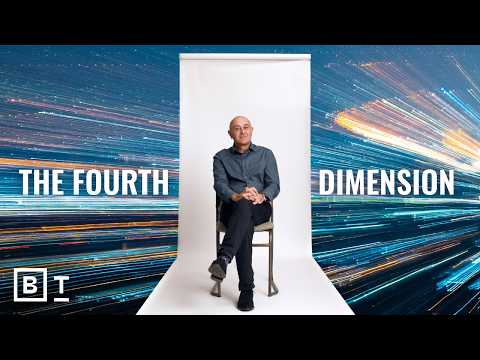
If you ever want to challenge your perception of time, spend some time with the ideas of Jim Al-Khalili, a renowned theoretical physicist and science communicator. His full interview with Big Think dives deep into the mysteries surrounding the nature of time, offering a thought-provoking cocktail of relativity, quantum physics, and our own subjective experiences.
Time, as Al-Khalili reveals, is not the straightforward arrow we often believe it to be. In fact, according to the laws of physics, past, present, and future might coexist simultaneously. That’s a notion that can feel as disorienting as teleporting into another reality. We often sense time as a river—flowing, swift, and unstoppable—but this might be nothing more than an illusion shaped by our minds.
Based on content from Big Think
The Changing Perception of Time
Why is it, one might wonder, that a year in childhood seems an eternity while the years as we age feel like sand slipping through the fingers? Al-Khalili addresses this perception, linking it to the laying down of new experiences. As kids, new events stretch time like taffy. However, as adults, familiar routines compress time, making it seem fleeting.
But beyond personal perception, physics itself tells us a more estranging story. Al-Khalili uses the framework of Einstein’s theories to showcase how the flow of time is not absolute. Instead, it’s more like a stage set where actors perpetually play their parts at varying speeds, depending on their circumstances.
Einstein’s Legacy: Shattering Absolute Time
Einstein revolutionized our understanding of time with his theories of relativity. The crux of Einstein’s proposition is that time doesn’t run consistently in all scenarios. It’s flexible, interwoven with the fabric of space, creating a four-dimensional space-time that can stretch and bend under the influence of gravity and speed.
Special relativity introduced us to the concept of time dilation—the curious effect where time ticks slower for someone moving close to the speed of light than it does for someone at rest. General relativity takes this further, suggesting that gravity can bend time, slowing it in the presence of massive objects.
Time Through the Quantum Lens
Jumping into the rabbit hole of quantum mechanics, Al-Khalili discusses the interplay between quantum field theory and the general theory of relativity, which paints a complex picture of time. In quantum mechanics, time is just a parameter in equations, not the robust conduit we psychologically experience.
Al-Khalili doesn’t shy away from discussing quantum entanglement either, where particles remain interconnected across distances. This phenomenon hints at a reality where time might not behave the way our senses tell us. It further blurs the line between past, present, and future, suggesting an entwined existence within the quantum realm.
Philosophical Ramifications
The philosophical implications of these ideas are vast, extending beyond mere scientific curiosity into how we comprehend existence itself. Are we living in a block universe where time is just another dimension, or is the passage of time as urgent as we feel it to be?
As we peel back the layers, the reality of time becomes complex, perhaps similar to exploring a city with countless hidden paths and alleys waiting to be discovered. Al-Khalili’s insights challenge us to rethink not just what we know but how we perceive the universe we inhabit.
Ultimately, Jim Al-Khalili leaves us with more questions than answers, illustrating the ceaseless allure of physics as a never-ending journey. It’s a quest to understand the underpinning of reality—where each answer paves the way for new inquiries.
Stay curious,
Frank