There’s a particular kind of silence that only shows up after a conversation that actually matters. Not the awkward kind, not the empty kind, the full kind. The kind that lingers in your chest a little, rearranging things quietly.
That’s what stayed with me after speaking with Petra Söderling.
Before anything else, I find myself returning to gratitude. Not the performative kind we sprinkle at the top of interviews, but the real thing: the recognition that someone chose to slow down with you, to think out loud, to offer perspective that isn’t optimized for headlines but for clarity. Petra has that rare quality: she is not chasing noise. She’s observing systems. Watching how people, policy, and time itself interact.
And once you notice that, it becomes difficult to go back to surface-level conversations. There’s a moment that keeps repeating itself whenever quantum comes up. Someone leans in, half-curious, half-skeptical, and asks:
“So… when is quantum actually going to be here?” It sounds reasonable. It even sounds practical.
But sitting with Petra’s perspective, you start to feel the edges of that question soften… and then fall apart entirely. Because the question assumes something neat. Something cinematic. A moment where the lights flick on, and the world splits into before and after. But that’s not how this works. Quantum isn’t waiting backstage. It’s already on stage. It’s just not performing for applause.
One of the most striking things Petra said, almost casually, was that she doesn’t spend her time chasing every new technical breakthrough. At first, that feels almost rebellious.
In a field obsessed with metrics, qubits, error rates, and coherence times, it seems like the only thing that should matter is progress you can measure, chart, and announce. But Petra operates at a different altitude.
From where she sits across governments, institutions, and international ecosystems, quantum doesn’t look like a race. It doesn’t look like a finish line waiting to be crossed. It looks… layered. Slower than the headlines suggest. But also far more substantial. More like something being built into the fabric of how things will work, rather than something that arrives and replaces everything overnight. And once you see it that way, the whole narrative shifts.
We’ve been trained, almost subconsciously, to expect technology to arrive in sharp, undeniable moments.
The iPhone appears, and suddenly, behavior changes. The internet expands, and entire industries reorganize. AI reaches a tipping point, and adoption feels instantaneous. So we wait for quantum to do the same. We wait for that clean, dramatic turning point—the “this changes everything” moment. But quantum doesn’t behave like consumer technology. It behaves like infrastructure. And infrastructure is patient.
It doesn’t ask for attention while it’s being built.
If you zoom out the signs are already everywhere. Governments are not treating quantum like an abstract idea tucked away in research labs. They’re treating it like something strategic. Something that will matter whether people are paying attention or not. Policies are being written.
Funding is moving—not hypothetically, but concretely. Talent pipelines are being shaped, slowly and deliberately. Standards are being discussed across borders, which is perhaps the quietest but most telling signal of all. That kind of coordination doesn’t happen for something uncertain. It happens when something has already crossed an invisible threshold from possibility to inevitability. And when that happens, the conversation changes. It’s no longer if. It becomes how.
One idea Petra shared keeps echoing in my mind: Quantum is not a binary outcome.
Not “it works” or “it doesn’t.” Not “it’s here” or “it’s not.” It’s something that integrates gradually. And maybe this is where most people lose their footing because gradual change is harder to feel. It doesn’t announce itself. It doesn’t interrupt your day. It layers.
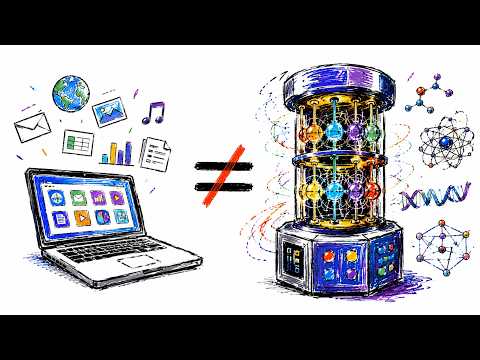
We’re already seeing this in subtle ways: classical systems working alongside quantum ones, not replacing them but complementing them. Specific use cases are emerging not as universal solutions, but targeted advantages that matter deeply in the right context. This is not a disruption in the dramatic sense. It’s more like a merge. And merges, especially slow ones, are easy to underestimate while they’re happening.
There’s something psychological happening here, something subtle but powerful. Calling something “far away” is comforting it gives you permission to ignore it, to file it under someday, and move on. But calling something “early” shifts the weight. “Early” asks something of you. It asks you to stay curious without needing full understanding, to sit with ambiguity, and to notice patterns before they fully form. And that’s uncomfortable, especially in a field like quantum, which can feel dense, technical, and even quietly exclusionary.
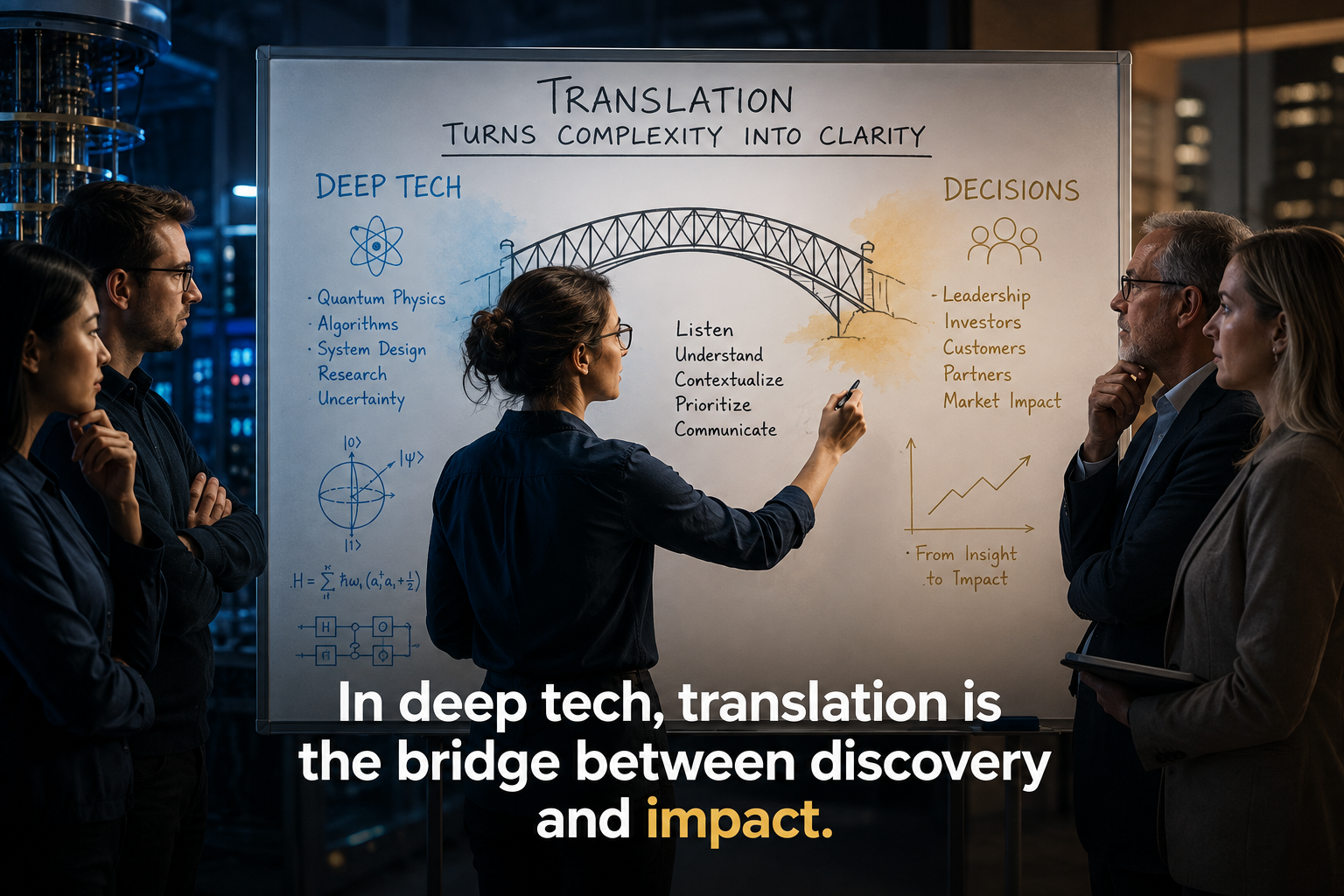
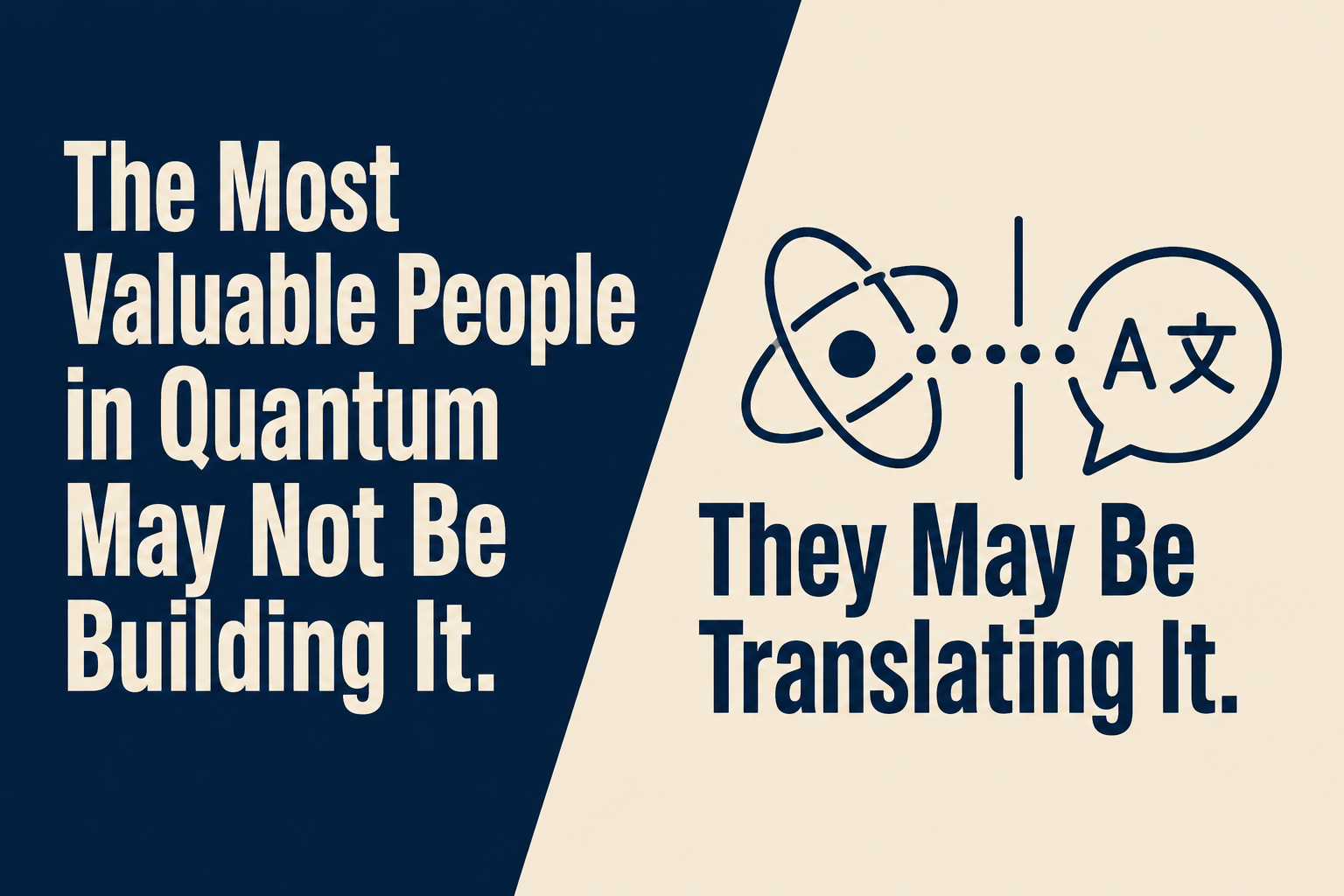
But Petra’s path gently disrupts that narrative. She didn’t come up through physics or spend years inside a lab. Her background lies in business, marketing, and events worlds built on translation, connection, and making complex things feel human. And maybe that’s exactly why her perspective lands the way it does: steady, clear, grounded in reality rather than abstraction.
Because what she sees—and what more of us are beginning to recognize is that quantum isn’t just a scientific challenge. It’s a communication challenge. An alignment challenge. At its core, it’s a human one.
Different groups are moving at different speeds. Governments think in decades. Startups think in funding cycles. Researchers think in breakthroughs. Corporations think in terms of application and risk. And all of them are speaking slightly different languages. What Petra sees and what she gently pointed me toward is that progress doesn’t come from a single breakthrough in isolation.
It comes from alignment. From enough of these worlds beginning to overlap, even imperfectly. And that alignment is already happening. You can feel it in policy conversations that are becoming more coordinated. In collaborations that stretch across borders.
In the quiet, often overlooked work of standardization, the kind of work that rarely gets headlines but quietly determines how things scale. You can feel it in companies shifting their focus not just to building hardware but to thinking about access, tooling, and integration. And in conversations that are evolving from “what is quantum?” to “how do we use this responsibly?” That shift alone says everything.
And yet, culturally, we’re still stuck in extremes.
Quantum will solve everything.
Quantum will solve nothing.
Quantum is decades away.
Quantum is right around the corner.
But reality, quiet, steady reality, lives in the middle. Less dramatic. More layered. Infinitely more interesting.
What stayed with me most after the conversation wasn’t a specific prediction or a bold claim. It was a reorientation. A soft but firm nudge to stop waiting for a moment that may never arrive in the way we expect. Because quantum doesn’t need a grand entrance to start shaping the world.
It already is.
In the decisions being made right now. The investments are quietly compounding.
In the systems being designed with a future in mind that isn’t fully visible yet—but is already influencing the present.
So maybe the question isn’t:
“When will quantum be ready?”
Maybe the better question, the more honest one is:
“Where is quantum already showing up, and what does that change for me?”
For how you think.
For what you pay attention to.
For how you position yourself in a world that is shifting not loudly, but persistently.
By the time the change feels obvious, it will already be old news. That’s the paradox of transformations like this. They build slowly, almost invisibly… until, in hindsight, one day it looks like everything changed at once. But conversations like this one with people like Petra let you step into that shift a little earlier.
Not with certainty. But with awareness. And sometimes, that’s the only real advantage there is.