How Following What Fascinates You Can Lead Somewhere Unexpected
There is a moment in our recent Impact Quantum conversation that I can’t stop thinking about.
When asked what advice she would give her younger self, Klem didn’t talk about titles, salaries, or strategic positioning. She talked about the Curiosity.
She said she always followed what was interesting to her even when it didn’t look like the smartest move on paper.
That thread’s curiosity over calculation is powerful.
Because her career path does not read like a straight line. It reads like exploration.
And yet, it led her directly into one of the world’s most advanced technology sectors.
Curiosity → Quantum
Let’s zoom out.
She didn’t start in quantum.
Her background was in industrial design.
Before that, she worked across culture, education, and creative technology. She built interactive theater installations. She experimented with unusual interfaces. She explored how humans interact with systems beyond the standard keyboard-and-screen model.
Nothing about that screams “future leader in quantum computing UX.”
Until it does.
Because curiosity compounds.
Those explorations into unconventional interaction design led to an invitation to Singapore to work on a game about quantum physics at the Centre for Quantum Technologies.
She went because it sounded interesting.
Not because it was the obvious next rung on a career ladder.
And that decision, driven by curiosity rather than strategy, changed everything.
What began as a project became a calling.
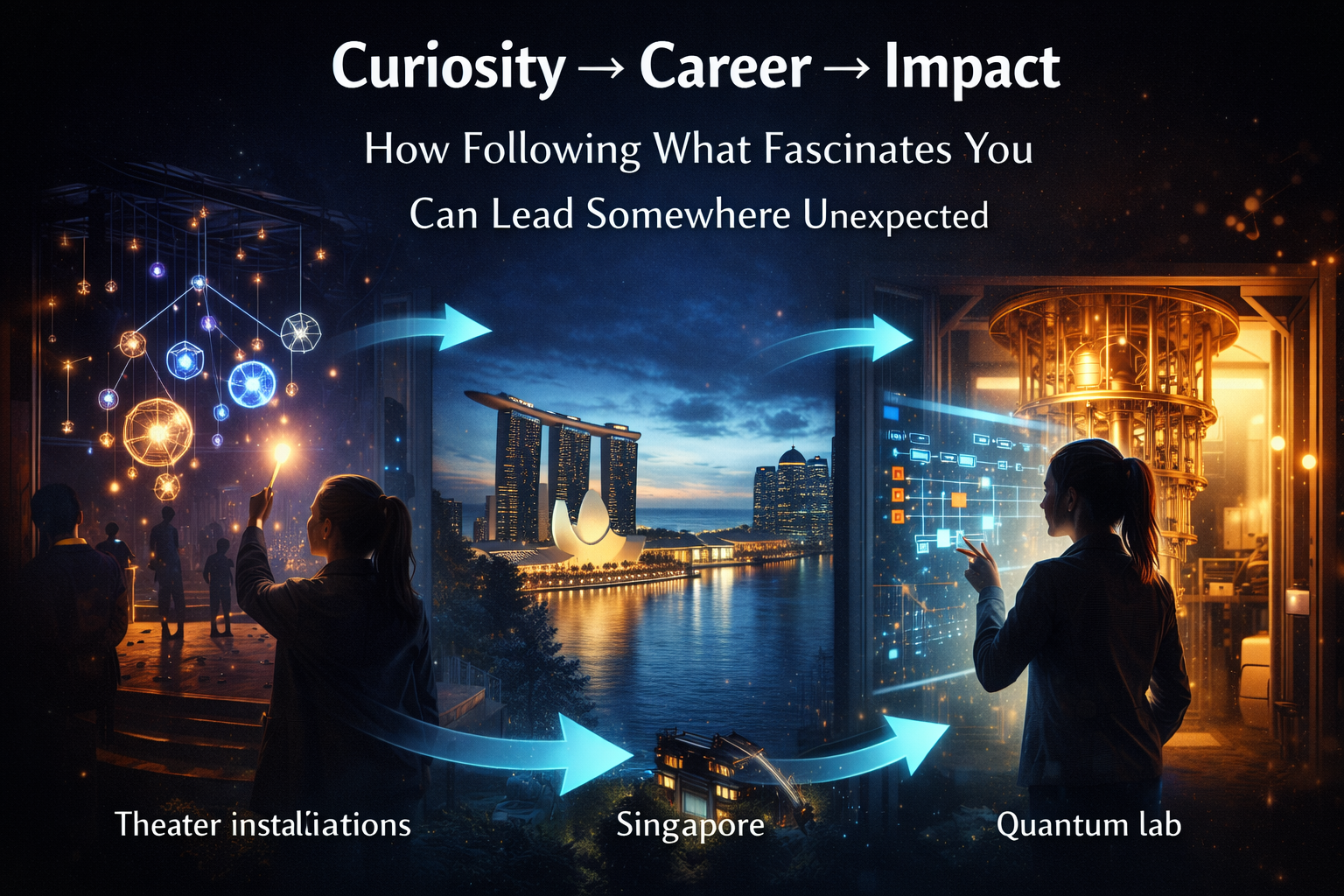
Theater Installations → Singapore → Quantum Lab
This is the part I love.
We often think breakthroughs come from highly linear, highly technical trajectories. But innovation ecosystems are built by cross-pollination.
A designer who understands physical space and human interaction walks into a quantum lab.
A physicist explains superposition.
A designer sketches it.
The physicist looks at the sketch and says, “Oh… that’s not how I was thinking about it.”
That moment matters.
Because when you translate complex ideas into new forms, you don’t just communicate them differently. You see them differently.
Her early curiosity about “unusual ways to interact with technology” didn’t disappear. It evolved.
It became:
- Virtual quantum labs used by universities
- Visual tools for debugging complex circuits
- Interfaces that act as “doors” into quantum systems
Curiosity did not distract her career.
It built it.
Design → Language Design → Quantum Visualization
One of the most fascinating parts of the conversation was her collaboration with a language designer at Classiq.
Not a linguist.
A programming language designer.
Together, they worked on visual representations of a high-level quantum language. Code written in Qmod would compile into gate-level circuits. The challenge was not just technical accuracy; it was making that transformation visible, intuitive, and navigable.
Think about that for a second.
We are witnessing the creation of entirely new computational languages.
And alongside them, new visual grammars.
There was no roadmap.
No precedent.
No “this is how it’s always been done.”
That is what happens when curiosity-driven professionals step into frontier industries. They are not constrained by “the way things are done.” They are designing the way things will be done.
This is not about abandoning expertise. It is about layering it.
Industrial design thinking layered onto quantum software architecture.
Creative experimentation layered onto algorithm visualization.
Curiosity layered onto technical depth.
The Myth of the Straight Line
We are still conditioned to believe that successful careers are linear.
Pick a lane.
Specialize early.
Climb deliberately.
But we are living in a century where industries are collapsing and reforming in real time.
Quantum intersects with AI.
AI intersects with design.
Design intersects with language theory.
Language theory intersects with hardware optimization.
The professionals who will thrive are not those who stayed narrowly inside one silo.
They are the ones who asked questions.
Curiosity builds adaptability.
Adaptability builds relevance.
Relevance builds impact.
Curiosity Is Not Reckless. It Is Strategic.
Let’s be clear.
Following curiosity does not mean being directionless.
It means being attentive to what energizes you.
When she said she sometimes made decisions that weren’t the most “career-driven” in a traditional sense, what she was really describing was alignment.
Alignment between:
- Personal interest
- Intellectual stimulation
- Meaningful contribution
That alignment is sustainable.
And sustainability matters in deep tech.
Quantum is not a two-year hype cycle. It is a generational build.
The people who will shape it long-term are those who genuinely find it fascinating.
Curiosity is fuel.
Curiosity → Career → Impact
This is why this thread resonates so deeply with me.
So many people hesitate before entering emerging fields.
“I don’t have the right background.”
“I’m not technical enough.”
“I didn’t study physics.”
But look at the path.
Theater installations → Singapore → Quantum lab.
Industrial design → Language collaboration → Visualization tools.
Curiosity → Contribution → Impact.
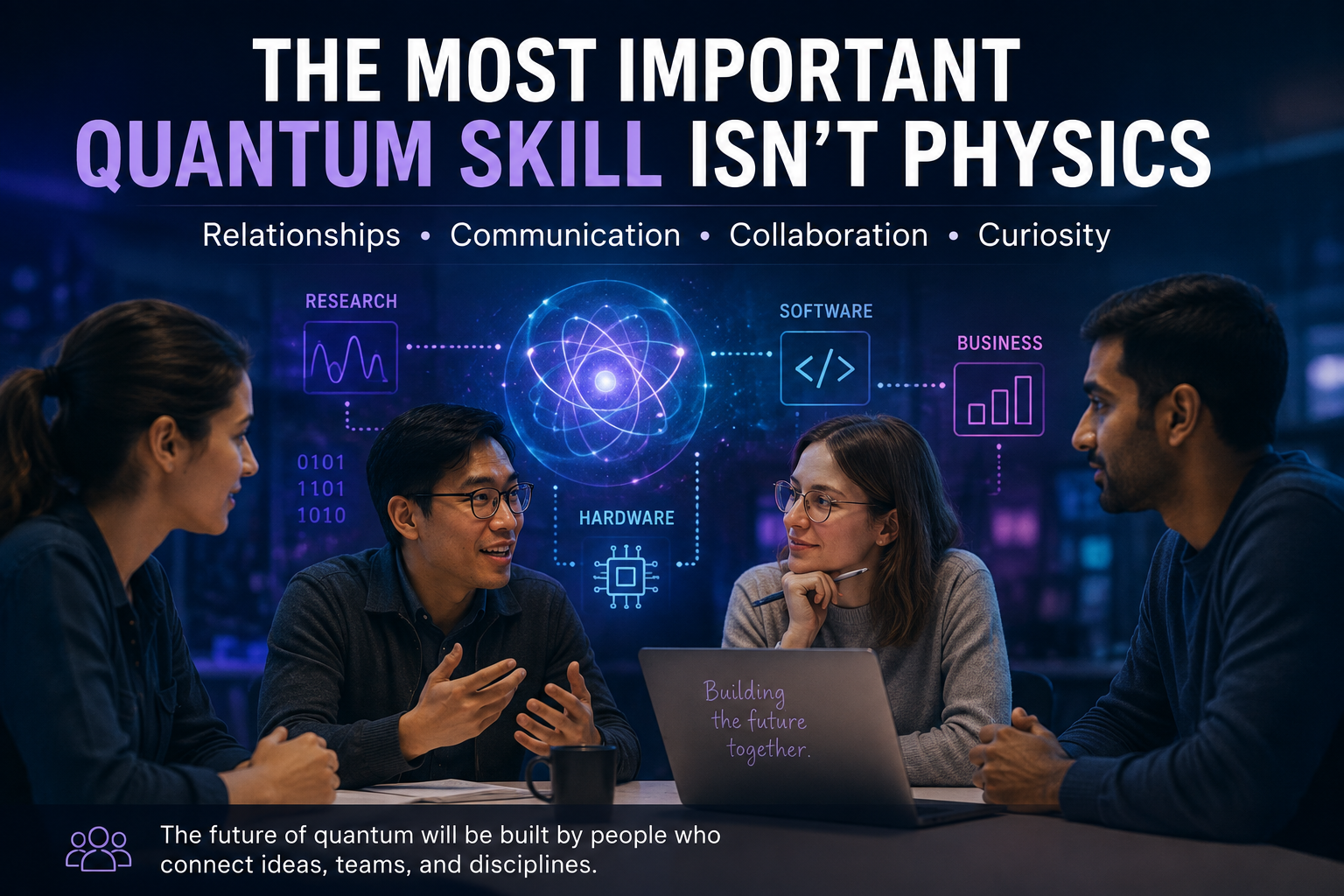
The quantum industry is not just a physics story.
It is an ecosystem story.
And ecosystems reward the curious.
If you are curious about:
- Security
- Visualization
- Education
- Hardware
- Policy
- User experience
- Workforce development
There is a door for you.
But the first step is not choosing the perfect plan.
It is choosing the next interesting problem.
Because sometimes, the most powerful career move you can make is not the most predictable one.
Sometimes it’s the one that makes you lean forward and say:
“I don’t fully understand this yet… but I want to.”
And that is where everything begins.
Curiosity → Career → Impact.
Always.