For most of human history, our intuition has led us to believe that the world is smooth.
Pour water into a glass, and it rises in a steady stream. Slide your hand across a wooden table, and the motion feels continuous. Watch a car accelerate along a highway; its speed increases gradually. Everything about our lived experience suggests that nature operates on a sliding scale. Any value should be possible. Any position, any energy, and any speed should exist somewhere in between.
But at the dawn of the 20th century, physics hit a wall.
The elegant classical laws that explained the motion of planets and the tides of oceans began to fall apart when scientists turned their attention to the very small. At the atomic scale, the math no longer worked. Predictions broke. Experiments disagreed. The smooth world we thought we understood fractured under scrutiny.
The solution did not gently refine our worldview. It shattered it.
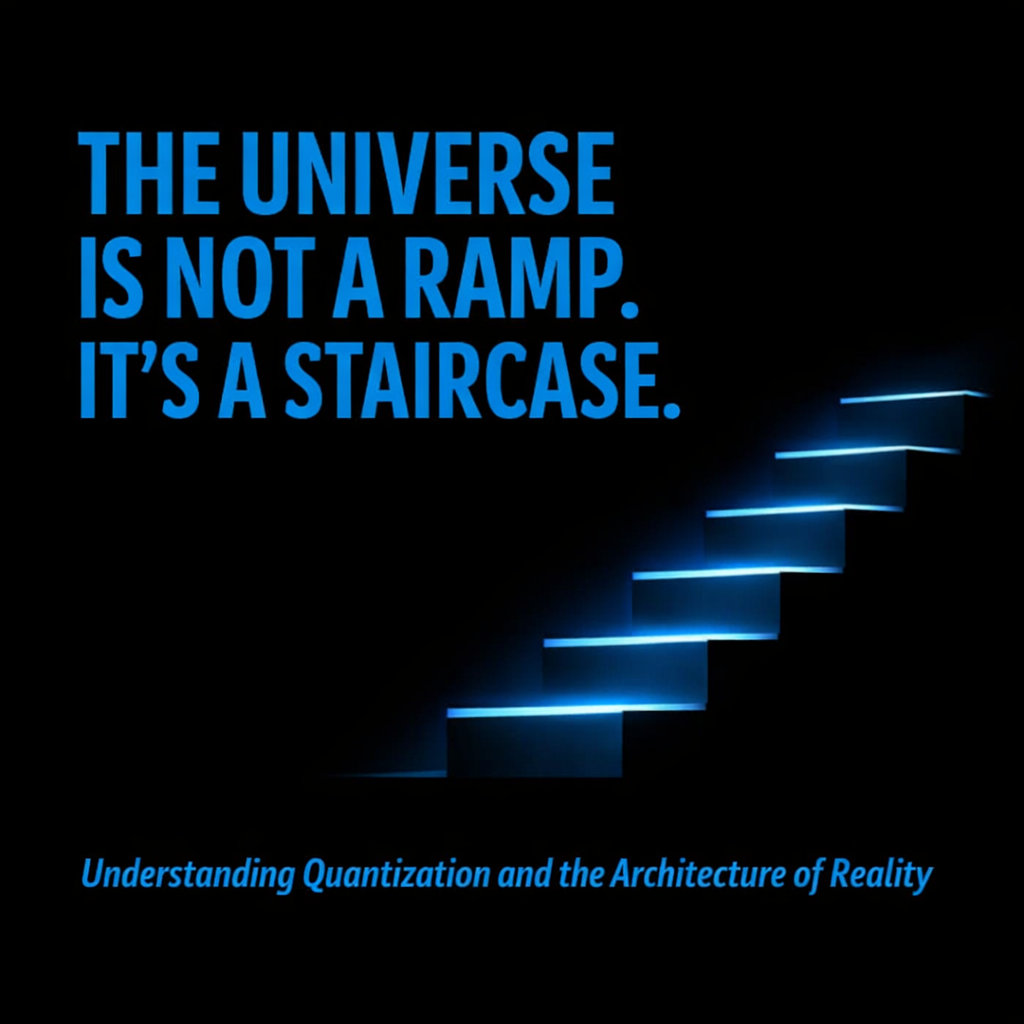
We discovered that at its most fundamental level, the universe is not a smooth slope. It is a staircase.
That revelation is called quantization.
The Shift From Continuous to Discrete
Quantization is the process of moving from a classical understanding of nature to a quantum one. In classical physics, physical quantities like energy can vary continuously. In quantum physics, those same quantities are restricted to specific, discrete values.
If you want a mental model, imagine the difference between a ramp and a staircase.
On a ramp, you can stand at any height. You can move upward by a millimeter, a centimeter, or a fraction of a hair’s width. Your potential energy varies continuously.
On a staircase, you cannot hover between steps. You are either on one step or the next. To move up, you must commit to a jump. There are gaps that are not permitted.
In the quantum world, those steps are called quanta.
Energy does not flow like water. It arrives in packets.
That single idea rewrote physics.
The Spark That Started It All
The concept of quantization was not born from philosophical ambition. It emerged from desperation.
In 1900, physicist Max Planck sought to address a problem known as the ultraviolet catastrophe. Classical physics predicted that objects should emit infinite energy at high frequencies. This was clearly impossible. Nature was not exploding with infinite ultraviolet radiation.
Inside the Atom: Nature’s Staircase
The most powerful demonstration of quantization lives inside the atom.
Before quantum theory, scientists struggled with a fundamental question. If electrons orbit the nucleus like planets around a star, why do they not spiral inward and collapse into it? Classical electromagnetism predicted that orbiting charges should radiate energy continuously and lose altitude.
Atoms, by that logic, should be unstable.
They are not.
Niels Bohr applied Planck’s radical idea to atomic structure. He proposed that electrons do not orbit at arbitrary distances. They occupy specific, allowed energy levels. Think of them as fixed steps on the atomic staircase.
Electrons can exist on step one or step two. They cannot exist in between.
To move to a higher level, an electron must absorb exactly the right amount of energy to bridge the gap. Too little, and nothing happens. Too much, and it overshoots to another allowed state.
When an electron drops back down, it releases that precise energy difference as a photon of light.
This explains why elements emit distinct colors when heated. Each element has a unique set of allowed steps. Each jump produces a specific wavelength of light. That is why hydrogen glows differently from neon. The staircase is custom-built for each atom.
Quantization is not a minor detail. It is the reason matter holds together.
Why the World Still Looks Smooth
If the universe is granular and jumpy, why does daily life feel seamless?
The answer lies in the size of Planck’s constant.
It is unimaginably small. At macroscopic scales, the energy differences between allowed states are so tiny and so densely packed that they blur together. The staircase becomes indistinguishable from a ramp.
Think of a digital photograph. Up close, you see individual pixels. From a distance, the image appears continuous. Our senses operate at a scale where quantum pixels blend into a smooth experience.
But beneath that smoothness, the grain remains.
Reality is quantized whether we notice it or not.
The Digital Age Was Built on Jumps
Quantization is not just a philosophical curiosity. It is the foundation of modern technology.
Transistors, the on and off switches that power every computer chip, rely on the discrete energy gaps in semiconductors. Without quantized energy levels, there would be no binary logic, no computing, no internet.
Lasers operate because electrons can be stimulated to transition between specific energy levels, emitting coherent light with high precision.
MRI machines exploit the quantization of nuclear magnetic moments, allowing physicians to image the human body with high spatial resolution.
Every time you tap your phone, you are interacting with the staircase.
As we enter the quantum computing era, we are learning to manipulate those steps directly. Qubits depend on quantized energy states and superpositions that only make sense in a world where nature enforces discrete rules.
The same principle that once solved a theoretical radiation puzzle now underpins trillion-dollar industries.
The Legacy of the Jump
Quantization teaches us something profound about reality.
Energy is grainy. It arrives in packets.
States are restricted. Nature operates with a membership-only policy. You are either in an allowed state or you are not.
Change, at the smallest scales, is abrupt. There is no sliding between levels. There are only jumps.
When we accepted that nature prefers the staircase over the ramp, we unlocked atomic structure, modern electronics, and the architecture of the digital world. We also confronted a humbling truth: our intuition is not a reliable guide at fundamental scales.
The smoothness we experience is an illusion born of scale.
Underneath it all, the universe moves in steps.
And once you see the staircase, you cannot unsee it.