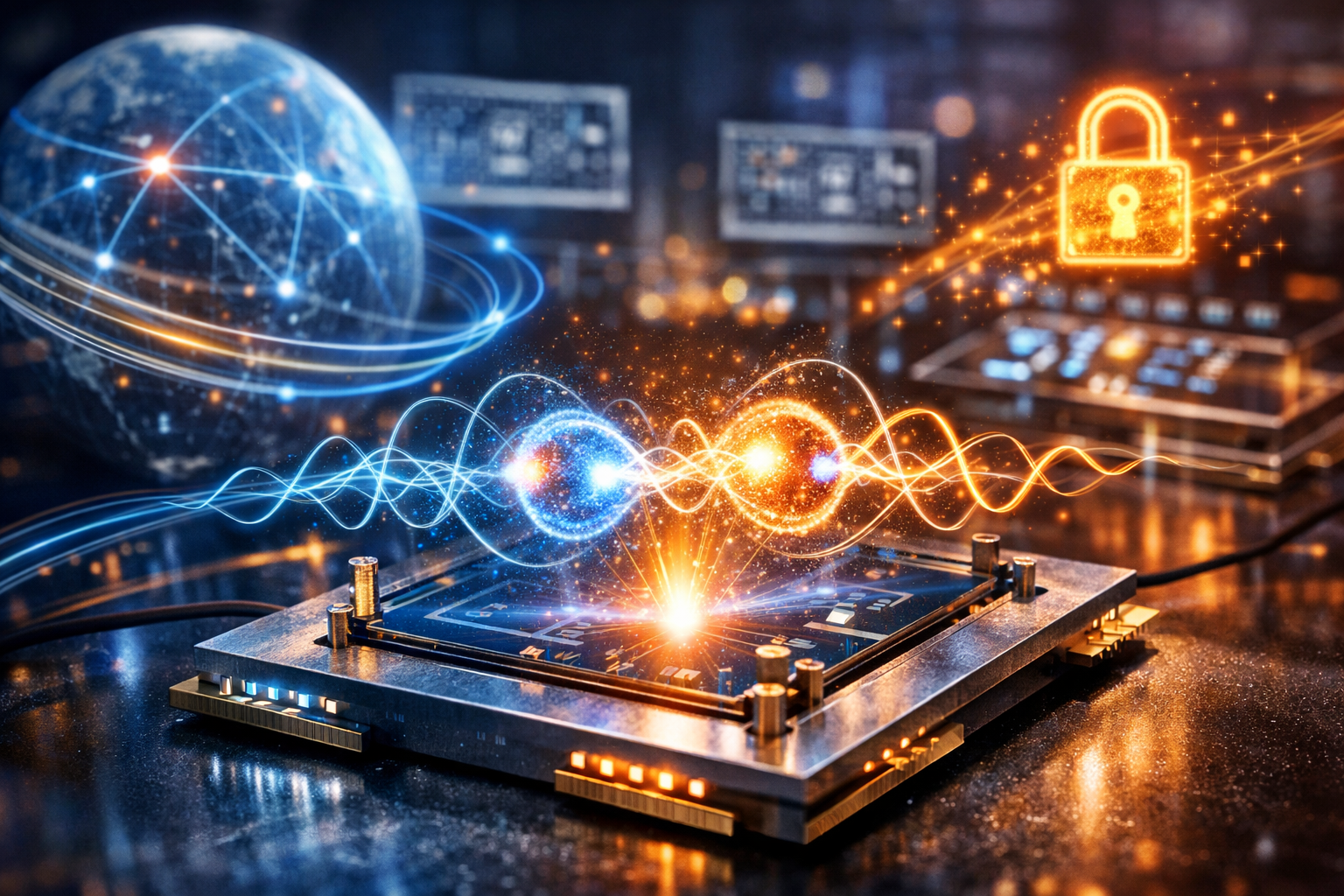
Imagine sending a message from Earth to a distant exoplanet and having it arrive the instant you hit send. No delay. No waiting for light-years of travel time. For decades, this has been a dream of science fiction. Yet there is a real scientific phenomenon that seems to echo this fantasy: quantum entanglement.
Entanglement is one of the most mysterious and counterintuitive discoveries in modern physics. It binds particles together so profoundly that the state of one instantly reveals the state of the other, even when vast distances separate them. This raised a provocative question: if nature already allows instantaneous correlations, does that mean faster-than-light communication is possible?
The answer is subtle, surprising, and far more profound than a simple yes or no.
What Entanglement Really Is
Quantum entanglement describes a relationship between two or more particles that share the same quantum fate. When particles are created together or interact in specific ways, their physical properties become perfectly correlated. If one is measured to have a spin pointing up, the other is guaranteed to have a spin pointing down, or vice versa, depending on how they were prepared.
Einstein famously referred to this phenomenon as “spooky action at a distance.” He believed something must be missing from the theory because the instant correlation seemed to violate the speed limit set by the speed of light. If one particle on Earth is measured, and its partner across the galaxy instantly takes on the opposite value, does that not imply faster-than-light signaling?
This question shaped decades of debate, experiments, and philosophical arguments. Eventually, physics found the answer.
The Illusion of Faster Than Light Communication
To understand why entanglement does not allow communication faster than light, you must grasp a key fact: the outcomes of quantum measurements are fundamentally random.
If Alice measures her particle on Earth, she cannot choose whether she gets spin up or spin down. It is a fifty-fifty chance each time. Even though Bob’s particle takes on the opposite result instantly, Bob cannot interpret that outcome as a message because he faces the same random fifty-fifty result. He cannot know whether his spin was predetermined or whether Alice measured hers.
This is the essence of the no communication theorem. Entanglement gives you instantaneous correlation but not control. You cannot select your outcome, and if you cannot select an outcome, you cannot encode a message.
A simple analogy makes this clear:
Imagine Alice and Bob each hold one half of a special quantum coin. The moment Alice flips her coin, Bob’s coin instantly shows the opposite result. But Alice cannot choose heads or tails. She only discovers the result after the flip.
Bob, seeing tails, has no way of knowing if Alice flipped hers, or if his coin simply resolved itself randomly. Only when Alice sends a classical message saying what she saw can Bob compare results and confirm the connection. That classical message cannot travel faster than the speed of light.
This is why entanglement does not break relativity. The universe allows instantaneous connection, but not instantaneous communication.
Entanglement’s Real Power: Quantum Technology
While entanglement cannot send messages across the galaxy faster than light, its actual applications are far more revolutionary than any sci-fi scenario. Entanglement is the engine behind the rise of quantum technologies, including:
Quantum Cryptography
Quantum Key Distribution, or QKD, utilizes entangled photons to generate encryption keys that are virtually impossible to intercept without detection. If an eavesdropper interacts with the photons, they disturb the quantum state, and Alice and Bob detect an error spike, which indicates that the key has been compromised.
This form of cryptography is considered future-proof even against attacks from powerful quantum computers.
Quantum Computing
A qubit can exist as both 0 and 1 at the same time because of superposition. Entangling many qubits links their states, allowing them to compute an enormous number of possibilities simultaneously.
A quantum computer with only a few dozen high quality entangled qubits can perform calculations that would take classical supercomputers billions of years. This capacity could transform drug discovery, materials science, finance, optimization problems, and artificial intelligence.
The Quantum Internet
The next major frontier for entanglement is the creation of a global quantum internet. This will not be a faster internet in the traditional sense. Instead, it will be a secure and deeply interconnected network designed to distribute entanglement between quantum devices worldwide.
A full quantum internet would require:
- Quantum nodes that store and process qubits
- Quantum channels that send photons while preserving their fragile quantum states
- Quantum repeaters that refresh and extend entanglement over long distances
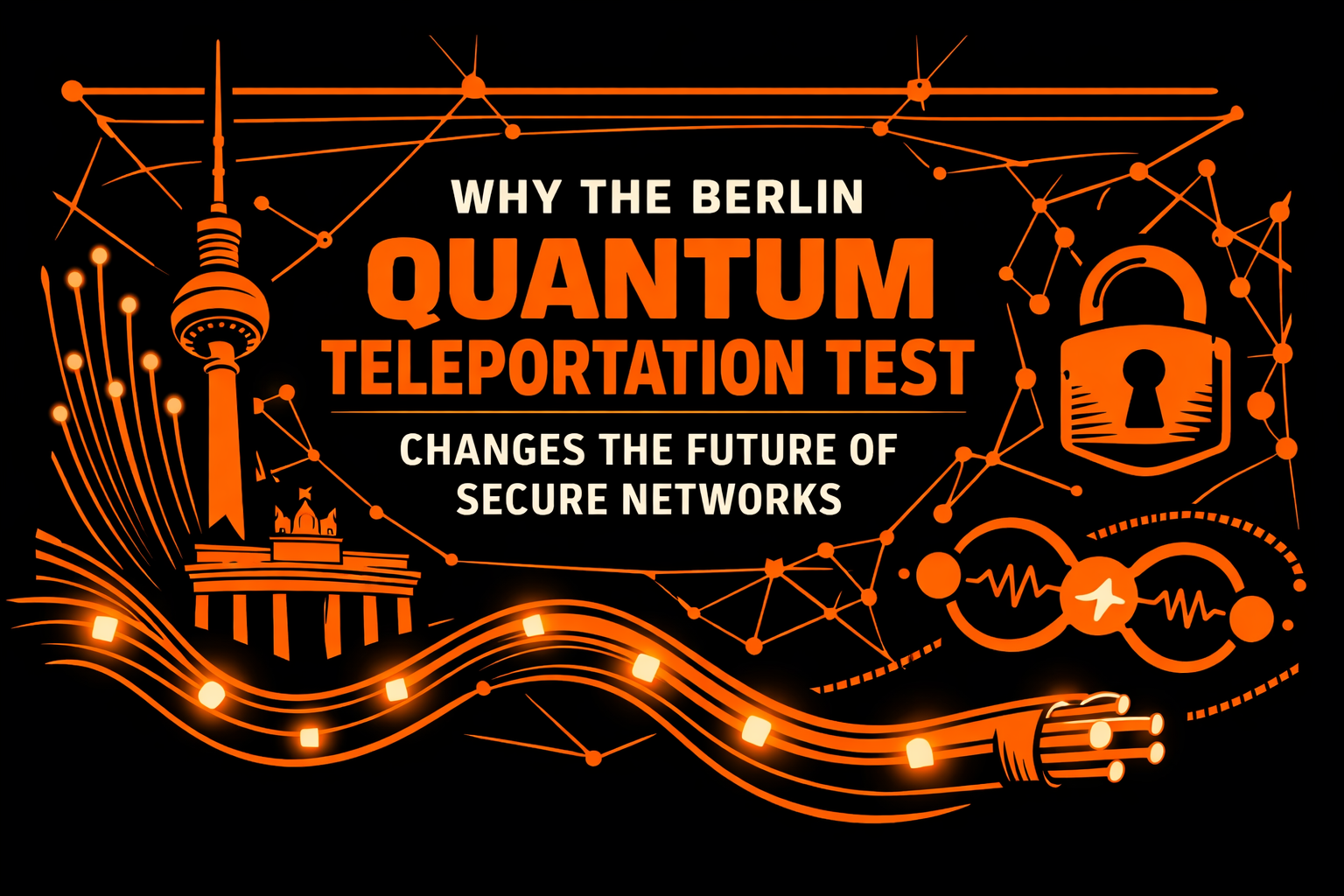
Scientists have already entangled photons across more than 100 kilometers of fiber and even sent entangled particles between Earth and orbiting satellites. Researchers are now racing toward quantum repeaters durable enough to build continent-spanning networks.
This internet would enable:
- Unhackable global communications
- Distributed quantum computing
- Secure financial and governmental networks
- Novel scientific experiments in physics and cosmology
The impact would be enormous across defense, healthcare, banking, energy, and more.
Beyond Technology: What Entanglement Says About Reality
Perhaps the most fascinating part of entanglement is what it suggests about the very nature of the universe. If two particles remain linked across unimaginable distances, does this imply that space itself is not as fundamental as we once thought? Some physicists propose that space and time may actually emerge from networks of entanglement, making it the fabric from which reality is built.
This idea sits at the frontier of research exploring quantum gravity, black hole thermodynamics, and the deep structure of spacetime. Entanglement may hold clues about how gravity emerges or how information behaves at the edge of a black hole.
While these ideas remain speculative, they point toward a stunning possibility: entanglement is not only a technological resource but also a window into the universe’s hidden architecture.
A Universe More Connected Than We Imagined
Quantum entanglement challenges everything we think we know about separation, communication, and causality. It does not allow messages to travel faster than light, but it reveals that the universe contains connections deeper than classical physics can describe.
As researchers continue to push the boundaries, entanglement is becoming more than a scientific curiosity. It is becoming a practical tool that will drive future quantum networks, unlock new computing power, and possibly reshape our understanding of space and time.
The universe is far stranger, more interconnected, and more astonishing than our everyday perception suggests. And we are only at the beginning of understanding this spooky, beautiful truth.