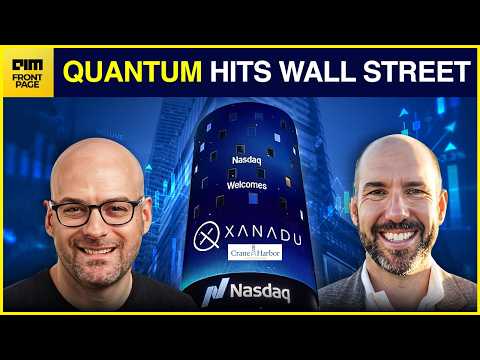
Quantum computing is reaching a significant moment in 2026, with Xanadu Quantum Technologies set to become the first publicly listed photonic quantum company on NASDAQ. This development highlights major breakthroughs in the field, particularly in quantum computing explained, and marks a crucial investment opportunity in the stock market. The video also touches on advancements in quantum error correction and the impact of quantum computing on industries like AI and business intelligence.
Based on content from AIM Network
Every revolutionary technology has its defining moment. Cloud computing had one. AI had another. Now, as we step into 2026, quantum computing stands at the brink of its own significant leap—a leap that bridges laboratory research with commercial reality.
Xanadu Quantum Technologies is poised to make history as it becomes the first photonic quantum company to list publicly on NASDAQ and the Toronto Stock Exchange. This initial public offering not only signifies a milestone for Xanadu but also for the entire quantum technology sector.
The merger with Crane Harbor Acquisition Corp. and a capital infusion of $302 million, topped off by an additional CAD $390 million from the Canadian government, paints an intriguing picture for investors. Bain & Company estimates the quantum market will grow to between $100 billion and $250 billion as it matures, setting the stage for industries prepared to embrace this quantum future.
But as we idolize these advancements, let’s delve into the nuances. Quantum computing—so shrouded in mystique—is transitioning beyond theoretical promise. Companies like Qubit are delivering quantum machines capable of error correction to institutions like Japan’s National Institute of Advanced Industrial Science and Technology this very year. Microsoft, along with Atom Computing, is on the cusp of unveiling error-corrected quantum systems for enterprise clients, branding them as “level two” quantum computers.
On the horizon, tech behemoths like IBM, Google, and AWS are integrating quantum capabilities into their cloud platforms, potentially within the next couple of years. This means businesses might access quantum computing via familiar tools far sooner than expected.
Yet, innovation seldom follows an unblemished path. Researchers at the University of Pittsburgh have unearthed that some celebrated quantum breakthroughs rest on simpler, non-quantum mechanisms. It’s a potent reminder that alongside dazzling progress, rigorous scrutiny remains vital.
The anticipated arrival of “quantum’s transistor moment,” when these machines might outperform classical computers on practical problems, hints at a timescale around 2028 to 2029, requiring around 100 logical qubits. As Science Daily metaphorically compared it, the transistor took time to leap from the lab to becoming an indispensable tool—early adopters shaped the future.
As quantum computing nudges into a commercial phase, its capital investments, strategic partnerships, and IPO listings are no longer speculative; they are real and happening now. However, the scientific journey is still iterative, punctuated by tests and validations. Recognizing the potential of quantum computing without prematurely embedding it as a cornerstone of business strategy could be pivotal. Waiting until quantum becomes the currency of obviousness might incur a steep price, as history with cloud computing and AI has shown us.
So, we stand at a crossroads, observing quantum’s intriguing dance between promise and practical utility. Does your industry see quantum on the horizon, or is 2028 too distant? As these thoughts linger, consider how quantum conversations might evolve and let us know: Is quantum a quantum leap you’re ready to grapple with?
Till then, stay curious and keep questioning.
—