In the world of quantum computing, the narrative has long been one of “perpetual potential.” For years, the community has operated under the assumption that while quantum computers are theoretically capable of shattering modern encryption, the physical hardware required to do so—millions of stable qubits—was decades away. We lived in a comfortable buffer zone where the “Quantum Apocalypse” or “Q-Day” was a problem for the 2040s.
That buffer zone just evaporated.
In a recent and sobering update, physicist Sabine Hossenfelder highlighted a series of breakthroughs that suggest quantum computers are becoming dangerous much faster than even the most aggressive experts predicted. The “news about nothing” has suddenly become news about everything, as researchers find ways to do more with less, effectively shrinking the timeline for breaking the codes that protect our global financial systems, military secrets, and private data.
The Google Bombshell: 2029 is the New 2035
The most significant tremor came from Google’s quantum AI team. Historically, the benchmark for breaking high-level encryption like RSA or the ECC (Elliptic Curve Cryptography) used by Bitcoin was estimated to require roughly 10 million qubits [01:33]. Given that we are currently hovering in the range of a few hundred qubits, the world felt safe.
However, Google researchers have unveiled a new algorithm that is roughly 20 times faster than previous versions [01:49]. By optimizing how the quantum computer processes the math, they’ve significantly reduced the hardware requirements. They now estimate that a quantum computer with just 500,000 qubits could break these codes in about 10 minutes [01:57].
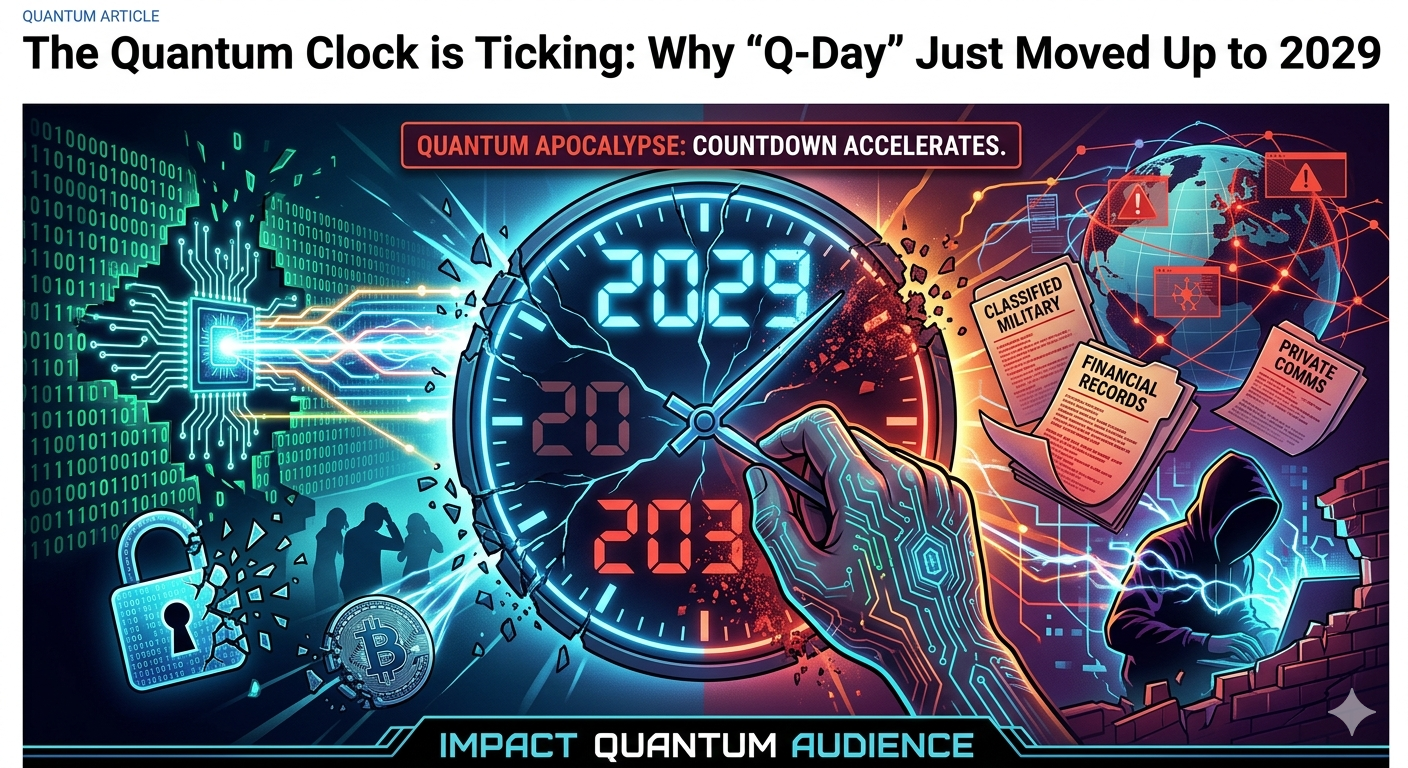
More alarming than the math is the shift in Google’s official timeline. They have revised their estimate for “Q-Day”—the moment quantum computers can crack existing encryption—from the mid-2030s to 2029 [02:10]. We are no longer talking about a generational shift; we are talking about a deadline that is less than five years away.
The Rise of “Zero-Knowledge” Research
The geopolitical stakes have reached such a fever pitch that the scientific community is beginning to self-censor. Scott Aaronson, a titan in the field of quantum complexity, recently noted that researchers are now questioning whether they should even publish their findings on resource requirements for Shor’s algorithm (the primary math behind quantum code-breaking) [02:56].
In an unprecedented move, Google’s latest work wasn’t even fully published. Instead of releasing the code for the algorithm, they used a “zero-knowledge proof”—a cryptographic method that proves the algorithm works as claimed without actually revealing the secret sauce [03:10]. This suggests that the “Quantum Leap” is no longer just a technological race; it is a burgeoning arms race where the most powerful tools are being classified before they even fully exist.
Hardware: The Dark Horse of Neutral Atoms
While Google and IBM have focused on superconducting qubits—which are notoriously difficult to entangle over long distances—a new contender is sprinting toward the finish line: Neutral Atoms [03:54].
A startup called Oratomic recently published a paper claiming that by using neutral atom arrays, they could achieve code-breaking capabilities with only 26,000 qubits in about ten days [04:08]. To put that in perspective, we have moved from needing 10 million qubits to potentially needing only 26,000 in a matter of years. If these “late-comers” to the quantum race continue at this pace, the 2029 deadline might even be conservative.
The Single-Purpose Superweapon?
Hossenfelder points out a biting irony in this rapid acceleration. While we hear constant buzz about quantum computers revolutionizing stock market analysis, drug discovery, or logistics, the actual progress in those fields has been remarkably stagnant [04:42]. It turns out that finding a “quantum advantage” for useful, peaceful applications is incredibly difficult.
The one area where the advantage is clear, measurable, and devastating is code-breaking [05:14].
This creates a lopsided reality: we are building a “superweapon” that can unlock every digital vault on Earth, but we haven’t yet figured out how to use it to cure a single disease or fix the economy. For the ImpactQuantum audience, this serves as a critical wake-up call. The transition to Post-Quantum Cryptography (PQC) is no longer a “future-proofing” exercise; it is an immediate survival requirement for the digital age.
What’s at Risk?
It’s not just about future transactions. Hackers and nation-states have been practicing “Store Now, Decrypt Later” (SNDL) for years—harvesting encrypted data today in the hope that a future quantum computer will unlock it [00:49]. From military secrets to the private communications of world leaders, the “Harvesting Attacks” of the last decade are about to bear fruit.
As Hossenfelder dryly notes, at this rate, by next Tuesday, someone will claim they can break RSA on a laptop with a strong espresso [04:22]. While that’s hyperbole, the underlying message is clear: the quantum clock is ticking, and it’s moving much faster than we thought.
The question for 2029 isn’t whether the technology will be ready. The question is: will we?
Watch the full analysis here: Quantum Computers Just Got Much More Dangerous