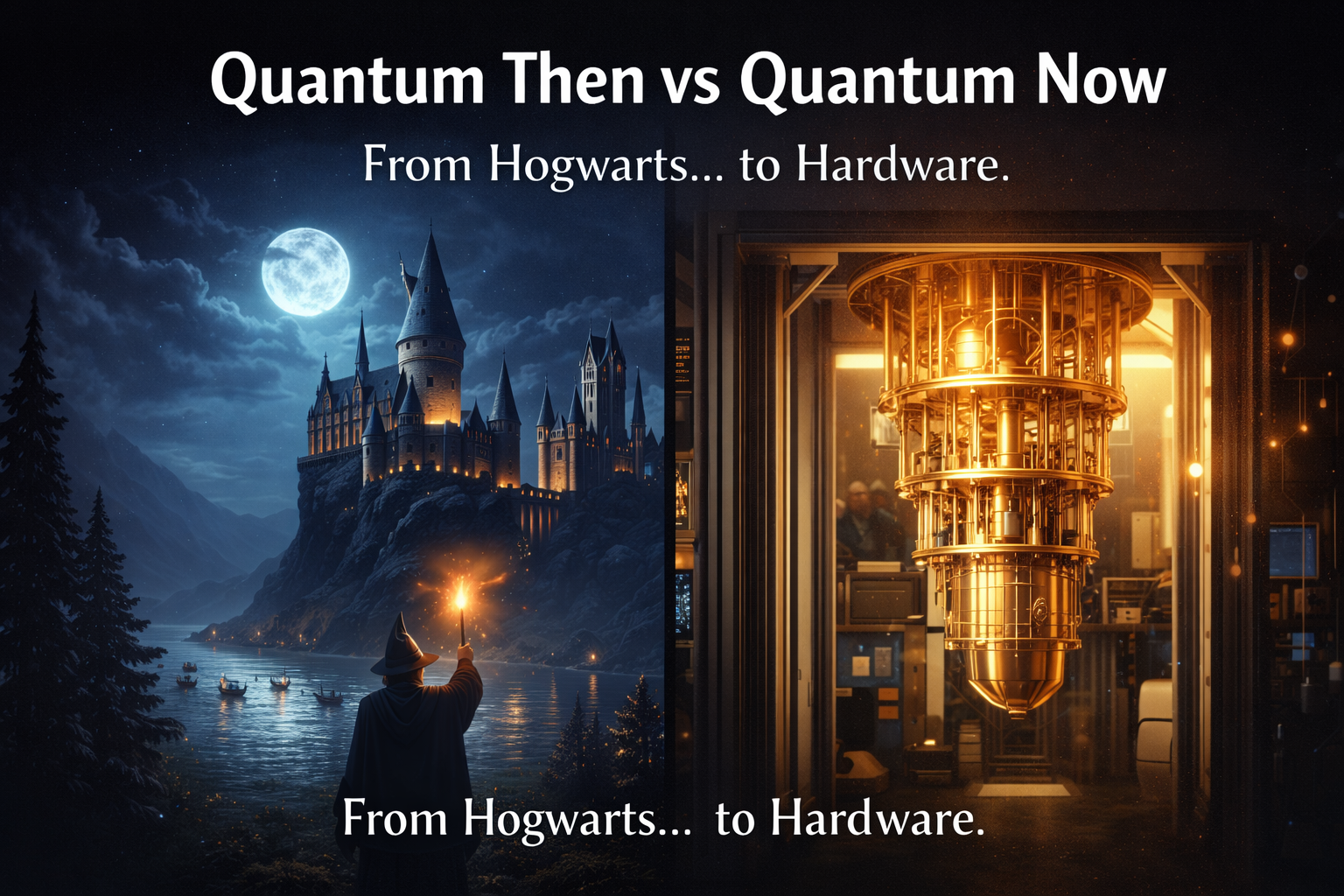
Six years ago, working in quantum computing felt a bit like saying you were going to Hogwarts IQ Podcast Taping with Klem Jan….
It carried that same mixture of awe and confusion. You could see the curiosity in people’s eyes. You could also see the mental door quietly close.
Quantum was mysterious. Academic. Slightly otherworldly.
If you weren’t a physicist, you assumed it wasn’t for you.
And if you were inside the field, it sometimes felt like you were part of a small, highly specialized guild speaking a language no one else understood.
But something has shifted.
Quantum no longer feels like a castle hidden in the clouds.
It feels like infrastructure under construction.
Evolution is subtle but profound.
The Early Days: Mystery Over Usability
Every breakthrough technology begins in abstraction.
In its earliest stages, quantum computing lived primarily in equations, conference papers, and research labs. The primary interface was code. The primary audience was physicists. The conversations were dense and deeply technical.
It wasn’t exclusion by design. It was simply the natural state of a young scientific field.
But abstraction creates distance.
When technology feels like magic, it inspires wonder. It also intimidates.
If something looks like wizardry, most people assume they are not meant to touch it.
That perception shapes who enters the field, who experiments, who builds tools, and who imagines use cases.
Perception in emerging industries is powerful.
The Transition: When an Industry Grows Up
In the interview, there was a quiet but important observation: the industry feels more real now.
More market-driven.
More professional.
Closer to actual users.
This is what maturity looks like.
Funding has accelerated.
Enterprise use cases are being explored seriously.
Governments are investing strategically.
Startups are building product stacks rather than research demonstrations.
Quantum is no longer just an idea to marvel at. It is becoming something organizations must evaluate, plan for, and integrate.
And when an industry moves from research to relevance, everything changes.
The questions shift from:
“How does this work?”
to
“How do we use this?”
Design as the Bridge
One of the most revealing aspects of the conversation was the role of design in that transition.
When Klem described interfaces as “doors” to technology, it reframed the entire discussion.
Code is a door.
A graphical interface is a door.
An interactive visualization tool is a door.
Each door determines who feels comfortable walking through.
In the Hogwarts phase, the primary door was coded. If you did not speak that language fluently, the castle remained closed.
Now, new doors are being built.
Interactive circuit visualizations.
Virtual labs used by universities.
Tools that allow large-scale algorithms to be explored intuitively, IQ Podcast Taping with Klem Jan….
These are not cosmetic upgrades.
They are participation mechanisms.
They signal that quantum is no longer reserved for a small inner circle. It is expanding into an ecosystem.
Ecosystem Is the Real Story
The shift from magic to infrastructure is not just technological. It is cultural.
In the interview, there was a discussion about how welcoming the industry has been, and how it now feels more grounded in market realities. IQ Podcast Taping with Klem Jan….
That matters.
A field dominated by a single discipline can only grow so far.
An ecosystem, on the other hand, scales.
Quantum today includes:
- Physicists
- Software engineers
- Language designers
- UX designers
- Product leaders
- Educators
- Enterprise strategists
This diversity is not dilution. It is evolution.
When non-physicists begin contributing meaningfully to quantum tools, the industry becomes more resilient. It becomes adaptable. It becomes capable of real-world integration.
And perhaps most importantly, it becomes sustainable.
The Responsibility of Maturity
There is something romantic about the early days of any technology.
The small conferences.
The niche conversations.
The sense of being on the inside of something rare.
But romance does not build infrastructure.
Maturity does.
As quantum grows up, the responsibility increases.
How do we design tools that invite participation rather than intimidate it?
How do we communicate breakthroughs without oversimplifying them?
How do we prepare a cross-disciplinary workforce rather than a siloed one?
The industry cannot afford to remain mystical.
It must become usable.
From Magic to Market
The Hogwarts metaphor is charming, but it also marks a boundary.
It represents the moment when quantum was primarily about wonder.
Today, quantum is increasingly about application.
Visualization tools are being built for large-scale circuits.
Educational labs are still being used years after launch.
Companies are considering hardware constraints and optimization strategies.
This is not a theoretical curiosity anymore.
This is engineering.
This is collaboration.
This is infrastructure planning.
Quantum is no longer just about bending the laws of physics.
It is about building systems that organizations can rely on.
And that transformation, from magic to machinery, may be the most important breakthrough of all.
When technology becomes tangible, it ceases to be a spectacle.
It becomes a responsibility.
From Hogwarts… to hardware.
And we are only at the beginning.