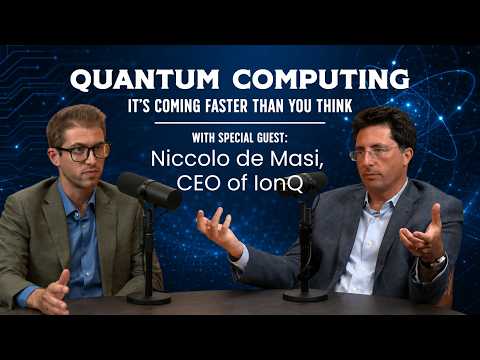
There’s a quiet revolution on the horizon, resonating not through the clang of machinery but in the quantum hum of possibility. Quantum computing, a concept once ensconced in the farthest realms of futuristic imagination, is knocking at the doors of the present. And according to Niccolo de Masi, Chairman and CEO of IonQ, it’s arriving faster than we dare to assume.
Based on content from Texas Public Policy Foundation
In a conversation that’s both compelling and crucial, de Masi delves into the contrasts and synergies between classical computing and the burgeoning realm of quantum technology. The evolution from CPUs to GPUs might have felt revolutionary, but it’s the rise of Quantum Processing Units (QPUs) that promises to redefine our technological landscape. While classical machines calculate in serial, quantum machines dance in a tapestry of possibilities, solving problems in mere minutes that would otherwise stretch across centuries.
Consider the implications for industries pivotal to our everyday world—energy, healthcare, and national defense, to name a few. These sectors stand on the cusp of transformations that quantum computing could precipitate, unraveling complexities like tangled threads to reveal clarity beneath. Quantum’s potential for modeling complex molecules and materials could lead to breakthroughs in personalized medicine and materials engineering, charting paths previously thought inaccessible.
But with great power comes profound responsibility. Enter “Q-Day,” a term that encapsulates the ironic dual nature of quantum advancement: the point at which quantum computers possess the ability to breach current cryptographic protocols, laying bare the vulnerabilities of national security infrastructure. This isn’t just a theoretical exercise; it demands immediate consideration from policymakers, industries, and technologists alike, lest we find ourselves on the back foot in an increasingly interconnected world.
Texas finds itself at the epicenter of this burgeoning potential, with the Texas Quantum Initiative poised to spearhead not just statewide but national leadership in the quantum sector. De Masi paints a picture of a Texas that utilizes its extant advantages—robust energy resources, semiconductor prowess, leading research universities—as springboards into the quantum future. Effective policy-making in workforce development and infrastructure security will be instrumental in ensuring that Texas doesn’t just participate in but leads the quantum economy.
The dialogue is rife with notes of urgency and opportunity. National paradigms are shifting; other states and countries are taking substantial strides. As de Masi notes, “Quantum is coming like a freight train,” heralding changes that resonate far beyond Texas’s borders. The questions, however, linger—are we ready for Q-Day? What contingencies are in place for when quantum changes not only the rules but the game itself?
Ultimately, the conversation with de Masi serves not only as an insight into quantum computing’s immediate futures but also as a clarion call for proactive engagement. In understanding quantum computing’s power to transform, perhaps we also find a framework for navigating that transformation responsibly.
As we stand on the threshold of a profound technological shift, the imperative is clear: to foster environments, particularly in places like Texas that are ripe for innovation, where quantum advancements are not just possible, but actualized in ways that reflect and propel our deepest values of liberty, personal responsibility, and enterprise.
The dialogue may be about technology, but its roots dig into a broader soil of societal change, beckoning us to consider not just how quantum computing will reshape our world, but how we might reshape ourselves to meet what comes next.
Learn more about IonQ
Explore more Texas Public Policy Foundation research
—