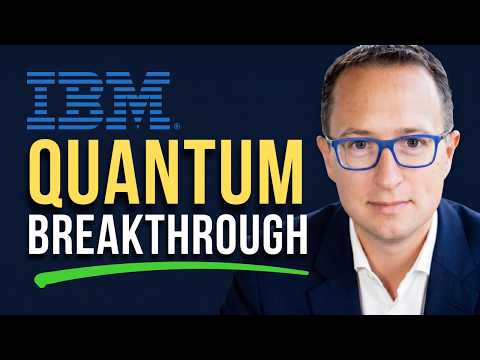
There’s a settled comfort in the idea of IBM as an old, dependable dividend stock. It’s akin to a piece of familiar furniture, perhaps overlooked in the corner of a well-traveled room, trusted for its stability rather than admired for its innovation. But that assumption may demand a reassessment. While historically overshadowed by its mainframe era, IBM is quietly crafting a future narrative intertwined with the arcane yet burgeoning world of quantum computing.
Based on content from Rick Orford – Trading Stocks and Options For All
Imagine, if you will, a piece of driftwood on the shore, initially plain and unassuming, but it holds stories of tempestuous seas and distant lands just beneath its weathered surface. IBM is akin to this driftwood, its quantum ambitions perhaps obscured by its sedate exterior, yet there’s a powerful narrative written in its grain, noticeable only if you look closely.
Amidst the chatter about cloud services and artificial intelligence through hybrid developments like Red Hat and enterprise AI such as Watson X, IBM’s real quantum breakthrough might still lie in plain sight—a secret whispered amongst its partners and government enterprise friends. The United States Pentagon and over 340 partnerships don’t engage lightly, nor do they pivot on mere potential. The question emerging now is whether IBM’s quantum agenda progresses from speculative whispers to something far more tangible and, critically, valuable.
The intrigue is further accentuated by what Rick Orford describes as the “Utility Filter,” a mechanism for discerning whether quantum computing is still immersed in theoretical allure or if its facets are being polished by practical application. IBM finds itself at this crucial juncture—innovating past the cacophonous “sell” of hollow stock symbols and transforming into a viable enterprise-backed portfolio investment. In this space, IBM does not stand solitary; with Google’s, Microsoft’s, and Amazon’s shadows looming, competition is not just expected but intensified.
Yet, what colors IBM distinct is its ecosystem reach—most notably, Qiskit, which covers nearly 70% of quantum developers worldwide. Through this, IBM lays claim to a highly sticky narrative, one where its developers and users become integral threads in a larger quantum tapestry that might one day redefine computational possibilities, much like Nvidia’s CUDA in graphics, albeit in more abstract and complex computations.
Further intertwining their story, IBM’s collaboration with the US Department of Commerce on the “Andor on” quantum chip foundry reflects strategic vision. A billion-dollar commitment, matched by prospective government funding, signals that IBM is taking steps to lay a foundation for quantum infrastructure growth. These partnerships don’t simply reflect investment in technology but an acknowledgment of its strategic import—a change from retail frenzy to a symphony of strategic designs.
Investment, inevitably, comes with risks. The timelines for quantum computing reaching fruition extend to 2029, as IBM pursues the creation of a large-scale fault-tolerant quantum computer. Such pursuits loose themselves into a wilderness of not just engineering feats, but challenges in physical laws as well. In this arena, IBM must not merely articulate a roadmap; it must navigate one.
Moreover, IBM’s consulting endeavors, substantive but cyclical, could drag under the weight of economic downturns, reshaping financial horizons for analysts keen on a world where quantum is headline rather than footnote. Then there are the competitive titans of tech standing ready to defend or expand their own turf, a counterbalance to IBM’s calm but resolute progress.
Perhaps the resonance in this story is the juxtaposition of what IBM was and what it’s becoming. The aged walls of this once-mainframe titan are being decorated anew, embellished not with fleeting fads but with emerging technology that promises to redefine industry standards in a material, substantive way. The careful synthesis of its dependable enterprise core with cutting-edge quantum technology may earn IBM a renaissance—one that invites careful watchfulness from investors and technologists alike.
So the query remains, as if spoken to shadowed corridors: Is IBM’s quantum venture simply another chapter in a timeworn saga or the prologue to a narrative yet fully grasped?
—