
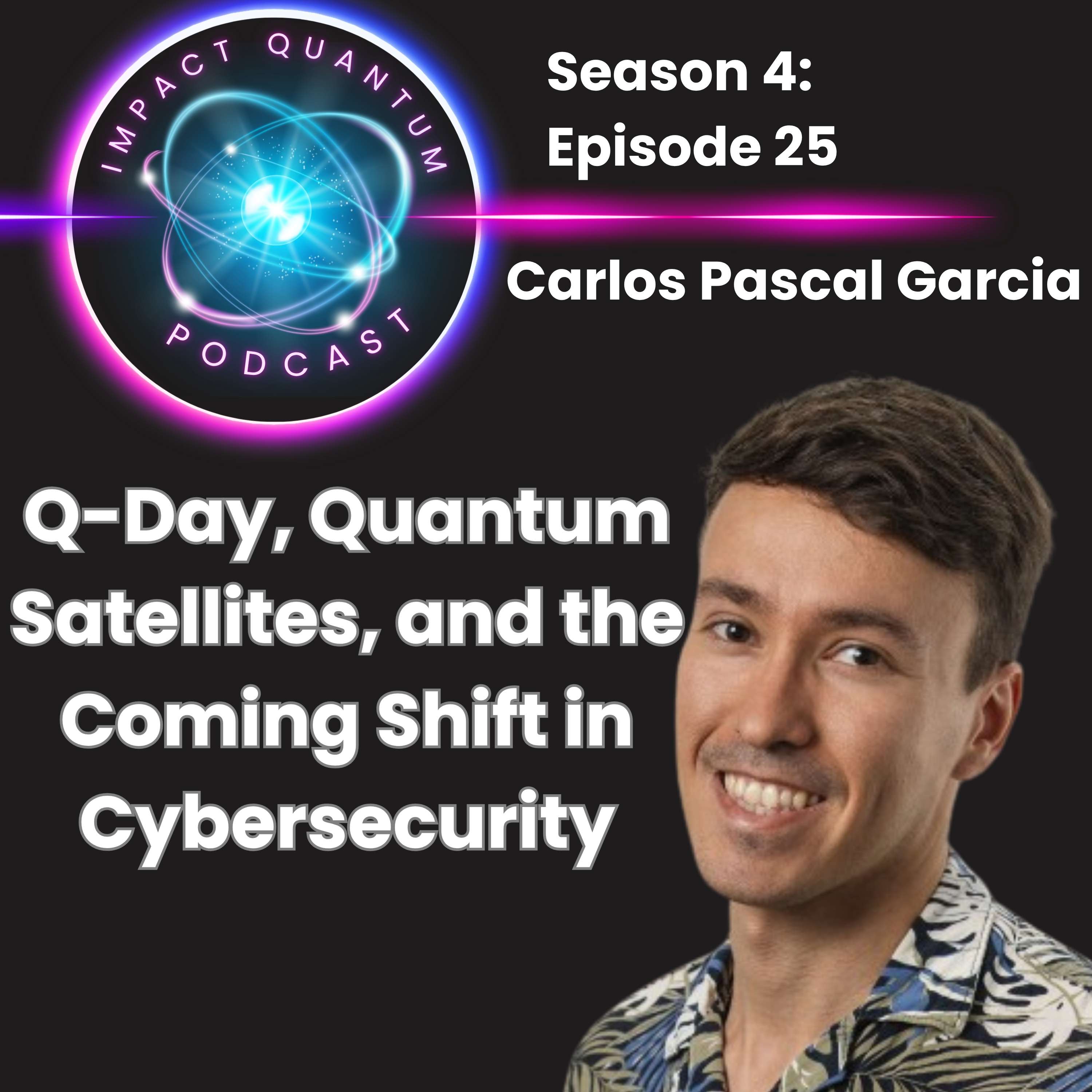
In this episode, the conversation focused on the transformative potential of quantum networks alongside the ever-prominent quantum computers. A key theme that emerged was how curiosity—rather than just advanced degrees—can open doors in the quantum industry. The discussion explored the path from complex mathematical curiosity to a career in quantum information science, highlighting how quantum communication is emerging as a crucial counterpart to quantum computing.
Listeners will learn about the threats and opportunities presented by quantum technologies, including the significance of quantum key distribution (QKD) and the coming era of “Q Day,” where classic cryptographic systems may become obsolete. The episode provides insights on the unique challenges of quantum networking infrastructure, the role of satellites, and why quantum communication remains an underappreciated area with immense potential. Several points were raised, including the tension between post-quantum cryptography and QKD, the fragmented approach to quantum infrastructure across nations, and the key industries that will drive adoption. If you’re quantum-curious—whether you’re a technologist, executive, or just fascinated by the future of secure communications—this episode breaks down the stakes, the science, and the paths forward in quantum networking.
Links
- Carlos on LinkedIn – https://www.linkedin.com/in/carlos-pascual-garc%C3%ADa-ph-d-8469b216b/
- Watch on YouTube – https://youtu.be/ohDtnOwYpHg
Time Stamps
00:00 Choosing a PhD in Quantum Communications
06:44 Satellite communication and defense strategies
10:03 Introduction to quantum cryptography
11:27 Post quantum cryptography explained
14:26 Challenges in communication authentication
17:51 Quantum communication projects in the EU
23:35 Efficient energy solutions for data centers
27:18 Challenges of scaling quantum networks
29:39 Challenges in Quantum Device Commercialization
34:02 Challenges in setting tech standards
35:57 Fragmentation in global security tech
40:23 Challenges of microscale computations
42:58 Julia’s role in data science
45:49 Quantum podcast with Candace and Frank
Transcript
Quantum computers get the headlines. Quantum networks may change the world.
Speaker:Hello, and welcome back to Impact Quantum, the podcast where we explore the
Speaker:emerging industry that is quantum computing, what that means
Speaker:for careers, and do you need to have a
Speaker:PhD to get into it? Maybe not. You just really need to have
Speaker:a lot of curiosity. And with me is the most quantum curious person I
Speaker:know, Candace Kahule. How's it going, Candace? It's great. Thank you
Speaker:for asking. Today is a beautiful sunny Friday in June,
Speaker:and I'm enjoying the weather. I'm not going to lie.
Speaker:I'm very excited about it. Today we have. We're lucky
Speaker:to speak with Dr. Carlos Pascal Garcia,
Speaker:and he is a quantum information scientist
Speaker:at Lux Quanta. How are you,
Speaker:Carlos? Hello, Candace. Doing great.
Speaker:Yeah. Thank you very much for the invitation. I'm really pleased to be invited into
Speaker:this podcast. Yeah, well, we're great to have you. And,
Speaker:you know, even though we say you don't need to have a PhD, you
Speaker:do. But I also think that not. I think that can be,
Speaker:one, congratulations, because that's not an easy thing to do. And two, you know, a
Speaker:lot of people, I think, get intimidated by that idea that you have to have
Speaker:a future PhD in quantum physics. But. So how did you end
Speaker:up where you are? Right. Your LinkedIn profile says you're a
Speaker:quantum information scientist. That's. That's interesting. I'm
Speaker:curious, how did you find your way to quantum? So,
Speaker:I don't know. For me, it was kind of a natural path in the sense
Speaker:that I like complex mathematical problems that you can actually play around,
Speaker:and they have some correspondence with reality. Something that, for example,
Speaker:you're going through the streets and you see, for example, a
Speaker:neon billboard, and you ask yourself, how is it that it's
Speaker:emitting light? Right? You ask yourself these kind of questions. And for me,
Speaker:it was a very natural idea to, first of all, get into physics.
Speaker:Right at the beginning, I got to admit I was more into general relativity.
Speaker:But then I gravitated, pun intended, towards more quantum technologies
Speaker:and quantum mechanics in general. And it had a very
Speaker:direct evolution since from Bachelor until your PhD.
Speaker:You start from very small problems that you can solve in about 1 minute, 5
Speaker:minutes, and then it evolves into some hours. And finally you get into some problems
Speaker:which you admit that it's going to take not just days, but even months. That's
Speaker:how I got into my PhD, and I was indeed pretty much into that, like
Speaker:solving problems and especially if they have an actual impact by another day,
Speaker:like, they. They can help the mankind that was something pretty
Speaker:rewarding to me. Interesting.
Speaker:Okay, so I have notes here. Oh, sorry, Frank, I have noticed
Speaker:that communication, quantum communications
Speaker:was. Has become a big focus for you.
Speaker:Can you tell us more about that? In my case, when
Speaker:I. When I started thinking about my PhD right at the end of my master's,
Speaker:was indeed thinking about doing content technologies, right? And the question that
Speaker:begs itself is what kind of technology are you actually willing to study?
Speaker:The first, the first problem that you have to face is that indeed there are
Speaker:three branches. Quantum communications, quantum sensing,
Speaker:as well as quantum computing. And in the end, I decided to
Speaker:pick quantum communications because for me, it's kind of like the flip side of
Speaker:quantum computing. Namely, we know that quantum computers
Speaker:are powerful, right? They will be able to solve some tasks which right now
Speaker:they seem to be impossible. And this is good on the one hand because it
Speaker:means drug discovery, for example, but on the other hand, it means that your security
Speaker:is going to be at risk. Because classical cryptography is based on typical
Speaker:factorization of prime numbers or problems which are computationally hard, but they can be
Speaker:tracked using quantum computings. And quantum cryptography, which
Speaker:is a subfield of quantum communications, actually works towards fixing this issue,
Speaker:right? Which is going to be a very huge threat for the years to come
Speaker:once we see in the next 10 to 15 years how quantum
Speaker:computers become cryptographically relevant. And I mean that they can indeed crack
Speaker:rsa, Diffie, Hellman, or other current cryptosystems that we use
Speaker:now to store, for example, our banking information or the
Speaker:databases of hospitals.
Speaker:Interesting. Okay, so let me ask you from your perspective, because you talk
Speaker:about quantum key distribution. So what does Q day
Speaker:mean to you? So Q Day means the
Speaker:start of a new era in terms of, especially in terms of cybersecurity,
Speaker:st the same way that the year:Speaker:could have meant a complete change in, for example, the way we had the
Speaker:computers storing information, because, you know, the change of dates was supposed to start
Speaker:at year zero and we had to fix a lot this issue,
Speaker:right? Invest a lot of money to avoid resetting
Speaker:all the computers of the world. We could face that same threat in the sense
Speaker:that, for example, a certain old database which has been storing
Speaker:information for 30 years, right? Did you recall that actually that is
Speaker:using RSA, which is not secure anymore, like a lot
Speaker:of forgotten information that is actually critical, is going to be under
Speaker:threat, and we'll have to double check basically any kind of
Speaker:database that we have here and there in order to see whether
Speaker:it's actually safe. Or if we actually have to change into some
Speaker:new cryptographic system like post quantum cryptography, or use quantity
Speaker:distribution. Interesting. And
Speaker:your LinkedIn profile also mentions quantum
Speaker:satellites. So what? What makes satellites special? We've had
Speaker:a couple people talk about satellites, but yes,
Speaker:I think I know what the answer is. But why would I want a satellite
Speaker:as opposed to a terrestrial solution? So
Speaker:it has to do indeed with the quantum properties, especially of light.
Speaker:So indeed you would like to have a solution that works for optical fibers for
Speaker:your communications, because they are reliable, they are guided,
Speaker:right? And they are very predictable. It's not that they
Speaker:fluctuate, like for example, the atmosphere does. What's the problem?
Speaker:That the losses in optical fiber are exponential, which means that
Speaker:after just, I think it is 15km how far your signal has
Speaker:disappeared. And if you try to go beyond 100km, actually you
Speaker:cannot perform quantum communications anymore because the quantum properties of your
Speaker:signal have basically vanished and they cannot be
Speaker:neither detected anymore. Or if you try to use what it's done in
Speaker:classical communications, the amplification, then you're introducing
Speaker:a pulse that destroys the quantum correlations in your signal. So
Speaker:you have no contact communications anymore. What's the solution? If you want
Speaker:to go beyond 100km, you have to go into free space.
Speaker:This means one shooting signals from one laser
Speaker:into one antenna between, for example, two skyscrapers. You could
Speaker:use satellites like from, from the Earth into a certain
Speaker:satellite that you have in the orbit. Or you have for example, satellite
Speaker:constellations as well, like a starlink, which are satellites communicating between each
Speaker:other in order to distribute a signal each in one point in the Earth into
Speaker:another one. That's how you can actually reach distances which are relevant to
Speaker:the, to the scale of the Earth. And all this thanks to the fact that
Speaker:fear dissipates signals with the inverse of the square, basically with a
Speaker:factor which is way smaller than the exponential that you have, the nautical fiber.
Speaker:And then you have the other factor, right, which is also very important, which is
Speaker:defense applications. So one of the very important lessons that we learned from Ukraine
Speaker:back in:Speaker:communication signals you have in Earth, they can be denied in just a few hours
Speaker:or a few days. How can you keep communications in
Speaker:such a scenario, putting all your infrastructure into satellites which can
Speaker:be protected, sorry, which cannot be attacked with the same efficiency
Speaker:or with the same power as you would have on the Earth.
Speaker:Interesting. It's just fascinating that
Speaker:space is a major
Speaker:platform for quantum computing and quantum compute, quantum
Speaker:networking, really? Right. And I guess, really, what's the difference between
Speaker:quantum networking and quantum computing? Right. It's probably a loaded question,
Speaker:but do you think investors are paying enough attention to quantum
Speaker:networking? I think it's not the case.
Speaker:Indeed. And that's something that you can actually spot when you, when you
Speaker:say, for example, the startup ecosystem, because you can
Speaker:name lots and lots of different startups in America or in Europe that they are
Speaker:devoted indeed to quantum computing. Right. But then when it comes to quantum
Speaker:networking by itself, maybe you have a bit like we
Speaker:have, we link in Paris, we have new quantum, it does some networking
Speaker:solutions. And here in Barcelona, for example, we have a startup just started a
Speaker:few months ago, Arc quantum, that indeed
Speaker:they all do quantum memories or some sort of dcp, quantum computing or quantum
Speaker:networking. But indeed there's just not enough activity at the moment.
Speaker:There's also a very important thing, which is that quantum repeaters, for example, quantum
Speaker:memories, they're still in a very early stage. It's a subject of a
Speaker:current economic study. But indeed we should pay attention to this in the
Speaker:short term in order to make it, for example, quantum computers scalable in the
Speaker:context of high performance computing or distributed computing.
Speaker:Interesting. So let's
Speaker:go back to QKD for just a second because I think it's
Speaker:important, I think that there's a disconnect
Speaker:between what executives understand about it
Speaker:and what quantum
Speaker:key distribution can actually solve.
Speaker:Certainly. So, okay, quantum key distribution by itself
Speaker:tells you that to users, right, which are typically called Alice and Bob,
Speaker:by exchanging signals which are of a quantum nature, they can
Speaker:generate a series of correlations which they can use in order to verify that indeed,
Speaker:that the signal has not been distorted by any third parties. Right. By any hacker,
Speaker:or let's say by very high noise in the optical fiber or the channel
Speaker:that connects them. Right. What does this mean? You can indeed
Speaker:detect any kind of attack that was happening on the signals. But you were, for
Speaker:example, distributing a key in order to later perform an encryption, which is
Speaker:one of the biggest problems that you have in classical cryptography, the distribution
Speaker:of keys. The good thing about this is that if you tell me that the
Speaker:transmission of information was secure, the only problem that you have afterwards is
Speaker:the storage of the information. Which means that, for example,
Speaker:the public keys that you have to distribute in order to perform
Speaker:asymmetric cryptography. And again, classical cryptosystems like rsa,
Speaker:right. This can be harvested by a quantum hacker and in
Speaker:a matter of minutes or days with a quantum computer which is powerful enough,
Speaker:this Classical sorry, this public key can be used in order to decrypt the private
Speaker:key. But this is not the case in quantum computing and
Speaker:quantum communications, thanks to qkd, because it indeed has this
Speaker:property, the fact that Alice and Bob, by using their correlations, they can detect
Speaker:whether there was a third person harvesting this information.
Speaker:And such denial is what we call the information theoretical security.
Speaker:Knowing the fact that by just applying measurements on your quantum signal,
Speaker:you can indeed characterize it fully. And in particular, you can detect the
Speaker:presence of third parties that were trying to extract information from
Speaker:you. Okay,
Speaker:so what is the. How does QKD differ from
Speaker:post quantum cryptography? That's actually a
Speaker:very important point, right? Because people typically think that they have a solution to the
Speaker:same problem, which is not actually the case. Right. So post
Speaker:quantum cryptography is actually more related to mathematics and software
Speaker:engineering in the sense that it's based on creating problems which are
Speaker:computational hard for a quantum computer as well. Right. When I was
Speaker:saying before that any hacker could harvest information, right?
Speaker:And after a certain time, this information can be used in order to crack
Speaker:the coding of the crypto system. This is something that can happen with
Speaker:classical crystal systems. But if you go to post quantum cryptography, you can
Speaker:indeed deny this in practical terms, because these problems are
Speaker:engineered in such a way that the quantum computer, the hacker, can take
Speaker:centuries or even millions of years in order to actually decry that information.
Speaker:So for a certain time scale which is relevant, you can
Speaker:indeed certify that you have security based on these computational
Speaker:constraints. What's the problem? That again, just like it
Speaker:happens with classical cryptographies, nothing prevents you or
Speaker:anybody in the future to discover a new algorithm that. Look at that. Actually it
Speaker:can solve your PQC algorithm and crack your encryption
Speaker:efficiently. That's the main difference with respect to quantic
Speaker:acquisition and quantic ACE vision. This cannot happen because again, you enforce
Speaker:information theoretic security from very first principles. You can certify
Speaker:the information is secure and it will be eternally secure.
Speaker:Okay, so they're not. Are, can they be seen,
Speaker:Are they competitors or complementary technologies?
Speaker:I would say that for the majority of public, they are competitors
Speaker:in the sense that especially that's a very huge divide between
Speaker:America and Europe, because the United States, there's a very
Speaker:hard bet on post quantum cryptography. And actually the
Speaker:NSA already published a couple of years ago standards for encryption
Speaker:based on PQC and is recommending actively the migration of
Speaker:databases and cryptosystems into this new PQC paradigm.
Speaker:Whereas in Europe we are betting on quantum key distribution. This is
Speaker:incorrect or is an improper image in my opinion. Because by the end of the
Speaker:day you will need both. Right? That was why I was thinking like it sounds
Speaker:like both are going to have to or both because you can't. Because key distribution.
Speaker:If this is all for my, my cryptography nerds out there. Key
Speaker:distribution has always been a major weak point, right? You think about
Speaker:Star wars and the Death Star Candace. Remember how like in the first movie
Speaker:there was like this massive thing, but one little ex,
Speaker:one little port could be the shoot a little like torpedo down and the whole
Speaker:thing goes up. Key distribution is a bit like that, right? Doesn't matter how
Speaker:complicated your math is. But if you, if you
Speaker:mess up. I was going to use a different word, but if you mess up
Speaker:the, the getting the keys and managing the keys, it doesn't matter.
Speaker:It doesn't. I mean it, I mean clearly, maybe I'm not an
Speaker:expert in the field, but like you know, it matter. It doesn't blow
Speaker:up everything, but it really puts a big hole in your big secure. It's like
Speaker:having an armored truck and then leaving the door open and the keys in the
Speaker:ignition, right? Actually, yeah, that's something that
Speaker:if you need to exaggerate a bit the picture, I could say that the weakest
Speaker:part of distribution is the authentication, right? So basically
Speaker:you need your two users, ICE and bo, they need to preshare some secret
Speaker:from way before in order to basically authenticate the channel
Speaker:so that Alice knows that she's talking to Bob and Bob knows that he's talking
Speaker:to Alice. But of course you need that they know each other from before
Speaker:and they are sharing some secrecy. That's a
Speaker:big problem, Right. And right now the main recommendation by the
Speaker:European Commission that is being researched currently is to use this hybrid approach,
Speaker:namely a digital signature based on PQC such that
Speaker:Alice and Bob, they can authenticate their communication
Speaker:without needing a pre shared key. That way you have
Speaker:the distribution of the key which is information theoretically secure
Speaker:and you're using PQC technologies in order to simplify
Speaker:all the practical framework, namely the execution and the authentication of
Speaker:the relevant channels. Interesting.
Speaker:And that's going to be the future.
Speaker:Interesting. Do you think that businesses realize that the key distribution
Speaker:aspect is really going to be as
Speaker:crucial, especially in America, right. Where
Speaker:they have really leaned heavily into the PQC side of things.
Speaker:Do you think that people have really thought about
Speaker:QKD enough?
Speaker:You mean in America? Yeah, in America I would say yes,
Speaker:but no. For Me, I think that is mainly because of the rather
Speaker:philosophy of American people, right? Because QKD, by the end of
Speaker:the day is when you commercialize it, it's a product by itself, right? It's a
Speaker:physical product, whether it's going to be a bulk telecom system
Speaker:or a microchip. This means that you have. Since typically it's related
Speaker:to cryptography and security and defense applications, of course you will
Speaker:have that. The supply chain and the production is all
Speaker:within your country, right? Or at least within a friendly space, like let's say in
Speaker:natural countries. Of course, this means that this is going to be an
Speaker:expensive solution compared to putting all these, all these concepts,
Speaker:supply chain or the workforce and let's say countries like China. But
Speaker:you're not going to do that because it's a complete deal breaker, right? Right. In
Speaker:the case of quantum computing, for example, you have to extract and say this is
Speaker:what it is. Right? I had to do that because in order to do quantum
Speaker:computing, I need the machine itself. But in the case of fusion, you could
Speaker:indeed consider that it is equivalent to pqc, which
Speaker:ties back to the debate that was explained before. Right? And say that
Speaker:actually, for all practical purposes, PQC does the same.
Speaker:So this is scalable, it's just a software. It can be
Speaker:implemented using Python libraries. So why should I bother about building a product
Speaker:with QKD when I can actually have the software? And
Speaker:indeed that's what you have. So there are no startups or QKD in the United
Speaker:States. You have many programs also in the European Union,
Speaker:also startups, but also the European Union does not do that much of what you
Speaker:see. Interesting.
Speaker:Sorry, Candace, I don't want to go down the. I don't want to geek out
Speaker:too much on the cryptography stuff. No, I'm totally enjoying it.
Speaker:So you can geek out all you want. I haven't had enough coffee
Speaker:yet, so give me a minute. So how much of the infrastructure
Speaker:required for quantum networking already exists?
Speaker:I would say basically zero. Okay, so,
Speaker:okay, here in the European Union, for example, we have several initiatives, right? Like
Speaker:Euro qci, for example, which was a project by European Commission.
Speaker:Deploy the first attempts of quantum communication networks in all the
Speaker:capitals of the European Union, right? So you have, for example, a chapter in
Speaker:Madrid, you have another chapter in Paris, et cetera. They are all
Speaker:working on different concepts. Like one of them they're using, for example,
Speaker:in the one in Paris, for example, they use a conical distribution based on
Speaker:laser pulses, what we call continuous variables. In
Speaker:other ones, for example, they trying to analyze the energetic efficiency of
Speaker:networks. So these are very basic
Speaker:ideas and concepts that will scale up with time. There's for
Speaker:example another project that started just a couple of years ago, Petrus,
Speaker:and the one which will be followed, which is called Iris Square or
Speaker:Iris 2 also, which aims at taking all these small
Speaker:metropolitan networks, right. And join them using long
Speaker:distance links, which is going to be satellites via the date. And for
Speaker:example, Iris 2 has the official target
Speaker:of including all overseas territories of the European Union, which
Speaker:means that we'll have I global network that will integrate in
Speaker:metropolitan scales, right. Regional networks,
Speaker:international communications as well as satellite constellations.
Speaker:This is for me the biggest attempt for
Speaker:doing quantum networking for quantum distribution. Right.
Speaker:And indeed you will have another activities like for example, what is
Speaker:new quantum doing for distributed quantum computing, which is again
Speaker:quantum networks, but more from the perspective of the hardware and quantum
Speaker:computing. But well, to be fair, I'm not that
Speaker:much aware about the state of the art of those applications.
Speaker:Interesting. What would you say to someone if you had to
Speaker:explain quantum communications in under a
Speaker:minute, like kind of like 60 seconds or what would you say to
Speaker:a CEO? I know it's really tough because like there's a lot. But like what
Speaker:would you say to someone who's not technical but has money to pay
Speaker:for these solutions? Yeah,
Speaker:yeah. So no, Well, I
Speaker:actually have this kind of discussion with my business
Speaker:development manager, right. Which is that, for example, for
Speaker:the case of a conical distribution, what you want is to reach the same
Speaker:kind of production rates as you have in classical
Speaker:communications, megabits per second or if you can, just gigabits per
Speaker:second. Right. If we go in general to quantum
Speaker:communications, not just quantum cryptography, basically the same idea is the fact
Speaker:that you can pump much more information per second.
Speaker:So if you tell me that your classical system is able to go to
Speaker:the, I don't know, 100Mbps. Right. You
Speaker:can use quantum signals to encode more information for each laser
Speaker:pulse that you have in your optical fiber. Which means that instead of 100,
Speaker:I can get you, let's say 300Mbps.
Speaker:Right. Actually there are schemes that work on this, like for example, the
Speaker:well known super dense coating, which indeed support the idea.
Speaker:So if you can get better repetition rates with a
Speaker:simplified infrastructure, because again, we're just talking about lasers and
Speaker:commercial technologies, you can build actually a very good business case.
Speaker:Interesting.
Speaker:Which industries do you think are going to want to
Speaker:adapt this type of secure networking communication? First,
Speaker:so mainly two. The first one is governments and public institutions.
Speaker:Right. Especially within the context of defense.
Speaker:We see right now a lot of initiatives that have to do with
Speaker:indeed military applications, like for example,
Speaker:all these initiatives I told you about. So your qci, Iris
Speaker:Square, there's also QSMP that is actually managing
Speaker:from ICFO in Barcelona, which indeed have a defense
Speaker:chapter. So let's say your communication in restricted scenarios
Speaker:where for example, there's an adversary actively introducing noise in your
Speaker:channels and you also have other activities
Speaker:like making secure communications between different
Speaker:ministry buildings of the capitol.
Speaker:That's the first
Speaker:interesting sector. And the second one is telecom. Telecom providers.
Speaker:So basically companies that indeed they would like to sell in
Speaker:the medium to long run GKD devices. But in their case,
Speaker:they are indeed mainly concerned about what I said before, repetition
Speaker:rates, encoding as much information as possible per signal.
Speaker:And if they can also sell this extra in terms of security
Speaker:information, theoretical security, without inducing over
Speaker:cost compared to our current technologies, they are
Speaker:indeed interested into expanding the business line
Speaker:in this regard. Okay,
Speaker:so here in Canada they're talking a lot about
Speaker:these data warehouses and I
Speaker:know they're talking about this everywhere and
Speaker:energy consumption. And I know there's a really big push here. Data
Speaker:centers, you mean data centers. Data centers.
Speaker:And here in Canada they're doing this big push with
Speaker:energy and the creation of energy. And I wanted to
Speaker:understand why is energy efficiency becoming part of
Speaker:the quantum conversation, do you think? Okay, right.
Speaker:Actually, just reminding me that this is one of. When it comes to
Speaker:tech providers, the main target is in the data centers, right?
Speaker:Because they are what we call capillary networks.
Speaker:So they have many, many links which are very short, typically
Speaker:they do not exceed 5km, but indeed
Speaker:for each of these connections you would need a pair of QQD devices.
Speaker:This means that in a data center, which
Speaker:might be massive in the sense that it needs thousands of
Speaker:devices in order to implement QKD for all
Speaker:the different sectors, energy consumption becomes actually a very huge
Speaker:problem, especially within our current context where energy is expected to keep
Speaker:rising in prices as well as the demand is going to keep increasing
Speaker:any kind of efficiency, Even at just 1%, they can indeed mean
Speaker:thousands or even millions of dollars in the long run.
Speaker:And actually there are actively lines of research, like I
Speaker:got for example one paper, and there's even the so called Quantum Energy
Speaker:Initiative, which is managed by researchers from Spain and
Speaker:France leading the efforts in this regard. And namely study for example,
Speaker:new architectures for bulk QKD systems which are more
Speaker:efficient as well as how to create microchips
Speaker:which preserve the efficiency of these bulky devices, but
Speaker:they need to consume less energy because they can reduce all
Speaker:the scales and they need smaller electric pulses, for example.
Speaker:It will become a very huge and important field because of
Speaker:this scalability issue, particularly in data centers.
Speaker:Interesting.
Speaker:Where do you think we go from here
Speaker:in terms of
Speaker:adoption of quantum networking?
Speaker:And you mentioned before that there was really no infrastructure in place. Do you think
Speaker:that has to be the first step? You think that would be a good place
Speaker:to start? Well, because like we also, we talk to people who are quantum curious
Speaker:and people who are curious about building out their careers, right?
Speaker:Like what? It seems like if there's no infrastructure
Speaker:yet, that seems like a good place to go. Because I think the need,
Speaker:I think we'd all agree that, that, that the need is there. But like
Speaker:we need to, we need these highways. So you know, where can, where we need
Speaker:the infrastructure. What do you say to people who are kind of not physicists
Speaker:or marketing or sales and engineers type of thing?
Speaker:Where do you think they should look for a rather
Speaker:technical profile? I would say that they need to look into the standards
Speaker:that are going to be settled by. Well, eventually,
Speaker:because for example, in the case of qkd, there are many
Speaker:different approaches in order to implement these protocols.
Speaker:So you have for example, that you can use qubits, right? Which is actually the
Speaker:initial idea by Bennett and Broussard, the so called
Speaker:BB84. The problem is that creating
Speaker:single photons or just qubits is very, very expensive.
Speaker:So they eventually moved into laser pulses. And that's how
Speaker:you got the next technology, which is the so called continuous value
Speaker:quantity distribution, which is based on using just laser
Speaker:pulses. The good idea about using
Speaker:continuous variable QKD is the fact that you only need commercial
Speaker:devices, namely optical detectors, optical fibers, right?
Speaker:I would say that it offers better scalability in the long run
Speaker:because the technologies are rather. There are some other technologies
Speaker:that must be developed like processors,
Speaker:GPUs, etc. But in general these do not
Speaker:come at a very huge cost. The problem is that, well, in the case
Speaker:of a CVQKD or continuous viral qkd, it only works for small
Speaker:scales like typical distances which are less than 40 km. If
Speaker:you want to go between 40 and 100, then
Speaker:we need to switch back into this image of qubits, as I said before, right?
Speaker:Which has the caveat that is much more expensive because you need
Speaker:cryogenics, dedicated devices, technologies which are
Speaker:again still under current development, etc.
Speaker:The way we will eventually perform these protocols, right? When public
Speaker:agencies recognize that QKD protocols are given by these kind of steps and
Speaker:they can be implemented with this hardware, that will really set the
Speaker:tone of the conversation when we come to pricing
Speaker:this on the one hand, and on the other hand the fact that different scales
Speaker:will mean different technical stacks. So
Speaker:might be that, for example, performing QKV for 80km will become
Speaker:just too restrictive, right? Or for 40km it's
Speaker:better to use this technology instead of this other which is more scalable, that you
Speaker:can buy it more easily, etc, etc.
Speaker:So that by end of the day building your quantum network is going to depend
Speaker:basically on what public institutions will tell you.
Speaker:Okay? It also has to do with the definition of security
Speaker:in the sense that depending on how different, because there are
Speaker:different standards of security in quantum communications, you
Speaker:might tell me that you decrease the level of security for
Speaker:certain applications that you can nice that yes, this is secure for practical purposes.
Speaker:And in that case you could access a certain kind of technology
Speaker:which is much cheaper, much easier to produce, much more
Speaker:scalable. But it might be, for example, for other applications
Speaker:like sensitive data, you need another technology which is more
Speaker:expensive.
Speaker:So it all becomes the age old cost versus security
Speaker:needs conversation again, in the long run, that
Speaker:will be the main drive costs as well as security levels.
Speaker:So when you speak with business leaders that are outside the quantum
Speaker:field, what questions do they seem to ask you
Speaker:most often? Well, I got to make that
Speaker:this is sometimes a bit of a frustrating task in the sense that
Speaker:they're mainly concerned with the output. Like they
Speaker:admit that. Yes, well, you do this quantum communication
Speaker:thing, right? Like it works, right? This is secure
Speaker:and they indeed have the notion that you do your job
Speaker:properly. And thus they can indeed
Speaker:they purchase the device or the idea from you via licensing, and
Speaker:then they will eventually sell the device. And
Speaker:this becomes sometimes a sort of a rat race in the sense
Speaker:that by the end of the day, for example, the telecom providers, they only
Speaker:care about megabits per second, right? Like if you can
Speaker:achieve higher yields at your competence, you cannot win
Speaker:by end of the day. But of course this means that you can
Speaker:make any claims about the security of your device, like, yes, it's secure against
Speaker:any kind of quantum adversary without
Speaker:actually getting into the technical details of the security
Speaker:methodology that you have, you can reduce
Speaker:and custom corners and thus you will obtain a better
Speaker:result for your device, because of course you're restricting the action of any
Speaker:hacker. So this means that you can expand and
Speaker:achieve higher yields for your protocol.
Speaker:As a result, you have that many startups and many companies, they say that
Speaker:they indeed can achieve better results than anybody else, go to distances which
Speaker:are much larger. But this is mainly because they disregard the
Speaker:quality of their final product. In terms of security,
Speaker:the solution in the long run for this will be indeed the establishment of security
Speaker:standards by public institutions. But right now
Speaker:the main drive is indeed simply the results community. Well,
Speaker:the business community typically does not pay attention to the
Speaker:security standards.
Speaker:Interesting. Do you think
Speaker:that this is the most underappreciated
Speaker:opportunity, like quantum networking? Quantum comms
Speaker:is the most unappreciated. Because it seems like it is. Because it seems like
Speaker:there's. Everyone's talking about the hardware they're building, people are talking
Speaker:about the software layers that they're building. But this is.
Speaker:You don't hear a lot about it. Right. And there's only a handful of experts.
Speaker:And I think we've been lucky enough to have two.
Speaker:You're the second one, maybe the third. And if you look at the
Speaker:news feeds, at least the ones I get, the algorithm has
Speaker:chosen for me, this doesn't come up that often.
Speaker:And you're laughing. So there's probably a bit of truth in this.
Speaker:There's quite a lot of truth in views in the sense that
Speaker:media exposure and investment is typically focused only on
Speaker:quantum computing. Right. Like people typically hear about
Speaker:quantum technologies and they generally think about quantum computers
Speaker:and indeed. Well, quantum communications is a bit of
Speaker:the small branch Apple. I would actually say there's about a 20%
Speaker:of all the activity you have in quantum technologies,
Speaker:some in academia and industrial. Right.
Speaker:And we, we don't have indeed the level of exposure of,
Speaker:or let's say media coverage that quantum
Speaker:computing has. It has to do a lot with the fact that
Speaker:indeed quantum computers are, I don't know how to put in
Speaker:words like more interesting in the sense that you have the device
Speaker:itself. Right. Typical image of a cryostat, which is golden. Right.
Speaker:Isn't it beautiful? It's not like for example, you have
Speaker:in qkd, which is just a simple box that you put in a. In a
Speaker:typical rack. This on the one hand. On the other hand, when
Speaker:you. There's a lot of momentum in this. Like quantum computing already
Speaker:blew up. Right. It's getting into big numbers in terms of
Speaker:investment as well as image. So when you have freshmen
Speaker:coming into, into their PhDs, they indeed want to get into quantum
Speaker:computing because that's where opportun are, that's where money is, right?
Speaker:Indeed. For example, in my case, there's only A very handful of
Speaker:researchers in quantum communications here in Europe, or specifically in
Speaker:quantum distribution. But I can name a lot. When it comes to quantum
Speaker:computing, is there a gap between what
Speaker:researchers are building and what the industry currently needs?
Speaker:That's actually a very nice question. I would say yes.
Speaker:Right now the market is demanding the product.
Speaker:The thing is that in order to set your device, you
Speaker:indeed have to give a list of all the requirements that
Speaker:they give you. Like for example, how can you control the metrics of the
Speaker:device, how do you enforce security, etc.
Speaker:Which is indeed a good solution for the short term,
Speaker:like in the sense they have to check boxes.
Speaker:But in the long run, if we want things to scale
Speaker:into the big picture, like having quantum communications,
Speaker:for example, the layperson,
Speaker:you will indeed need again the standards, which is the main thing.
Speaker:What's the problem? Building a standard requires basically all
Speaker:the relevant scientists of, for example, Europe or America to
Speaker:sit down, write a paper, agree that quantum distribution
Speaker:is Based on steps 1, 2, 3, 4, 5, sign that
Speaker:paper and put it into archive, or give it
Speaker:to the relevant information agency, like for example,
Speaker:security agencies here in Europe. And that's how eventually, if
Speaker:everybody agrees on the fact that security for quantum devices means
Speaker:this, the governments recognize it. So that by the end of the
Speaker:day you have an elaborate standard, and when you sell your product, you can simply
Speaker:put the seal of quality and say that yes, we're certified by this organism,
Speaker:it's this device, and indeed it works thanks to
Speaker:the security proof, which is standardized according to the certain
Speaker:bullet points.
Speaker:Interesting. Do you think we're moving towards
Speaker:a future with interconnected global quantum networks?
Speaker:Or do you expect countries to build separate sovereign quantum
Speaker:infrastructures? The second one, actually,
Speaker:that relates a bit to the current fragmentation that we
Speaker:see in the global landscape, right? And also the. The fact
Speaker:that since QKD is typically tied to security
Speaker:applications, this means that governments of different
Speaker:nations, they want to retain some degree of control over the
Speaker:technology. I'm thinking right now, for example, about this proposal that
Speaker:happened a few months ago by defense
Speaker:company Rheinmetall in Germany, together with
Speaker:a satellite company, ohb, in which they proposed a
Speaker:Starlink like satellite network for the German government, only for
Speaker:military applications with a budget of
Speaker:30,000 billion years. Well, 30
Speaker:billion euros, something like that. Quite a lot. And
Speaker:indeed that only for Germany, right? And I would expect
Speaker:to France, which also has a very important military sector, to follow
Speaker:suit and pretend to elaborate a similar proposal.
Speaker:We will observe indeed, first of all, some sort of
Speaker:national initiatives in this regard, and Maybe in the long run for
Speaker:some transnational agencies, like, for example, the European Union, these
Speaker:will be integrated into one big network,
Speaker:like as I said, tied, for example, to the Iris
Speaker:Square program. But I think that this will happen in the very long
Speaker:run, like in:Speaker:wow. I know. We're getting
Speaker:close to the top of the hour. So
Speaker:what do you think? You mentioned that there's going to be these
Speaker:nationalized sovereign networks, which I do agree with. I think that
Speaker:that is the direction that we're headed to. We're kind of in. If you take
Speaker:a longer look at the arc of history, where we were all about globalism from
Speaker:about the 90s till around now, you're starting to see kind of
Speaker:that walk back. It's a pendulum, right? It'll. It'll swing back, don't worry.
Speaker:But what you think, like,
Speaker:alliances will kind of. That you think these sovereign networks will connect
Speaker:via kind of like the trading blocks that they're already in and the military alliances
Speaker:that they'll block. Like I can easily see a BRICS version and
Speaker:a European one and possibly a NATO
Speaker:type. Yeah. I don't know. Do you think it'll. It'll. It'll. Yeah,
Speaker:it'll map to our geopolitical realities.
Speaker:It will map into. Yeah, you will map into political realities. Like, for
Speaker:example, NATO is indeed
Speaker:actively supporting the development of quantum technologies, among
Speaker:others, indeed quantum crypt cryptography. So I think that
Speaker:this would be the main guiding principle towards
Speaker:either the integration of synergies between all these
Speaker:different networks, starting from indeed some sort of military application
Speaker:that happens with a lot of other technologies. It
Speaker:will gradually create more and more civil
Speaker:applications, and by the end of the day it could become. That's a
Speaker:big telecom network for both civilian
Speaker:and military purposes. But this is something
Speaker:again, pretty much in the very long run. Right now, the main drive is
Speaker:indeed defense and security, which
Speaker:is driving the deployment of these networks. Then
Speaker:we'll have the standards, and with the standards, we'll have
Speaker:telecommunications implementations for commercial
Speaker:purposes.
Speaker:Interesting. The other thing you pointed out is that people are all
Speaker:about the, you know, the golden quantum computer, you know,
Speaker:the chandelier looking thing. Right. And I. And they're not so much
Speaker:thinking about networking, but that reminds me of the
Speaker:early days of the personal computer. Right. Everyone was about
Speaker:the PC, Junior, the Compaq, the laptops.
Speaker:Yes. But then quickly
Speaker:then you had the realization that as standalones,
Speaker:they had a certain amount of power, but when they're networked, and that's when
Speaker:you saw the rise all the networking companies that were
Speaker:out there, Cisco, Novell, Netware,
Speaker:Banyan Vines, all these networking.
Speaker:Based on what you say, I can kind of like history seems like it's about
Speaker:to repeat itself again, right? Oh yeah.
Speaker:It's not going to be something easy actually.
Speaker:As you were saying, we started from the very big chunky voice.
Speaker:Let's say I will have to go into the microscale as well. As
Speaker:we go into the microscale, we go into problems which are harder and harder to
Speaker:simulate so that we need more and more resources that cannot even fit in
Speaker:the room. Which means that we need to train to distributed
Speaker:solutions both for, for example, highly demanding
Speaker:computations like hpc or simply when you
Speaker:have a cryptographic solutions as well. Because there are solutions
Speaker:which are based on encrypted information and distributing into different
Speaker:packages that go into different servers or into
Speaker:different computers. This is an effort that
Speaker:will take a lot of time and also a lot of money.
Speaker:Right. Especially because we have a very high constraint
Speaker:in the. In our current infrastructure. You cannot just start a
Speaker:new kind of deployment out of the blue. You need to base
Speaker:everything that you have from the perspective of the 5G
Speaker:or beyond 5G networks, which means, among others, for
Speaker:example, understanding the stability of your network. Right. What
Speaker:happens when a node falls and it's not useful anymore?
Speaker:Rerouting strategies, which nodes are reliable according to what
Speaker:security standards? Etc, which is
Speaker:also another subject of active research like
Speaker:quantum communications for beyond 5G networks.
Speaker:Interesting. Wow. There's a lot we can kind of
Speaker:go down and I don't fully understand a lot of this, but we're
Speaker:also coming to top of the hour. We'd love to have you back and kind
Speaker:of maybe do a deep dive on some of the more
Speaker:wilder esoteric parts of this.
Speaker:But where can folks find out more about you and your company,
Speaker:which the name.
Speaker:Luxquanta. Lux Quanta. Correct. Yeah. So where can
Speaker:people find out more about you and what you're working on?
Speaker:You can find me on LinkedIn, right. Carlos Pascol Garcia. You
Speaker:can also find me on GitHub C. Pascual Garcia, where I typically upload
Speaker:my works in Julia for numerical optimization and quantum technologies
Speaker:as well as on Arxiv where I upload my research.
Speaker:There's Julia again. I was just about to say.
Speaker:I saw that look. Yeah, yeah, yeah. He said Julia. You said Julia.
Speaker:So there you go. Yeah. It's funny because talking about that a lot lately, it's
Speaker:exploding. Yeah, yeah. Because Julia was,
Speaker:you know this. Right. Jupyter. The. The Ju And Jupyter Notebooks was meant
Speaker:to be Julia and then Python, then R. So it was originally,
Speaker:I think, pitched as a data science language or an
Speaker:AI language, but clearly Python took all the air out of that room.
Speaker:But, but a lot of folks in the quantum space are using Julia, like
Speaker:the, you know, this is now the third or fourth time we've heard that, you
Speaker:know, oh, my stuff's in Julia. And I remember we
Speaker:were talking to a guest and he said, oh, this is my GitHub repo. So
Speaker:I looked at the GitHub repo and I'm like, it's all in Julia. What's that
Speaker:about? Right? And it's not to start language hate, because I don't think that
Speaker:really helps anyone. Right. I chose Python because.
Speaker:Flexible. Yeah, it's flexible and it was there. Right.
Speaker:The Java vs Visual vs C sharp
Speaker:debates never solved anything. Right. It was really more about
Speaker:what your platform bias was. Right. So with everything kind of moving,
Speaker:open source and vendor lock in is not as
Speaker:prevalent as it used to be. People generally can
Speaker:choose whatever language they want to use. Generally. Right. I think
Speaker:Python won the AI space because there
Speaker:already were things like scipy and things like that, all the
Speaker:advanced mathematical things. So I find it, I find it interesting that
Speaker:Julia comes up again. That's of kind. Cool. That's kind of cool. Yeah.
Speaker:So, I mean, just as a short note for me to say, it's very
Speaker:direct in the sense that Python is flexible, right. But you have to
Speaker:systematically start patching around, like using
Speaker:this compiler, which is very efficient, or this version into
Speaker:C, which is a cyton, etc. So why don't you just start over with
Speaker:a language compile, which is easy to use, that allows you of an
Speaker:efficient memory management. And for me it was a very direct
Speaker:choice. That makes sense. That makes sense. I think
Speaker:Julia's time is yet to come.
Speaker:I see that actually the ecosystem is exploding. Like a lot of people from
Speaker:quantum information, they're right now migrating into
Speaker:Julia. And I'm very happy because I've been there since four years ago when
Speaker:Julia was like, Julia, what's that into? Oh yeah, I saw
Speaker:this new library that does, I don't know, condensed matter.
Speaker:Interesting. It's very rewarding to see how it evolves. That is
Speaker:cool. I'll definitely have to put some
Speaker:time into learning Julia, that's for sure. With that, we'll let the outro music
Speaker:play.
Speaker:The multiverse is skanking, Skanking in time. Black holes are
Speaker:wailing in a horn line. So fine from Planck scales to planets. They're
Speaker:connecting the dots. Candace and Frank, they're the cosmic
Speaker:hot shot.
Speaker:Quantum podcast, turn it up fast. Kenneth and Frank,
Speaker:blowing my mind at last. Quantum podcast, they're breaking
Speaker:the mold. Science has got beats. It's bold
Speaker:and it's gold.






Leave a Reply