Imagine for a moment the hum of everyday existence intertwined with whispers of an imminent revolution. A revolution not marked by explosions or fanfare but by the quiet yet profound impact buried within the intricate dance of bits and qubits. Quantum computing, often sensationalized and misunderstood, promises a shift in computing that we’re barely beginning to comprehend. Contrary to popular belief, these magical machines are not racing through all possible answers simultaneously. The allure and mystique surrounding them might make one think so, yet the truth is more nuanced and beautifully complex.
Based on content from Improper Integral
The soundbite we’ve all heard goes something like this: “Quantum computers try every possibility at once.” Such a statement might feel comforting in its simplicity; it’s a neat label for the chaos we struggle to contain. But therein lies the fallacy. If quantum computers were indeed doing this impossible feat, our current digital landscape would already have witnessed unimaginable shifts. Instead, classical bits remain the steadfast workhorses of our devices, steadfastly processing as they have for decades.
So what lies beneath the surface? It’s in the mathematics of interference, not parallelism, where the power of quantum computing truly unfurls. You begin with the humble bit—a solitary switch toggling between one and zero. The qubit enters the stage as its enigmatic counterpart, a vessel of probabilities, resplendent in its role perched somewhere along the Bloch sphere—a tool as much instructive as it is representative. In this sphere, the qubit can reside at any point, a blend of potential until observation collapses it into a single truth.
Amidst this interplay, you’re met with interference—a concept requiring careful consideration to appreciate fully. Through amplitudes carrying the potential for constructive or destructive interference, quantum computing orchestrates a symphony of probabilities, where wrong paths simmer into oblivion, and right answers gradually crescendo. Each qubit, a participant in this harmony, decks itself in amplitudes, with every addition doubling the complexity—honoring the exponential by subtly demanding more than the atoms of the universe could quantify.
This is where the beauty of quantum algorithms like Grover’s manifests—a method to sift through a haystack of a million entries, narrowing it down exponentially through interference patterns rather than brute force. This artistry is not about greater speed; it is about elegance within constraint. Quantum computation becomes less a mad dash to iterate everything and more a precisely choreographed waltz where partners enhance each other strategically, making careful steps to ensure optimal outcomes.
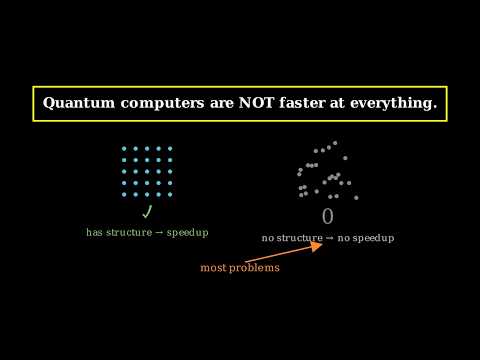
Yet, within the puff of this promise lies a crucial humbling detail: quantum computers cannot turn every problem in our world upside down. Their prowess shines only where problems possess the specific structure permitting constructive interference on correct solutions. For all else, the classical path remains unthreatened, dominant, and undisturbed. From encryption through Shor’s algorithm to chemistry simulations where nature itself provides the necessary canvass, quantum computing excels on questions uniquely tailored to its strengths.
In the end, this conversation rippling through future landscapes is not about laptops and daily devices whisked into obsolescence. It’s about discerning and directing the quantum revolution where it’s genuinely transformative—far from the everyday, yet intimate in the pervasive sectors largely invisible to most. Will this new wave change everything overnight? No. But it commands a place of respect among computational methods, each with their niche, achieving astounding feats when applied astutely.
As you deliberate this evolving narrative, consider what this means for us—not just as consumers but as thinkers poised to explore unknown math and science frontiers. Quantum computers represent a different kind of tool, reshaping our understanding of computation not through sheer velocity, but through the quiet, profound cancellation of possibilities, leaving only the right pathway glittering with potential.
“` This piece quietly invites you to ponder the understated yet monumental forces at play in the realm of quantum computing, encouraging you to question and appreciate the subtle magic woven into its fabric.
—