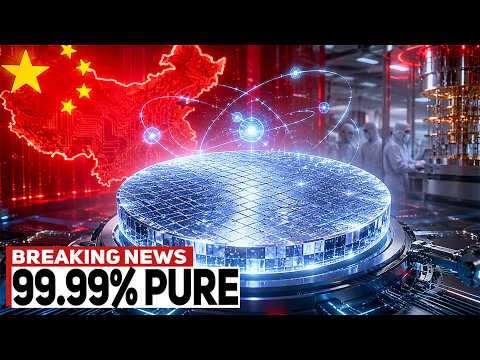
There’s an alluring depth to the stillness of quiet achievements, the kind that doesn’t clamor for immediate applause but quietly blinks in the background, gently nudging the axis of power and progress without a fuss. On June 15th, 2026, such a moment unfolded. China’s National Nuclear Corporation announced the mass production of silicon 28, the purest silicon on Earth, with unmatched precision — a sleek slab that stands to reshape the very foundation of future technologies.
Based on content from Eastern Engine
Imagine the delicate structure of a quantum computer, each qubit precariously perched in a state of superposition. The challenge has always been to maintain this balance in the face of incessant noise — not sound as we casually understand it, but a symphony of environmental interferences, subtle and sharp, displacing the fragile dance of quantum computation. This purity of silicon 28 promises a silent fortress for these qubits, devoid of the destructive magnetic disturbances that silicon 29’s nuclear spin introduces. It’s a pursuit not unlike trying to still a single feather amidst a whirlwind of noise; with silicon 28, China has handed that feather a sanctuary of calm.
The path to such purity is neither straightforward nor widely tread. Isotope separation is a task of tremendous difficulty, one more akin to the precision of nuclear refinement than the mass-productions of traditional chip fabrications. In chemically separating these ghostly siblings, where the only distinguishing aspect is a whisper of weight, China has demonstrated not just capability, but strategic foresight. No longer are they at the mercy of importing this critical substrate from a sparse handful of international sources. With autonomy in creating this pure silicon, the nation has stepped past a formidable geopolitical choke point.
Why does the world scrutinize this inert slab with such intent? Because to follow silicon in quantum computing is to follow the grain of technological evolution. Silicon is no stranger to the corridors of innovation. Decades of refining, slicing, and etching silicon chips have entrenched it as the substrate of the digital era. In silicon quantum computers, the vision isn’t just of a technological leap, but a seamless continuity — leveraging the trillions of dollars and entire industries that silicon expertise already commands.
The implications ripple outward. Silicon, already a miniaturized marvel, can potentialize a quantum realm with millions of qubits on a single etched plane. Here lies a tantalizing possibility: harnessing well-honed manufacturing might to forge a path forward, rather than igniting a painstakingly new discipline from the ground up.
Yet in the shadow of this optimism lies a temperate realism. Mass production of ultra-pure silicon does not unfurl a flag of quantum supremacy yet for China, nor for any nation. It removes a roadblock, yes, but the race towards a functional, world-altering quantum computer requires more strides — the qubits yet to transition from a dozen to a million, and then, the creation of robust control and error correction mechanisms.
This narrative, oft explored but rarely understood, nods to a strategic rhythm. It’s not always the loudest achievements, but the quiet, methodical infrastructure that dictates technological potential. By securing domestic production of silicon 28, China hasn’t just secured silicon’s silent space; it has also established a template for addressing the intricate matrix of dependencies that underpin the future of global technology development.
Where does this leave us, the observers of such a quiet revolution? Perhaps pondering the broader reach of China’s new enrichment capabilities — with silicon 28 joined by an array of domestically produced stable isotopes for varying industries like nuclear medicine and aerospace. It echoes a paradigm where foundational control isn’t merely preferred; it’s paramount.
And so we continue watching, listening closely for the quiet voices beneath the technological crescendo, each subtly rewriting the narrative of global leadership — not through loud declarations or swift evolutions, but by gently, quietly, yet firmly laying the groundwork for tomorrow.
—