For years, the quantum computing industry has been defined by a single question: Can we build a quantum computer powerful enough to outperform classical systems on meaningful tasks?
That question continues to drive research and investment across the sector, but a quieter and equally important shift is now underway. Increasingly, industry leaders are asking a different question: Can we manufacture quantum computers at scale?
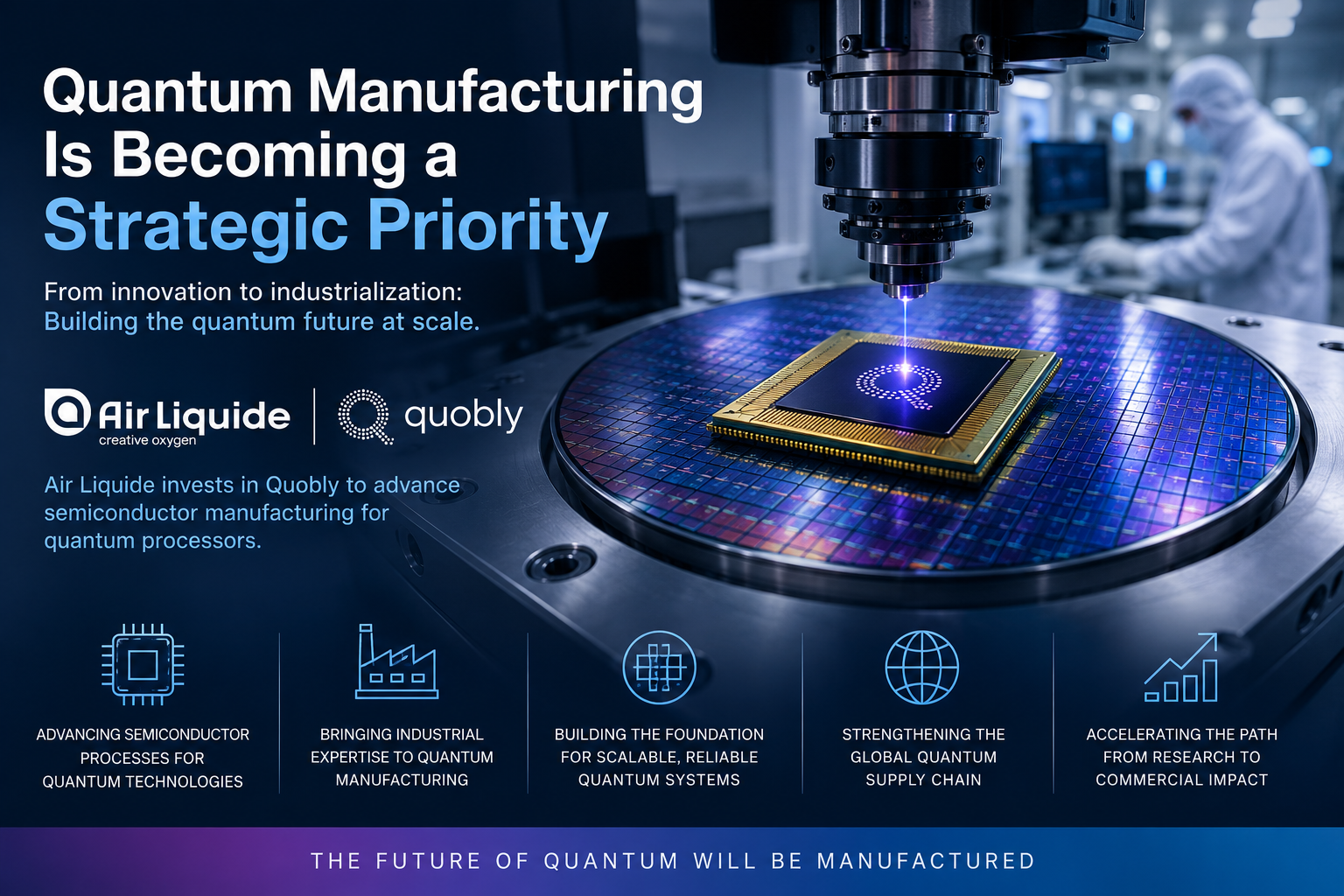
Recent developments in Europe highlight this transition. Industrial gas giant Air Liquide announced an investment in the French quantum startup Quobly to advance semiconductor manufacturing processes for quantum processors. While the announcement may not have generated the same attention as billion-dollar funding rounds or breakthrough processor demonstrations, it represents something significant for the future of quantum technology.
The investment reflects a growing realization that scientific innovation alone will not determine the winners in the quantum race. The ability to manufacture reliable quantum hardware efficiently, consistently, and at commercial scale is becoming just as important as achieving new performance milestones in the laboratory.
This evolution marks one of the clearest signs that the quantum industry is maturing.
In the early years of quantum computing development, most efforts focused on proving that quantum systems could work at all. Researchers concentrated on creating stable qubits, reducing error rates, and demonstrating increasingly sophisticated quantum operations. Success was measured through scientific achievements rather than production capabilities.
Today, many of the world’s leading quantum companies have moved beyond pure experimentation. While technical challenges remain substantial, the industry has reached a point where questions about manufacturing, supply chains, infrastructure, and scalability are becoming central to long-term success.
This mirrors the development path followed by many transformative technologies. The invention of the transistor revolutionized computing, but widespread adoption became possible only when manufacturers learned to produce millions, and eventually billions, of transistors reliably and cost-effectively. Similarly, the semiconductor industry’s success was built not only on scientific breakthroughs but also on extraordinary advances in manufacturing precision and industrial processes.
Quantum computing is now approaching a similar phase.
Quobly’s approach is particularly noteworthy because the company focuses on silicon-based quantum computing technologies. Unlike some competing architectures that require entirely new fabrication methods, silicon quantum processors can potentially leverage existing semiconductor manufacturing expertise and infrastructure. This compatibility has attracted growing attention from investors and industrial partners seeking practical pathways toward large-scale quantum production.
For Air Liquide, the investment aligns with its long-standing expertise in supplying advanced gases and technologies used throughout the semiconductor industry. Quantum processors often require highly specialized manufacturing environments, materials, and production processes. As quantum hardware development accelerates, companies with deep experience in industrial manufacturing are increasingly recognizing opportunities to contribute to the emerging ecosystem.
The partnership illustrates a broader trend that extends far beyond France.
Around the world, quantum companies are actively exploring ways to transition from laboratory prototypes to manufacturable products. Governments, investors, and technology firms are beginning to recognize that quantum leadership will depend not only on research excellence but also on industrial capabilities.
Manufacturing challenges in quantum computing are uniquely complex. Unlike traditional computer chips, quantum processors operate according to the principles of quantum mechanics and often require extremely precise fabrication techniques. Even microscopic imperfections can affect qubit performance, coherence times, and overall system reliability.
As a result, scaling production is far from straightforward.
A quantum processor that performs well in a controlled research environment may encounter significant obstacles when reproduced across hundreds or thousands of units. Achieving consistency between devices remains one of the industry’s most important engineering challenges. Manufacturers must ensure that each processor meets exact specifications while maintaining acceptable production yields and costs.
This is where industrial expertise becomes invaluable.
Companies experienced in semiconductor manufacturing understand how to optimize production processes, improve quality control, and build reliable supply chains. These capabilities can help bridge the gap between promising quantum research and commercially viable products.
The growing emphasis on manufacturing also reflects increasing confidence in the long-term future of quantum computing. Businesses rarely invest heavily in production infrastructure unless they believe demand will eventually justify the expense. Manufacturing investments suggest that stakeholders increasingly view quantum technology as a future industry rather than a perpetual research project.
This trend is becoming visible across multiple segments of the quantum ecosystem.
Hardware developers are working closely with semiconductor foundries. Materials companies are exploring quantum-specific applications. Equipment manufacturers are adapting existing technologies for quantum production requirements. Even software companies are preparing for a future in which more powerful and widely available quantum systems support commercial workloads.
The result is the gradual emergence of a comprehensive quantum supply chain.
Historically, discussions about quantum computing have focused primarily on qubits, algorithms, and computational breakthroughs. While these elements remain essential, the industry’s next phase may depend just as heavily on less visible factors such as manufacturing capacity, industrial partnerships, component availability, and production economics.
In many ways, the conversation is becoming more practical.
Investors increasingly want to understand how quantum technologies will be produced and delivered. Governments are examining how domestic manufacturing capabilities fit into broader technology and economic strategies. Enterprise customers are looking for evidence that quantum platforms can evolve from experimental systems into reliable commercial infrastructure.
These considerations are pushing manufacturing higher on the strategic agenda.
Europe’s growing focus on quantum manufacturing is particularly significant. The region has invested heavily in quantum research over the past decade and is now seeking ways to translate scientific leadership into industrial competitiveness. Partnerships such as the one between Air Liquide and Quobly demonstrate how established industrial companies can help strengthen the quantum value chain.
This approach could provide an important advantage as global competition intensifies.
The United States, China, Canada, and several other countries continue to invest aggressively in quantum technologies. While processor performance often captures headlines, manufacturing capabilities may ultimately determine which regions can successfully commercialize quantum innovations at scale.
The ability to manufacture quantum systems efficiently could become a critical differentiator over the coming decade.
For the quantum industry as a whole, the growing focus on manufacturing represents a healthy and necessary evolution. It suggests that companies are looking beyond proof-of-concept demonstrations and preparing for the realities of commercialization. Building a powerful quantum computer remains a remarkable scientific challenge, but transforming that achievement into a scalable industry requires an entirely different set of capabilities.
The investment by Air Liquide in Quobly may therefore represent more than a single funding announcement. It serves as a symbol of the industry’s broader transition from experimental science toward industrial execution.
As quantum computing moves closer to practical deployment, manufacturing is emerging as a strategic priority rather than an afterthought. And that shift may be one of the strongest indicators yet that the quantum industry is entering a new stage of maturity—one focused not only on what quantum computers can do but also on how the world will build them.