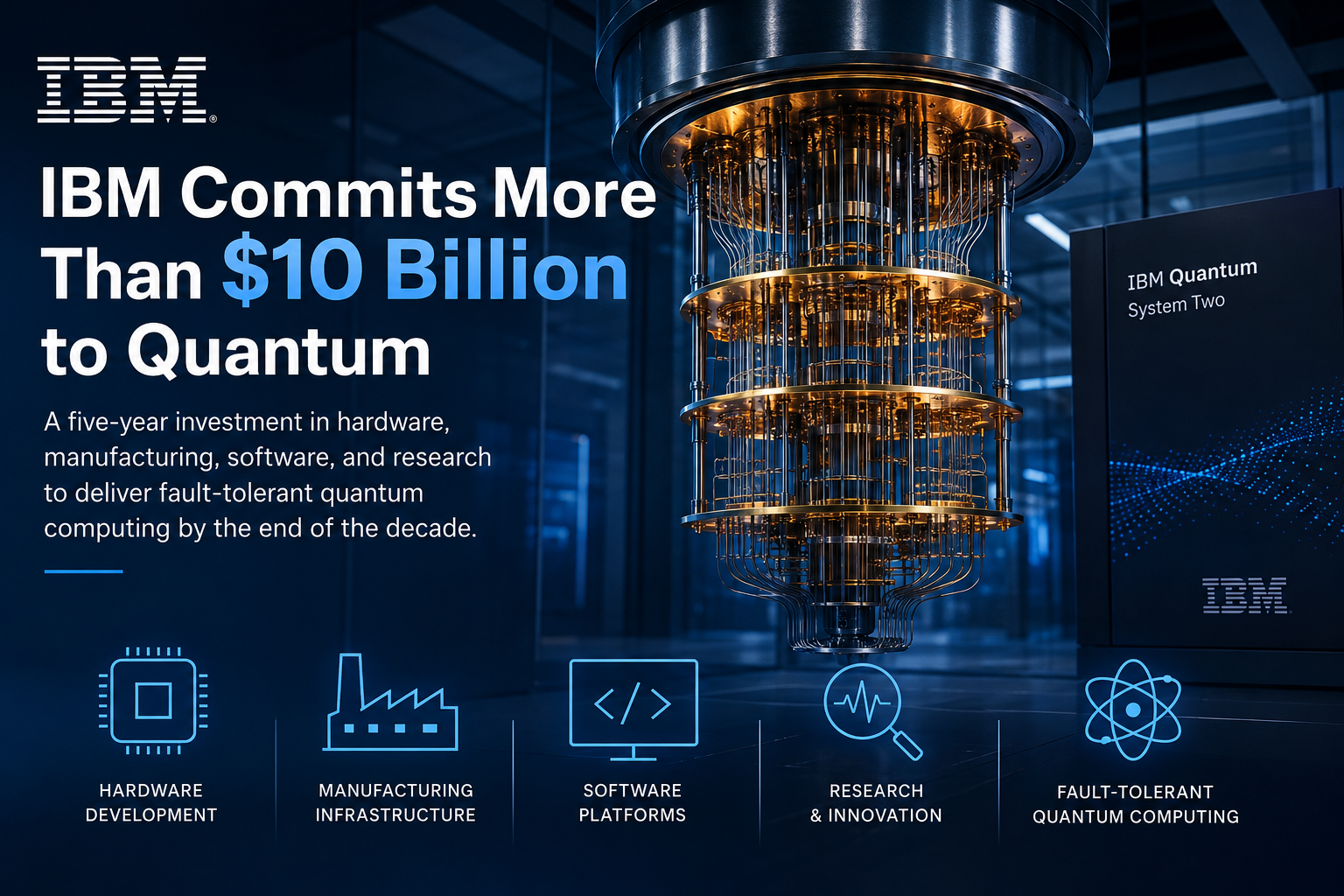
IBM has announced plans to invest more than $10 billion in quantum computing over the next five years, marking one of the largest financial commitments ever made to the emerging industry. The investment will span quantum hardware development, manufacturing infrastructure, software platforms, and advanced research into fault-tolerant quantum computing. The announcement underscores IBM’s long-term strategy to maintain its leadership in the quantum sector while accelerating progress toward commercially viable quantum systems.
The scale of the investment reflects a growing recognition that quantum computing is moving beyond the experimental phase and entering a period focused on engineering, scalability, and practical deployment. While many technology companies and startups continue to explore quantum technologies, IBM’s commitment signals confidence that the industry is approaching a critical turning point. By dedicating substantial resources across the entire quantum stack, IBM aims to solve the technical challenges that have historically limited the field’s progress.
Quantum computing has long promised to transform industries by solving certain classes of problems that are difficult or impossible for classical computers to handle efficiently. Potential applications include drug discovery, advanced materials design, financial optimization, logistics planning, cybersecurity, and complex scientific simulations. However, realizing these benefits at scale requires significant advances in both hardware and software, particularly in reducing computational errors that occur in quantum systems.
At the heart of IBM’s strategy is the pursuit of fault-tolerant quantum computing. Unlike current quantum computers, which remain susceptible to noise and errors from environmental interference, fault-tolerant systems are designed to detect and correct errors during computation. Achieving this capability is widely considered one of the most important milestones in quantum computing because it would enable quantum machines to execute longer, more complex calculations reliably.
IBM has consistently positioned itself as one of the industry’s leading advocates for a roadmap-based approach to quantum development. Over the past several years, the company has introduced increasingly powerful quantum processors, expanded access through its cloud-based quantum services, and cultivated a growing ecosystem of researchers, developers, and enterprise partners. The latest investment suggests IBM is prepared to intensify these efforts as competition in the sector accelerates.
A significant portion of the funding will be directed toward hardware innovation. Building quantum computers requires specialized technologies and manufacturing processes that differ substantially from those used in traditional semiconductor production. Quantum processors rely on delicate quantum states that must be maintained under highly controlled conditions, often at temperatures colder than outer space. Developing reliable hardware capable of scaling from hundreds to thousands—or eventually millions—of qubits remains one of the industry’s greatest engineering challenges.
The investment also includes manufacturing infrastructure, an area increasingly recognized as essential to quantum commercialization. While breakthrough research often captures headlines, large-scale deployment will ultimately depend on the ability to produce quantum hardware consistently and efficiently. By investing in manufacturing capabilities today, IBM is preparing for a future in which demand for quantum systems expands beyond research institutions and into enterprise environments.
Software development represents another major pillar of IBM’s strategy. Hardware alone will not unlock the value of quantum computing. Organizations will need tools, programming frameworks, development environments, and algorithms that make quantum resources accessible to a broader audience. IBM has already established a strong presence through its open-source quantum software ecosystem, and the new funding is expected to accelerate innovation in quantum programming, optimization techniques, and hybrid computing models that combine classical and quantum resources.
The company’s emphasis on software reflects a broader industry trend. As quantum hardware continues to evolve, software ecosystems are becoming increasingly important for attracting developers and creating practical applications. Organizations that establish strong software foundations today may gain a significant advantage as more powerful quantum systems become available in the future.
IBM’s announcement arrives at a time when governments and private investors worldwide are increasing support for quantum technologies. Countries across North America, Europe, and Asia have launched national quantum initiatives, viewing the technology as strategically important for economic competitiveness, scientific leadership, and national security. In parallel, venture capital investment has fueled the growth of dozens of quantum startups focused on specialized hardware, software, networking, and sensing technologies.
Against this backdrop, IBM’s $10 billion commitment stands out not only because of its size but also because of its comprehensive scope. Rather than focusing on a single aspect of quantum development, the investment targets every major component required to build a mature quantum ecosystem. This integrated approach may provide IBM with advantages in aligning hardware, software, research, and manufacturing efforts under a unified long-term vision.
The announcement also sends a strong signal to enterprise customers that IBM remains committed to bringing quantum computing into real-world business environments. Many organizations are currently evaluating potential quantum use cases, even though practical applications remain limited by today’s hardware constraints. By investing aggressively now, IBM aims to position itself as a trusted technology partner when quantum systems become capable of delivering measurable business value.
Industry analysts have often compared the current state of quantum computing to the early days of classical computing, when substantial investments were required before widespread adoption could occur. IBM’s latest commitment reflects a belief that the foundational work being done today will determine the leaders of the quantum era tomorrow. While significant technical challenges remain, sustained investment is widely viewed as necessary to transform scientific breakthroughs into commercially useful technologies.
As the race toward fault-tolerant quantum computing intensifies, IBM’s announcement reinforces the company’s ambition to remain at the forefront of innovation. The more than $10 billion investment demonstrates confidence in the long-term potential of quantum technology and highlights the growing momentum behind an industry that many believe could reshape computing over the coming decades.
If IBM succeeds in achieving its goal of delivering fault-tolerant quantum systems by the end of the decade, the investment may ultimately be remembered as one of the defining commitments that helped move quantum computing from research laboratories into practical, large-scale deployment. For the broader technology industry, it represents another clear indication that the quantum future is no longer a distant possibility but an increasingly important strategic priority.