There is a stereotype that people carry about quantum computing.
You can feel it almost immediately when the subject comes up.
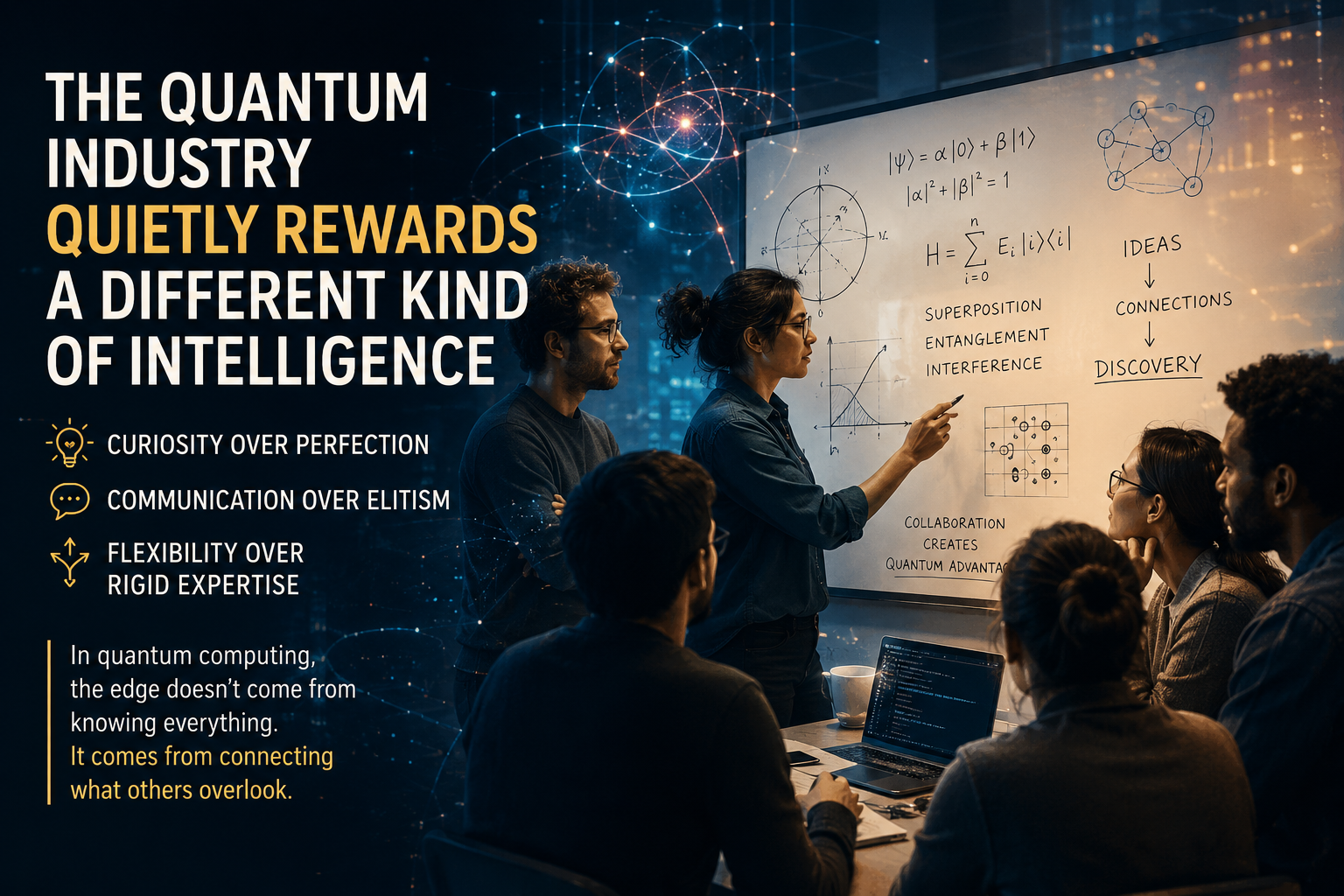
The room tightens a little. People straighten in their chairs. Someone jokes that they’re not smart enough to understand it. Someone else quietly exits the conversation before it fully begins. Quantum computing has become psychologically associated with impossible intelligence, the domain of unreachable mathematicians scribbling equations onto glass walls somewhere far beyond ordinary life.
But one of the most interesting moments during our recent conversation with University of Victoria researcher Thomas Baker had almost nothing to do with quantum mechanics itself.
It had to do with people. Who are adaptable?
The conversation drifted into something softer and strangely revealing. Thomas began talking about the kinds of people who succeed in quantum information science, and the answer was unexpectedly human.
Flexible thinkers.
People are willing to cross disciplines, to ask questions, and can communicate.
People are comfortable looking foolish long enough to learn something difficult.
Even typing quickly somehow entered the conversation.
And honestly, that stayed with me more than some of the technical discussions did.
Because underneath all the complexity surrounding quantum computing is a quieter truth about innovation itself:
Breakthrough industries rarely reward rigid intelligence for very long.
They reward people who can navigate uncertainty.
That is a completely different skill.
For years, the public narrative around intelligence has been dominated by specialization. The smartest person in the room was assumed to be the one with the deepest expertise inside the narrowest domain. Academia often reinforced this structure. Corporate environments did too. Expertise became associated with certainty. Precision. Control.
Quantum computing disrupts that psychology almost immediately.
The field itself refuses to stay inside clean boundaries.
Physics bleeds into computer science.
Computer science bleeds into mathematics.
Mathematics bleeds into chemistry.
Chemistry bleeds into materials science.
Engineering collides with cryptography, AI, optimization, logistics, sensing, networking, and biology.
Nobody fully owns the field.
And that changes the type of intelligence that becomes valuable inside it.
Thomas described students solving problems in unexpected ways simply because they did not yet know the “correct” approach. They moved sideways instead of forward. They ignored invisible intellectual fences because nobody had taught them where those fences were supposed to be.
That is not accidental.
Some of the most transformative moments in science happen when people carry ideas across disciplines before anyone realizes those disciplines were connected in the first place.
The quantum industry quietly depends on this kind of thinking.
And yet the public still imagines quantum researchers as isolated geniuses operating alone at the edge of incomprehensible mathematics.
The reality feels much messier.
More collaborative, creative, and improvisational.
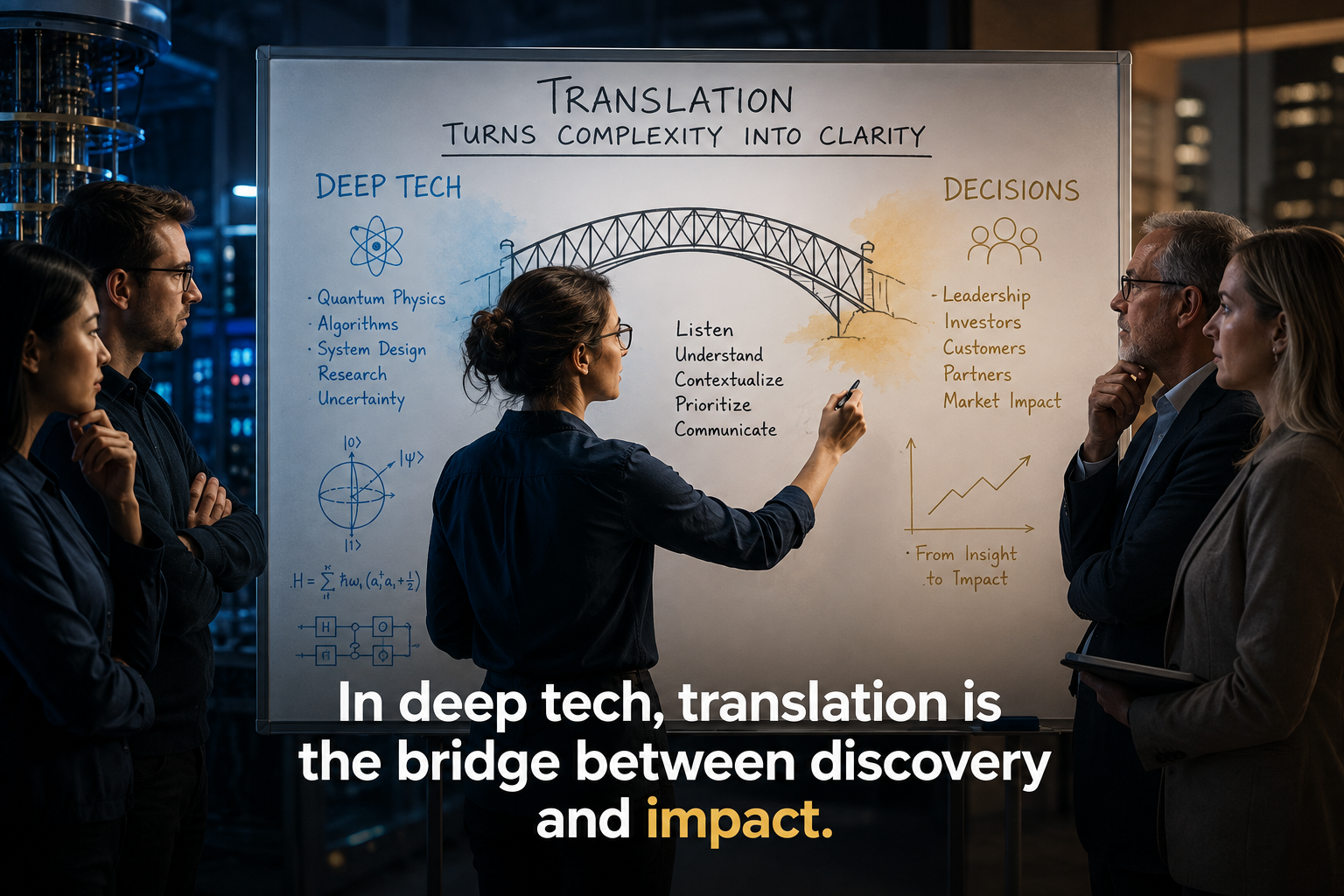
At one point during the conversation, Thomas talked about how difficult it is to even explain quantum computing to nonexperts without losing them halfway through. The observation was funny, but it exposed something deeper underneath technical industries as a whole.
Communication is not separate from innovation.
It is part of innovation.
A brilliant idea that cannot move between humans eventually stalls. Industries grow when ideas become transferable. When people can explain concepts clearly enough for businesses to invest in, governments to fund, students to pursue, and interdisciplinary teams to collaborate on them.
This is one reason public speaking unexpectedly matters in quantum.
Not because every researcher needs to become a performer.
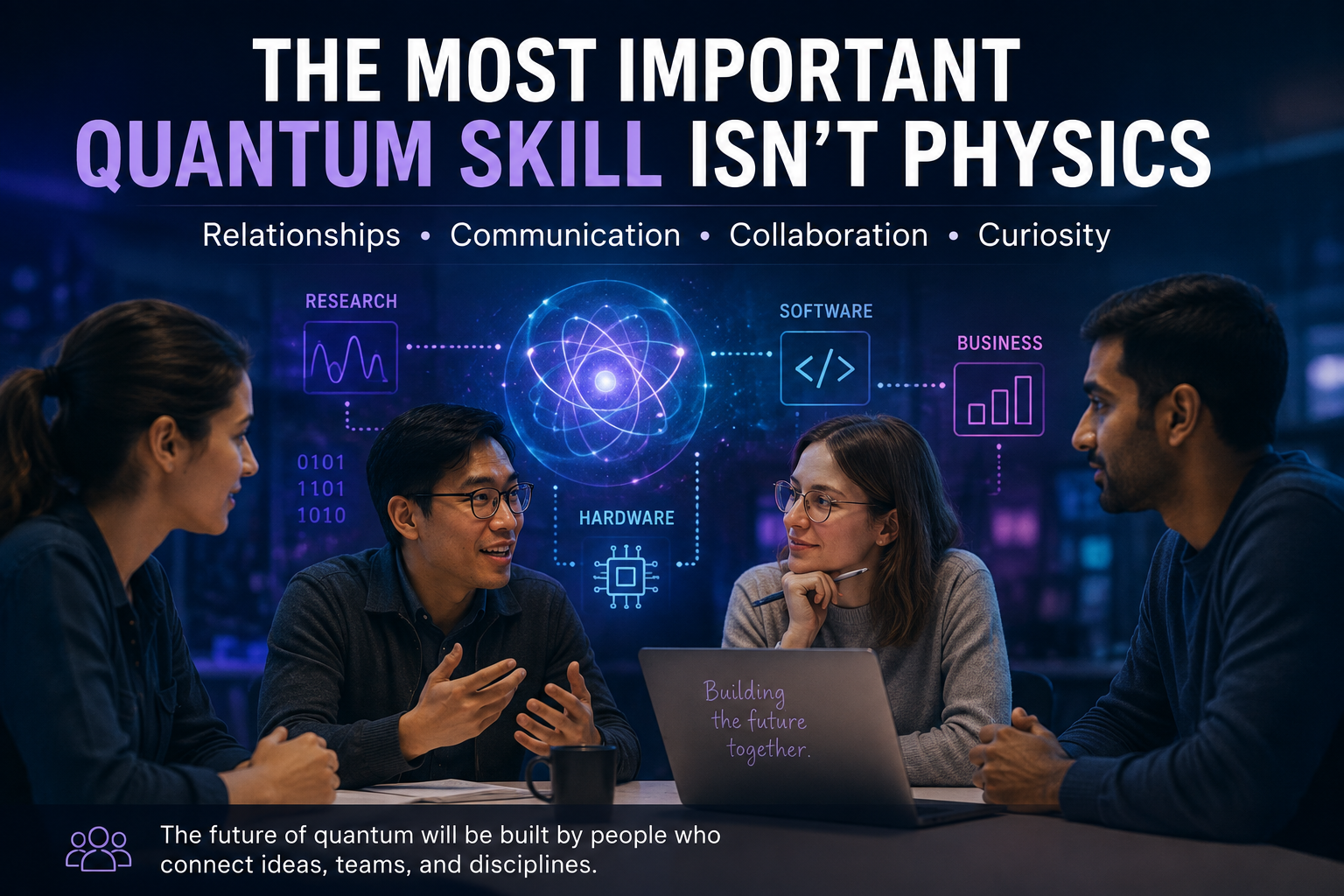
But because modern science is increasingly collaborative. The lone-genius mythology breaks down quickly once real systems begin to scale. Large quantum initiatives already involve physicists, chemists, engineers, software developers, policymakers, investors, hardware specialists, and infrastructure teams trying to communicate across entirely different mental frameworks.
The ability to explain something clearly without diminishing its complexity becomes an actual competitive advantage.
That skill is still deeply undervalued.
Especially in technical culture.
There is often an unspoken belief that if someone is truly brilliant, they should not need to simplify their ideas for others. But simplification is not intellectual weakness. In many ways, it is the opposite.
It requires understanding something deeply enough to remove unnecessary friction.
And quantum computing contains an enormous amount of friction.
The terminology alone creates emotional distance. Entanglement. Superposition. Decoherence. Error correction. Quantum advantage. Fault tolerance.
To insiders, these are ordinary technical concepts.
To outsiders, they can sound almost mythological.
This creates a strange social dynamic where people often disengage before curiosity has a chance to form. They assume the subject belongs to someone else. Smarter people. More technical people. More mathematical people.
But listening to researchers like Thomas shifts that perception.
Because the people actually building the field often sound less obsessed with perfection and more obsessed with exploration.
There is a willingness to experiment publicly.
To be wrong publicly.
To move into uncertainty without guaranteed answers.
That mindset matters because quantum computing itself remains deeply uncertain. The hardware race is unresolved. Error correction challenges remain enormous. Commercialization pathways are still evolving. Nobody fully knows which qubit architectures will dominate long term. Nobody fully knows which applications will emerge first at scale.
And yet the field keeps moving.
Not because certainty exists.
Because curiosity does.
That may ultimately become one of the defining characteristics of the quantum era.
The people succeeding inside these environments are not necessarily the people with the cleanest answers. They are often the people most comfortable existing temporarily without them.
There is something deeply human about that.
Especially now.
Modern culture increasingly rewards immediate expertise. Fast opinions. Instant certainty. Perfect positioning. Algorithms favor confidence even when confidence is disconnected from reality.
Quantum computing resists that entire structure.
The field humbles people constantly.
Maybe that is why conversations around quantum sometimes feel strangely thoughtful compared to other areas of technology. Beneath the competition and funding announcements, there is still an awareness that everyone is attempting to navigate systems larger and stranger than themselves.
You can hear it in the pauses during these conversations.
The moments where researchers stop speaking like experts and start speaking like curious humans again.
About learning.
About creativity.
About collaboration.
About luck.
Thomas said something else during the episode that lingered quietly in the background afterward: you can “make your own luck.”
That feels surprisingly relevant to the future of the quantum industry itself.
Because quantum computing may not ultimately belong to the loudest people or the most intimidating resumes.
It may belong to the people willing to stay curious longer than everyone else.
The people willing to cross disciplines.
The people are willing to communicate.
The people willing to ask questions that sound naïve.
The people are willing to look foolish for a while in pursuit of something larger.
And maybe that is the most important narrative shift happening in quantum right now.
Not that the technology is becoming more human.
But we are finally noticing the humans building it.