There is something strange about the way the public imagines quantum computing. Most people still picture one giant machine sitting inside a pristine laboratory somewhere, suspended in blue light, colder than space itself, solving impossible equations while governments hover nervously nearby. The imagery feels centralized. Singular. Almost mythological.
But the future of quantum systems may not look like one machine at all.
It may look more like a network.
Quietly, underneath the louder headlines about qubit counts and error correction, researchers around the world are working toward a different kind of architecture entirely: distributed quantum systems. Smaller quantum devices connected together through entanglement, communicating across distance in ways classical systems fundamentally cannot replicate.
And this week, researchers in Japan moved that conversation forward in an important way.
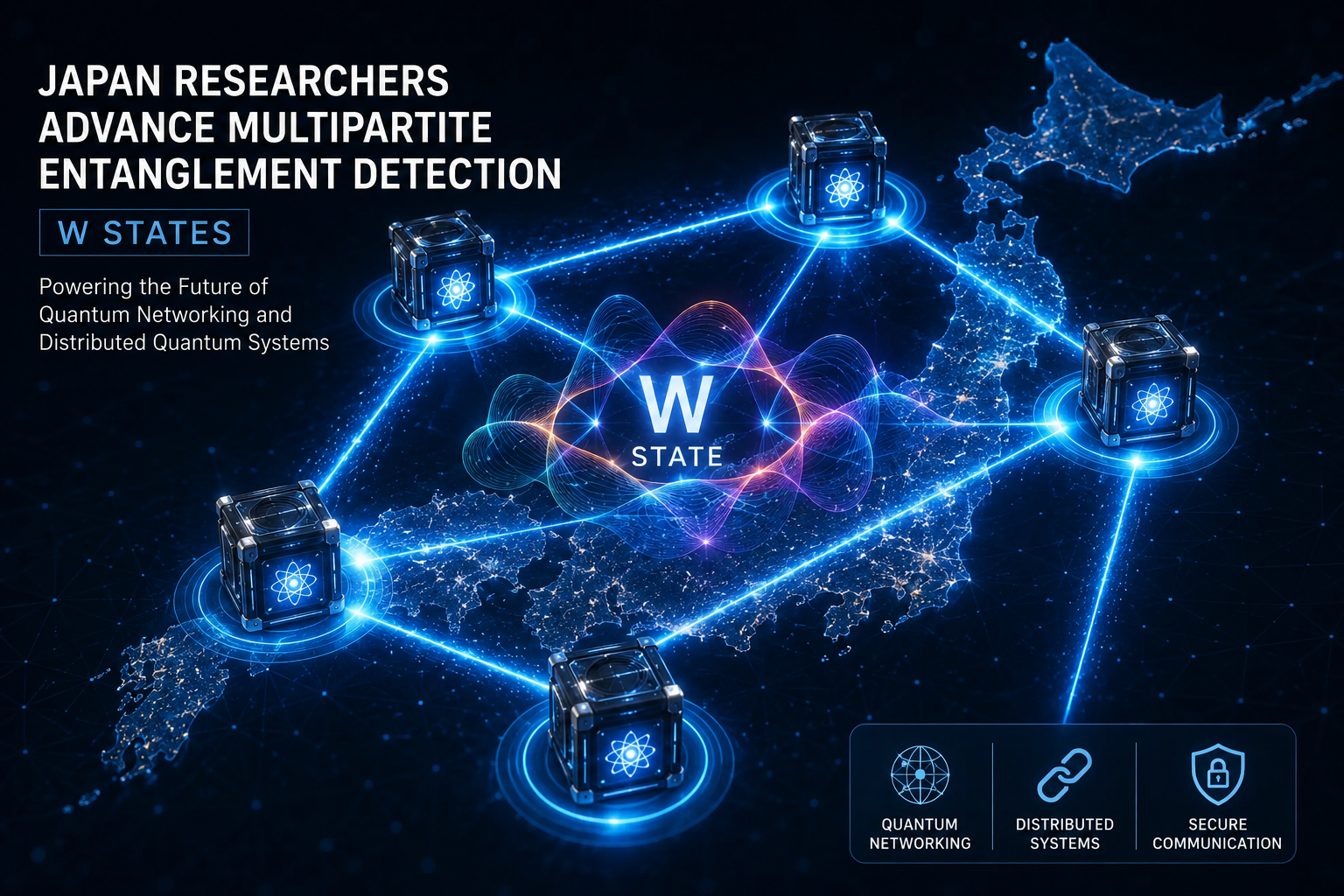
Their work focused on multipartite entanglement detection, specifically involving what are known as “W states,” a specialized form of entangled quantum state that many researchers believe could become critical for future quantum networking and distributed computing systems.
Some headlines rushed toward the word “teleportation,” because quantum media cannot seem to resist it. The term still carries cinematic gravity. It immediately triggers images of Star Trek transporters and particles dissolving into light.
But the more interesting story is quieter than that.
This is really about stability.
And stability, increasingly, is becoming one of the defining emotional undercurrents of the quantum industry itself.
For years, the field has been dominated by scale narratives. More qubits. Bigger processors. Larger machines. But quantum systems are fragile in ways that remain difficult for classical intuition to fully grasp. The moment information interacts too strongly with its surrounding environment, coherence begins slipping away like breath on cold glass.
Entanglement is even more delicate.
Now imagine trying to preserve entanglement not between two particles, but across multiple interconnected systems simultaneously. The complexity begins multiplying quickly. Verifying that multipartite entanglement actually exists becomes extraordinarily difficult as systems grow larger.
That is where this Japanese research matters.
W states belong to a particular category of multipartite entangled states where quantum information remains surprisingly resilient even if part of the system is lost. Unlike other forms of entanglement that collapse entirely when one particle disappears or decoheres, W states preserve portions of the entangled relationship across the remaining particles.
That resilience makes them deeply attractive for future networking architectures.
Because realistically, future quantum systems will not operate in perfect laboratory isolation forever. They will need to survive noise. Distance. Infrastructure imperfections. Signal degradation. Real-world environments that are messy and unpredictable in the same way human systems are messy and unpredictable.
There is something oddly human about that challenge.
The most successful systems in nature are rarely the most perfect ones. They are the ones that adapt while remaining connected.
Quantum networking is increasingly beginning to resemble that philosophy.
Instead of relying entirely on one massive fault-tolerant machine, researchers envision ecosystems of smaller quantum processors linked together through entangled communication channels. Information could potentially move between nodes in fundamentally new ways, enabling distributed quantum computation, ultra-secure communication, and advanced sensing applications.
This is one reason the phrase “quantum internet” keeps resurfacing in serious research discussions.
Not because scientists are trying to rebuild the classical internet with quantum branding attached to it, but because entanglement itself changes the rules of communication.
Classical networks transmit information conventionally through electrical or optical signals. Quantum networks rely on shared quantum states between distant systems. That distinction sounds abstract at first, but it changes the underlying architecture entirely.
And suddenly, multipartite entanglement detection stops sounding like an isolated laboratory experiment.
It starts sounding infrastructural.
The Japanese team’s advancement helps researchers better identify and verify these highly complex entangled states, which becomes increasingly important as quantum networks scale outward. Detection sounds procedural, almost administrative, but in quantum systems, measurement itself is notoriously difficult because observation can alter the state being observed.
There is an almost philosophical tension buried inside quantum mechanics that never fully stops feeling surreal.
To verify reality, you risk disturbing it.
That paradox has followed the industry from the beginning.
And yet despite the complexity, the field feels different lately. Less mystical. More operational.
A few years ago, many quantum announcements felt detached from practical deployment. They lived mostly in theoretical possibility space. Now the industry is beginning to harden around infrastructure conversations: networking, sensing, distributed architectures, quantum-safe cybersecurity, hybrid computing models, and manufacturing scalability.
The emotional texture has shifted from “Can this work?” toward “How do we build systems around it?”
That is a much more mature question.
And networking may ultimately become one of the earliest areas where quantum technologies demonstrate durable utility.
Universal fault-tolerant quantum computing still faces enormous engineering hurdles. Error correction overhead remains staggering. Cooling requirements are extreme. Hardware approaches continue competing for dominance across superconducting systems, trapped ions, photonics, neutral atoms, silicon spin qubits, and topological designs.
But networking creates a different pathway forward.
Instead of waiting for one gigantic perfect machine, distributed quantum systems could allow smaller specialized devices to collaborate. In some ways, it mirrors how modern cloud infrastructure evolved classically. Massive centralized computing eventually gave way to distributed architectures because distributed systems offer flexibility, resilience, and scalability.
Quantum may follow a surprisingly similar emotional arc, even if the underlying physics are entirely alien.
And that is why the Japanese multipartite entanglement work matters more than some people initially realize.
Because beneath the technical language sits a broader transition happening across the industry itself.
Quantum computing is slowly moving away from isolated demonstrations and toward ecosystem design.
Toward connected systems.
Toward infrastructure.
Toward coordination.
Even the language around breakthroughs is beginning to change. Researchers increasingly talk about interoperability, modularity, communication protocols, and networking layers instead of purely computational supremacy metrics.
The field is becoming less about singular magic moments and more about long-term systems engineering.
Oddly enough, that may actually make quantum technology more believable.
There is a kind of exhaustion people feel around constant technological hype now. You can hear it underneath conversations about AI, automation, and emerging tech generally. Audiences have become more skeptical of grand declarations because they have lived through too many cycles of inflated promises followed by quiet recalibration.
Quantum is not immune to that fatigue.
But infrastructure stories feel different.
They feel steadier.
And this Japanese advancement sits firmly inside that steadier category.
Not because it instantly changes the world tomorrow.
But because it strengthens one of the invisible foundations future quantum systems may eventually stand on.
The reality is that most transformative technologies do not arrive all at once in dramatic cinematic fashion. They emerge slowly through hundreds of smaller advances that initially sound obscure to everyone except the people building them.
Multipartite entanglement detection will not dominate mainstream headlines for long.
But years from now, when distributed quantum systems become more common, researchers may look back at work like this as part of the quiet scaffolding that helped make those networks possible.
And somewhere inside that idea is a reminder the quantum industry itself seems to be learning in real time:
Connection may ultimately matter more than scale alone.