There is still a strange stereotype surrounding quantum computing.
People imagine a person sealed inside fluorescent laboratories, surrounded by whiteboards dense with equations no one else can read. The field is often framed as a kind of intellectual priesthood. Mystical. Abstract. Reserved for people who emerged from childhood already speaking mathematics fluently.
But then you hear someone like Harshitta Gandhi talk about her path into quantum computing, and the story’s shape changes entirely.
Suddenly, the road into quantum machine learning runs through skating rinks. Swimming pools. Theater stages. Speech competitions. Long repetitions. Muscle memory. Breath control. Mental stamina.
Not genius mythology. Endurance.
And honestly, that may be one of the most important conversations happening in quantum right now.
During a recent episode of the Women in Quantum podcast, Harshitta described herself not as an intensely academic child but as someone drawn first to sports, music, and performance.
“I was more into theater and singing and I was more into sports.”
She competed nationally in skating and participated competitively in swimming. At first glance, none of that sounds connected to quantum computing at all. But listening closely, you begin to realize the overlap is almost painfully obvious once someone points it out.
Because high-level athletics are not really about movement alone.
They are about repetition without immediate reward.
Doing the same thing again and again while your brain begs for novelty. Learning to stay inside frustration long enough for incremental improvement to become visible is key. Managing boredom. Managing doubt. Managing your own internal noise.
That sounds a lot like research.
And maybe even more specifically, it sounds a lot like quantum research.
Harshitta explained it in a way that felt unusually grounded:
“It’s really difficult to keep going around in circles in a skating rink. It’s really difficult to keep lapping in a swimming pool and trying to improve your posture… it takes a lot of mental energy.”
That line stayed with me after the conversation ended.
Because quantum computing conversations often focus on hardware milestones, qubit counts, error correction, funding rounds, or speculative timelines. Those things matter, of course. But beneath the infrastructure lies the human condition. People are trying to hold concentration against complexity long enough to discover something useful.
The emotional texture of research rarely gets discussed honestly.
There are long stretches where nothing works.
Long stretches where you repeat experiments, retrain models, revisit assumptions, reread papers, reorganize datasets, rewrite code, or rethink the framing entirely. The public narrative around advanced technology tends to romanticize breakthrough moments while quietly skipping over the cognitive endurance required to survive the ordinary days between them.
Athletics prepares people for that in a surprisingly direct way.
Not because sports make someone “competitive” in the corporate LinkedIn sense. But because athletes develop tolerance for repetition, delayed gratification, and incremental progress. They learn how to continue after failure without turning failure into identity.
That mindset transfers remarkably well into quantum computing.
Especially now.
Because quantum as a field is still in its awkward adolescence. There is extraordinary momentum but also ambiguity everywhere. Competing hardware modalities. Unclear commercialization timelines. Constant technical tradeoffs. Shifting research priorities. New hybrid architectures are emerging almost monthly.
The people entering this field need intellectual flexibility more than rigid certainty.
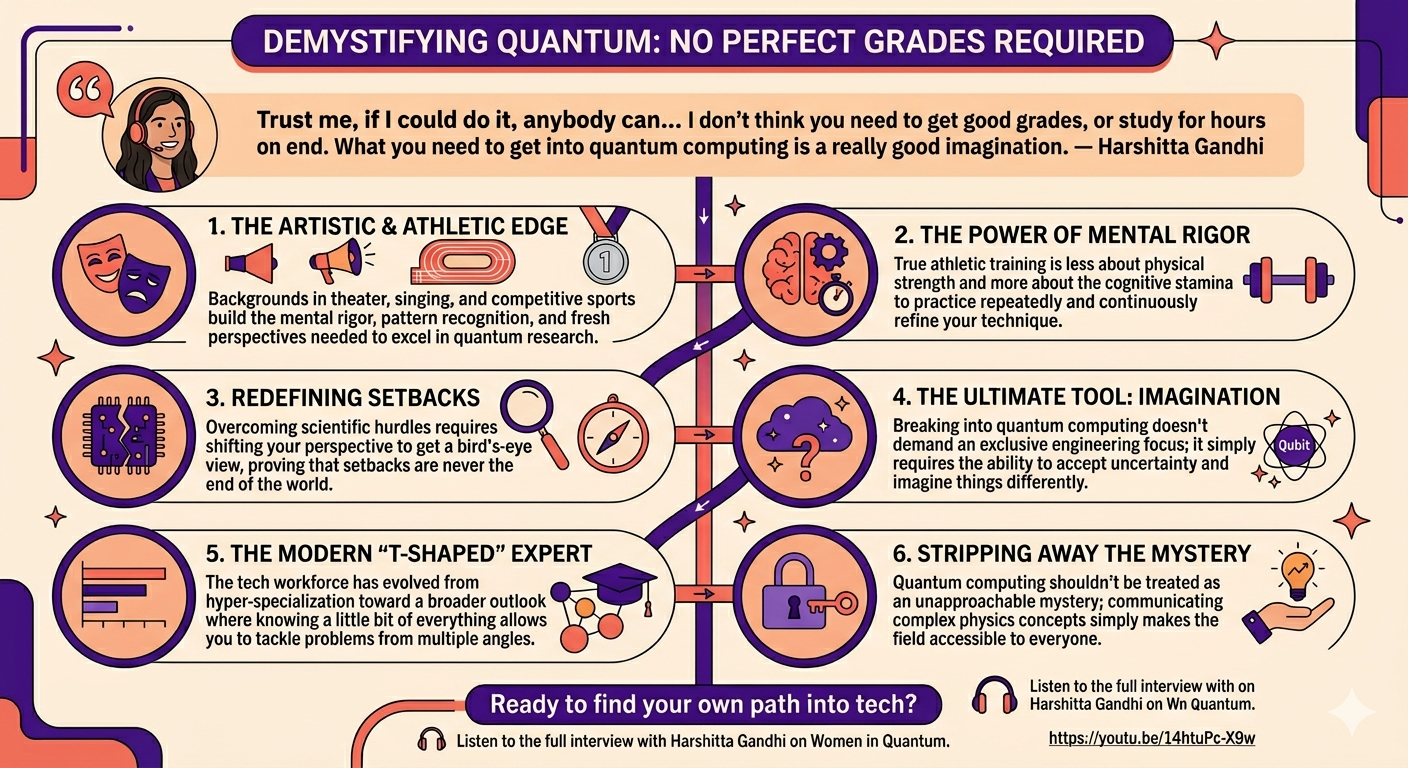
And that may explain another striking moment from the episode. When asked what young women truly need in order to enter quantum computing, Harshitta did not say perfect grades. She did not say “exceptional mathematical talent.” She did not say elite credentials.
She said imagination.
“I think what you need to get into quantum computing is a really good imagination.”
That answer feels deceptively simple.
But if you spend enough time around emerging technologies, you begin to realize imagination is often undervalued because it is difficult to quantify. Yet imagination sits underneath almost every meaningful technological leap. Someone has to mentally model systems that do not exist yet. Someone has to tolerate uncertainty long enough to visualize entirely different computational approaches.
Quantum computing especially demands this kind of thinking because the field itself resists intuitive human experience.
You cannot approach quantum systems the same way you approach ordinary mechanics. The logic bends differently. Superposition, entanglement, probabilistic outcomes, and hybrid quantum-classical architectures — these concepts require people willing to stretch their thinking beyond familiar structures.
That process looks far closer to creative thinking than most outsiders realize.
Which is why the pipeline problem in quantum may partially be a storytelling problem.
Too many people still view the field as inaccessible before they even attempt to enter it.
Harshitta addressed this directly during the conversation, saying:
“Quantum computing is not some mystery… I don’t think that’s the case. I think it’s supposed to be very approachable.”
That matters.
Because industries quietly shape who feels welcome through the stories they repeat about themselves.
If quantum continues presenting itself exclusively through the language of intellectual intimidation, entire categories of talented people may self-select out before they ever begin. Athletes. Artists. Designers. Systems thinkers. Neurodivergent thinkers. People who excel through pattern recognition, visualization, persistence, or interdisciplinary curiosity rather than a traditional academic identity.
And that would be a profound loss for the ecosystem.
Especially because quantum computing increasingly looks like a collaborative field rather than a solitary one.
Modern quantum research intersects with:
- machine learning
- thermodynamics
- cybersecurity
- chemistry
- optimization
- infrastructure
- climate modeling
- materials science
- energy systems
No single person fully masters all of it.
The future likely belongs to people who can connect domains together rather than remain isolated inside one specialty forever.
In many ways, Harshitta’s own transition reflects that broader evolution. Her research has already shifted from computer vision problems into thermodynamics and HVAC modeling, exploring how quantum machine learning could improve energy systems and prediction models.
That kind of intellectual adaptability feels increasingly essential now.
The workforce itself is changing shape underneath us.
Depth still matters. Expertise still matters. But modern technical ecosystems increasingly reward people who can move between disciplines, synthesize information, and learn continuously rather than remain fixed in a single identity.
And strangely enough, sports may prepare people for that too.
Because athletes understand something, technology industries sometimes forget:
Progress is rarely dramatic while it is happening.
Most transformations look repetitive from the inside.
A swimmer staring at the same black line at the bottom of the pool, lap after lap, probably does not feel cinematic in the moment. But over time, those repetitions reshape the body, the nervous system, and the mind itself.
Research works similarly.
So does innovation.
So does quantum computing.
And maybe that is the real takeaway from this conversation.
The mental rigor behind quantum computing may have less to do with being naturally gifted than people assume.
Sometimes it looks more like staying in the water long enough to become someone new.
Listen to the full episode here: https://player.captivate.fm/episode/715aaec0-03a9-48e9-98b8-e335631e3ec3/