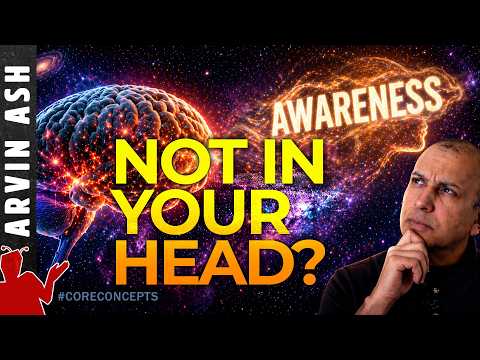
Consciousness, a word that fits awkwardly into the bounds of science, seems almost too slippery to pin down. It is the ghost in the machine, whispered about in hushed tones and tentative theories, a perplexity that shapes every thought, sensation, and personal echo of self. We stand listening to the mind’s quiet murmurs, even as modern neuroscience and physics strive to decode them, grappling with the enigma: why does matter become aware? The question propels us into a vast inquiry where science, philosophy, and physics overlap like contrails in the sky.
At the heart of this exploration lies a profound riddle: is consciousness merely what the brain does, a complex byproduct of neurons and synapses flickering like stars in a midnight sky, or is it something far deeper, woven into the fabric of the universe itself? Some paths lead back to the brain, tethered firmly to biology. Research has identified regions such as the claustrum, that elusive wisp of tissue, as potential hubs, orchestrating the symphony of sensory inputs, memories, and emotions into the luminous thread we call experience. It is a compelling concept—the idea of consciousness as a natural phenomenon, unfolding not from ethereal realms but from the earth-bound architecture of our minds.
Based on content from Arvin Ash
Yet, this narrative, at first as comforting as a familiar lullaby, is disrupted by the knowledge that the very brain it seeks to explain dances to the tune of quantum mechanics. Could consciousness arise from the strange, shadowed intricacies of quantum processes? Roger Penrose and others have courted controversy with such suggestions, traversing theories where quantum mechanics pulses at the threshold of conscious perception. The arguments echo through academic corridors, with critics cautioning against the notion due to the brain’s warmth and incessant noise, an inhospitable environment for delicately poised quantum effects.
Moreover, the “hard problem” emerges, dwarfing even these hypotheses: why do physical processes give birth to subjective experiences and qualia—the ineffable textures of consciousness that only we can know from within? Here, science brushes against its limits. Solipsism, the solipsistic shadow, whispers that only your consciousness can ever be truly known, casting doubt on the certainties that science seeks to hold. No matter how many wavelengths or synaptic sparks we measure, consciousness remains elusively invisible from the outside.
Emergent philosophical schools, intrigued by this dance of ideas, propose startling alternatives. Panpsychism casts consciousness as a universal property, an omnipresent hue bathing every corner of existence. Might the universe itself, like a great looming presence, ripple with consciousness? And if so, could this consciousness not just produce us, but pervade the cosmos as an integral presence?
In these contemplations, our understanding of consciousness remains a dynamic boundary where mind, matter, and time entwine—a mysterious nexus that presses us to reconsider our place in the universe. Each insight unveils more shadows; every theory births new questions. Where does this path lead us? What will we discover as we continue to peer into the depths of mind and cosmos? As we journey forward in our quest for understanding, we must remain open to every flicker of insight, every whisper of possibility that consciousness is not only the spark behind our waking lives but a thread through the very tapestry of existence itself.
The journey to understand consciousness evolves endlessly—an expedition inviting each of us to probe further, to look once more at the prisms of our perception, and perhaps, just perhaps, to catch a glimpse of the profound truth that awaits just beyond our reach.
—