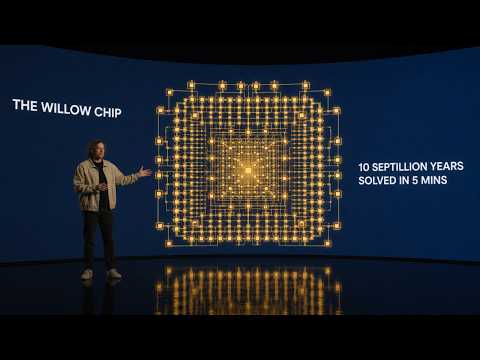
There’s something almost strange about the timing of this moment in quantum computing. For years, the industry has felt physically distant from ordinary infrastructure. Quantum systems lived inside photographs that looked more like experimental sculpture than technology you could actually deploy. Golden chandeliers suspended in sterile white rooms. Miles of tubing. Scientists were moving carefully around machines that seemed allergic to the outside world.
For most enterprise teams, quantum computing existed somewhere between fascination and abstraction. Interesting to watch. Difficult to imagine touching.
That is why Equal1’s unveiling of RacQ feels different. Not louder. Just… closer.
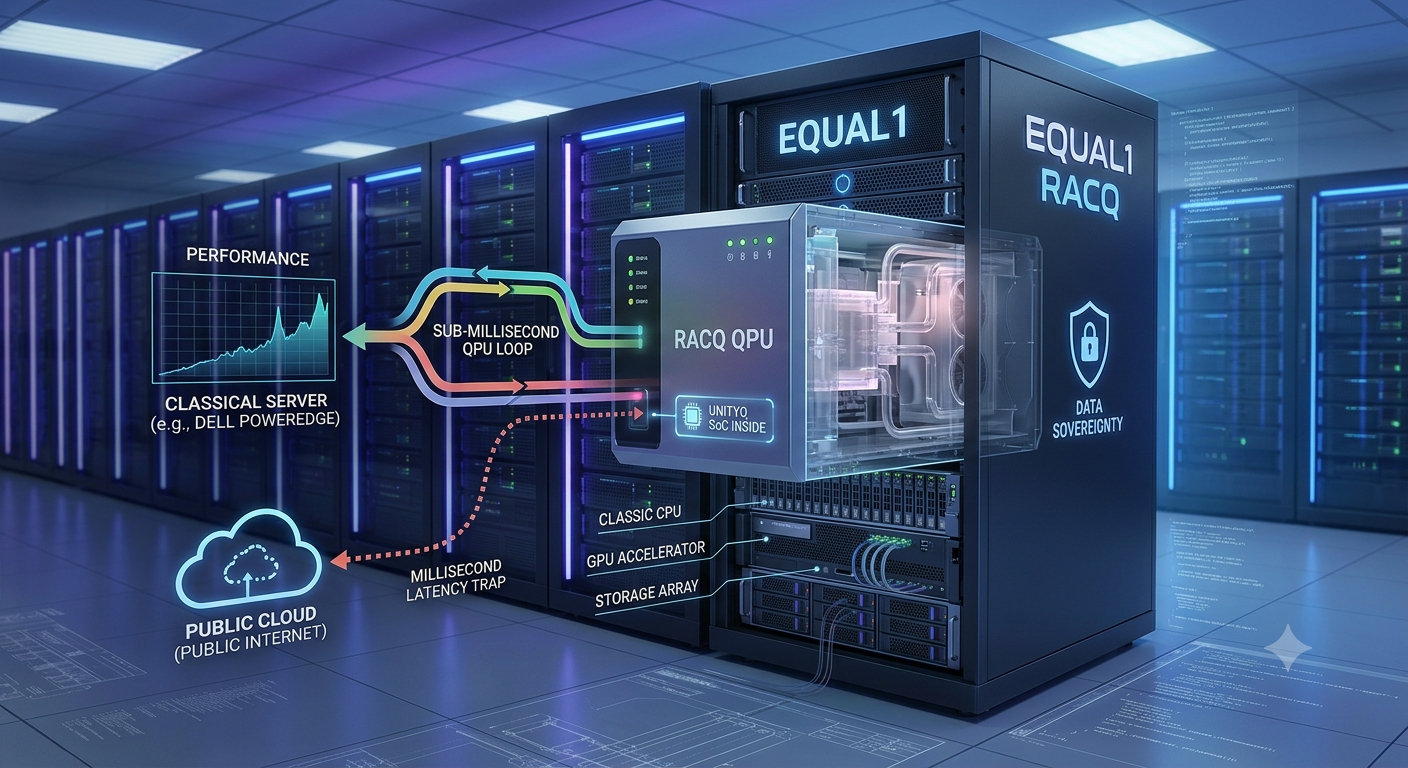
The company has effectively taken one of the most intimidating forms of modern computing and compressed it into something that slides into a standard enterprise server rack. No elaborate cleanroom construction. No specialized cryogenic infrastructure snaking through the building like hospital machinery. No need to redesign an entire facility around a single experimental device.
You roll it into the data center. You connect power. And suddenly the psychological distance between classical and quantum computing narrows in a way the industry has not really seen before.
That shift matters more than people realize.
Because for years, the biggest obstacle in quantum computing has not only been technical. It has also been emotional. Operational. Organizational.
Most enterprises do not resist innovation because they hate the future. They resist it because infrastructure changes are exhausting. Every new system introduces uncertainty into environments designed around stability. IT departments are already carrying enormous cognitive load: cybersecurity pressures, cloud migration, AI integration, compliance management, uptime expectations. Quantum computing often felt like adding another impossible layer onto an already overloaded stack.
Equal1’s approach quietly removes much of that friction.
The reason RacQ can exist in this smaller, self-contained form comes down to the architecture itself. While many quantum systems rely on superconducting or trapped-ion approaches that require massive support environments, Equal1 built around silicon spin qubits. These qubits operate inside silicon structures fundamentally similar to the semiconductor technologies already powering modern processors.
And that detail changes everything.
There is a subtle elegance in the idea that quantum computing may scale not through entirely alien manufacturing methods, but through the same semiconductor ecosystem already underpinning modern civilization. Foundries that produce classical chips can also fabricate these quantum components. The future arrives through familiar supply chains instead of replacing them entirely.
That feels important somehow. Less revolutionary in appearance perhaps, but potentially more revolutionary in practice.
Of course, quantum systems still require extreme cold. Physics does not suddenly become cooperative because the form factor improves. RacQ still operates at temperatures colder than deep space. But Equal1 integrated the cryogenic system directly into the hardware itself through a closed-cycle cryocooler.
And suddenly quantum computing begins behaving less like a physics experiment and more like infrastructure.
The specifications almost read like a conventional enterprise deployment sheet:
Power consumption. Airflow requirements. Rack footprint. Floor-load compatibility.
There is something quietly surreal about seeing quantum computing described in the language of procurement teams instead of theoretical possibility.
But the real story here is not just size reduction. It is latency.
The industry has spent years discussing cloud-access quantum systems, where organizations send workloads to distant quantum processors through APIs. That model works for experimentation. But practical enterprise workloads often require constant feedback loops between classical and quantum systems. Data moves back and forth repeatedly during optimization, simulation, or modeling tasks.
When those loops travel across public internet infrastructure, delays accumulate quickly. Milliseconds begin to matter.
By placing the QPU directly inside the enterprise environment alongside CPUs and GPUs, Equal1 is trying to eliminate that bottleneck entirely. Hybrid quantum-classical computing stops behaving like two separate systems awkwardly communicating across distance and starts behaving like a unified computational environment.
And honestly, this may be where quantum computing finally starts becoming emotionally believable for enterprises.
Not because the technology suddenly became magical overnight. But because it started fitting into existing operational reality.
There is a pattern that happens with transformative technologies. The breakthrough moment is often not when the technology first works. It is when the technology becomes boring enough to integrate.
Electricity changed the world once factories stopped redesigning themselves around steam shafts. Cloud computing exploded once companies no longer needed to physically think about server ownership. AI adoption accelerated once interfaces became conversational instead of requiring specialized research teams.
Infrastructure disappears into normalcy right before mass adoption arrives.
Quantum computing may be entering that phase now. Quietly. Without the dramatic cinematic feeling people expected.
And beneath all the infrastructure conversation sits another important shift: data sovereignty.
For industries like healthcare, finance, defense, and critical infrastructure, sending highly sensitive workloads to external quantum cloud providers has always introduced tension. Compliance teams do not enjoy experimental ambiguity.
RacQ keeps computation physically inside the organization’s own perimeter, operating under existing cybersecurity and governance frameworks. That may sound procedural, but it removes one of the biggest psychological barriers to enterprise experimentation.
There is also something deeply symbolic about the visual transformation itself.
For years, quantum computing looked fragile. Suspended. Delicate. Almost untouchable.
RacQ looks industrial. Matte black. Dense. Contained.
Less like a laboratory artifact. More like infrastructure already humming quietly behind walls most people never think about.
And maybe that is the real paradigm shift here.
For years, the industry kept asking when enterprises would be ready for quantum computing. Equal1 flipped the equation entirely. They adapted quantum computing to the enterprise instead.
That inversion changes the emotional texture of the entire conversation.
The future of quantum computing may not arrive as some distant, exotic machine hidden behind cloud interfaces and research facilities. It may arrive the same way most transformative technologies eventually do: sliding silently into existing systems until one day people realize the architecture around them has fundamentally changed.